How to Measure AI Search Visibility in Kenya
How to Measure AI Search Visibility in Kenya
Kenyan businesses can now be visible inside an AI answer without receiving a click, receive a referral from an assistant that analytics records imperfectly, or be named in a recommendation that changes the next time the same question is asked. If a report treats one screenshot as a ranking, it can make a weak programme look successful. If it counts only website traffic, it can miss early evidence that the brand is becoming a source.
The commercial consequence is simple: teams may spend on content, schema and digital PR without knowing whether the work creates more qualified discovery, enquiries or revenue.
AI search visibility therefore needs a measurement system, not a single score. The strongest system combines Google’s first-party impression data, a controlled panel of buyer questions, citation and source-page evidence, referral traffic, on-site actions and CRM outcomes. It also records the limits of every data source so a directional signal is never presented as a guaranteed market share.
Quick answer
To measure AI search visibility in Kenya:
- define the Kenyan buyer questions and locations that matter commercially;
- record a dated baseline across Google AI Overviews or AI Mode and the assistants relevant to your customers;
- use Google Search Console’s Generative AI performance report for Google impressions, pages, countries, devices and trends;
- track whether the brand is named, whether its pages are cited and which competitors appear instead;
- isolate AI referrals in analytics, while accepting that some visits may be recorded as direct or under another source;
- connect visits to qualified enquiries, sales opportunities and revenue in the CRM; and
- compare trends on a fixed weekly or monthly cadence instead of treating one prompt run as a stable ranking.
There is no universal AI visibility score shared by Google, ChatGPT, Gemini, Perplexity and other systems. A commercial tool can provide a useful repeatable index, but its score is a diagnostic based on its own prompt set and sampling method.
Key takeaways
- AI visibility includes impressions, brand mentions, citations, cited pages, referrals and business outcomes.
- Google Search Console now provides a dedicated Generative AI performance report for AI Overviews and AI Mode, but the report may be absent when a property lacks sufficient impressions.
- A prompt panel becomes useful only when the questions, locations, platform settings and cadence remain consistent.
- A mention is weaker evidence than a citation, and a citation is weaker commercial evidence than a qualified enquiry.
- Analytics can identify some AI referrals through session source and medium, but it cannot recover information that a referrer does not send.
- Prompt answers are variable. Report trends, sample sizes and limitations rather than claiming a permanent position.
- The goal is not the largest visibility score. It is more accurate inclusion in the buyer journeys that can become profitable work.
What AI search visibility means
AI search visibility describes whether an organisation, product, service or page appears inside an AI-assisted discovery experience. The evidence may take several forms:
- a link to the site appears in a Google AI Overview or AI Mode response;
- an assistant names the brand when a buyer asks for a suitable provider;
- a page is cited as a source supporting an answer;
- the answer describes the business accurately without linking to it;
- a person follows an AI-generated link to the website; or
- that visit becomes a call, WhatsApp conversation, form submission, qualified lead or sale.
These signals answer different questions. A citation shows source selection. A brand mention shows entity recognition or recommendation. A referral shows traffic. A qualified lead shows commercial response. Combining them avoids the false conclusion that every appearance has equal value.
For a Nairobi accounting firm, being cited for “how VAT registration works in Kenya” may build authority but sit far from a purchase. Being named for “accounting firms for a growing ecommerce business in Nairobi” is closer to a commercial decision. Both matter, but they belong in different intent groups and should not receive the same weight.
The Friday guide to SEO, AEO and GEO defines how search discovery is changing. This article has a narrower role: it explains how to measure the resulting visibility without creating a second definition page or changing the protected AI Search Optimization service.
Why conventional SEO reporting is incomplete
Traditional SEO reports usually focus on rankings, impressions, clicks, sessions and conversions. Those remain essential. Google’s current guidance says foundational SEO still supports generative search because its AI features use core Search ranking and quality systems. A business still needs crawlable pages, clear information architecture, useful content and measurement.
AI-assisted discovery adds three complications.
The answer may satisfy the user without a click
A brand can be visible in a response while the user stays on the platform. Traffic alone will understate that exposure. This is why Google’s dedicated report starts with impressions rather than clicks.
The same question may produce different answers
AI outputs can change with time, model updates, location, language, personalisation and answer context. A single prompt is a sample, not a permanent rank. Even repeated prompts can represent only the panel selected for the test.
Attribution can break between the answer and the sale
A buyer may see a brand in an AI answer, search for it later, visit directly, call from a Google Business Profile or ask a colleague for the URL. The final session may not carry the original AI source. This makes assisted conversion evidence, branded-search movement and customer-reported discovery useful supporting signals, provided they are labelled honestly.
The answer is not to abandon SEO metrics. It is to place them inside a wider evidence chain.
The five-layer measurement stack
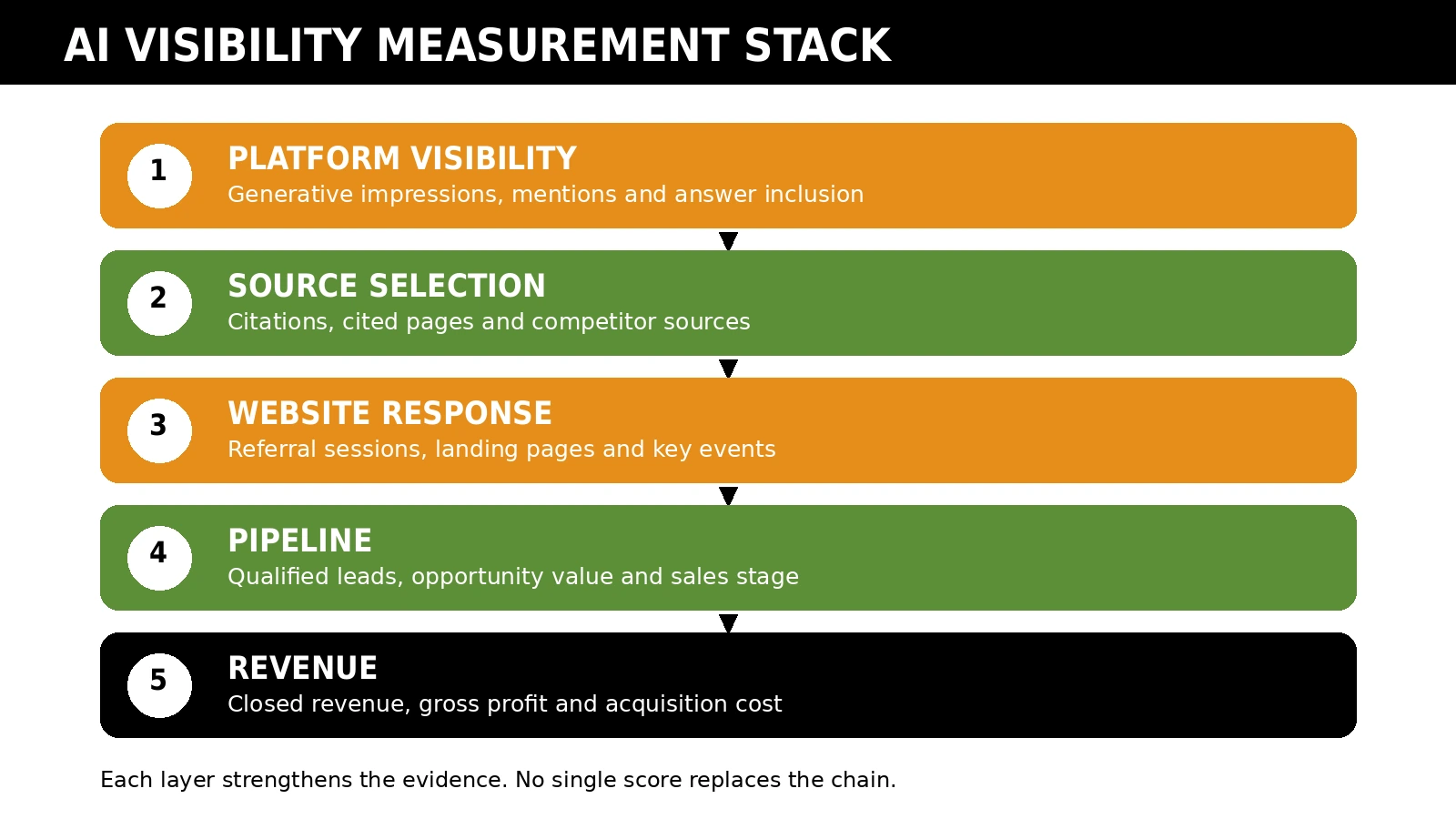
Use five layers so each signal has a defined job.
| Layer | What to measure | Best evidence source | Main limitation |
|---|---|---|---|
| Platform visibility | Google generative impressions, brand mentions, answer inclusion | Search Console and controlled prompt panel | Coverage differs by platform and sample |
| Source selection | Citations, linked pages, source domains, competitor sources | Search Console pages and dated answer records | A cited page may receive no visit |
| Website response | AI-referred sessions, landing pages, engagement and key events | Analytics and server logs | Missing referrers can become direct traffic |
| Pipeline | Qualified leads, opportunity value and sales stage | CRM with source notes and campaign fields | Human data entry must be consistent |
| Revenue | Closed revenue, gross profit and acquisition cost | CRM and finance records | Longer sales cycles delay feedback |
The stack prevents two common mistakes. First, it stops an impression from being reported as revenue. Second, it stops a team from dismissing early visibility simply because a long sales cycle has not closed yet.
For businesses that need a baseline before building the dashboard, the AI Visibility Audit should establish the priority questions, current inclusion, cited pages, competitor pattern and measurement gaps.
Build a Kenyan buyer-question panel
A prompt panel is a fixed list of buyer questions tested on a schedule. It should represent real commercial journeys rather than a collection of flattering questions about the brand.
Start with intent, not platform
Group questions by the decision they represent:
| Intent group | Example Kenyan question | Commercial meaning |
|---|---|---|
| Problem discovery | Why is my Nairobi website getting traffic but no enquiries? | Buyer recognises a problem |
| Category education | What does AI search optimization involve for a Kenyan business? | Buyer is learning the solution class |
| Comparison | SEO agency or in-house specialist for a growing company in Kenya? | Buyer is evaluating approaches |
| Provider discovery | Which agencies offer AI search optimization in Nairobi? | Buyer is selecting a shortlist |
| Local suitability | Who can improve AI visibility for a hotel in Mombasa? | Buyer needs sector and location fit |
| Transactional | Where can I run an AI visibility audit for my website? | Buyer is ready for an action |
Include Nairobi when the business genuinely serves Nairobi. Add Mombasa, Kisumu, Nakuru or Eldoret only when the offer, proof and delivery model support those markets. Repeating every city in every question creates a distorted panel.
Define the sample before measuring
Record:
- exact question wording;
- intent group;
- target market and language;
- platform and account state;
- test date and time;
- whether web search or browsing was enabled;
- brand named or absent;
- link or citation present;
- cited URL and source domain;
- competitors named;
- answer accuracy; and
- screenshot or transcript reference for auditability.
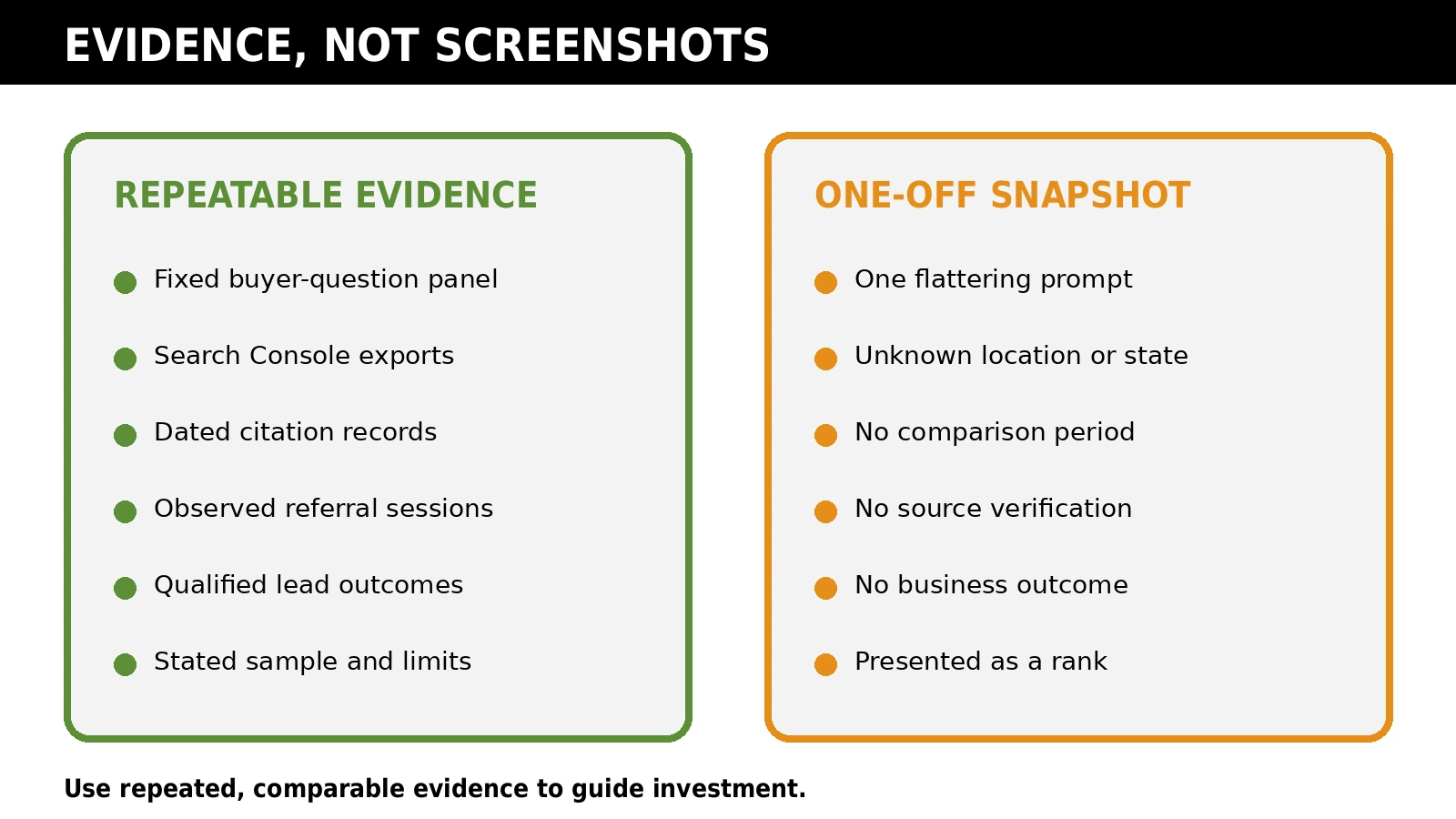
Do not change the questions every week and then compare the percentages. Add new questions in a separate cohort so the original baseline remains comparable.
Separate visibility from favourability
A brand mention can be negative, inaccurate or out of date. Record sentiment and factual accuracy separately. If an answer invents an office location or misstates a service, that is an entity-consistency problem, not a visibility win.
Measure Google generative search in Search Console
Google announced the Search Generative AI performance report on 3 June 2026 and completed worldwide rollout on 31 August 2026. The report covers impressions from AI Overviews and AI Mode in Google Search. It shows which pages appeared, where impressions originated, which devices were used and how visibility changed over time.
The official Search Console documentation defines the available dimensions:
- Pages: final URLs shown by a generative feature, generally assigned to the canonical URL;
- Countries: the country where the search originated;
- Devices: device groups for Search;
- Dates: trend data by the selected time granularity; and
- Impressions: times links to the site were shown in a supported generative feature.
Use the dedicated report alongside the normal Search Performance report. Google’s AI search optimization guide explains that the dedicated view measures generative visibility while generative activity also remains part of overall Search performance.
What to export each month
Export the current period and a comparable prior period for:
- total generative impressions;
- pages with generative impressions;
- Kenya versus other relevant countries;
- device mix;
- daily or weekly trend; and
- normal Search clicks, impressions, CTR and average position for the same pages.
The page comparison is useful because an article may gain generative impressions before it gains meaningful traffic. It can also reveal whether service pages, articles, case studies or tool pages are being selected.
If the report is missing
Google states that the report may not appear when the site has not received enough impressions in generative features. Also check the Search generative AI control in Search Console settings. The default is inclusion, but a property can be excluded. Do not report zero visibility merely because the dedicated report is absent.
What Search Console does not prove
The report does not reveal a universal share of voice across every AI platform. It does not show closed revenue. It also does not turn a page impression into a stable ranking. For technical eligibility and indexation problems, use the technical SEO checklist for Kenyan websites and the free SEO audit before blaming an AI-specific factor.
Track mentions, citations and competitor share
Outside Google’s first-party report, measurement usually relies on repeatable sampling.
Mention rate
Mention rate answers: in what percentage of valid prompt runs was the brand named?
Mention rate = brand-mentioned runs ÷ eligible runs × 100
Keep informational and provider-selection prompts separate. A company may have strong educational citations and weak commercial recommendation visibility.
Citation rate
Citation rate answers: in what percentage of eligible runs did the platform link to or cite a page from the site?
Citation rate = runs with a site citation ÷ eligible runs × 100
Also count unique cited pages. Ten citations to one article indicate a different opportunity from ten pages each receiving one citation.
Competitive share of sampled answers
For a defined panel, calculate how often the brand appears relative to named competitors. Call this “share of sampled answers” or “prompt-panel share,” not market share. The label keeps the denominator honest.
Source opportunity gap
When competitors appear and Tabala does not, record the sources supporting the answer. Patterns may reveal:
- stronger first-party guides;
- current case studies;
- sector directories;
- authoritative media coverage;
- consistent reviews;
- clearer organisation and service entities; or
- pages that answer comparison questions directly.
The competitive review should lead to useful content and stronger proof. It should not lead to copying a competitor’s wording or manufacturing mentions.
Measure AI referral traffic and engagement
In Google Analytics 4, use the Traffic acquisition report and inspect Session source, Session medium and Session source / medium. Google’s Traffic acquisition documentation explains that these dimensions show the source associated with a session.
Create an exploration or custom channel group for the AI sources that actually appear in your data. Review source values before building the rule because hostnames can change. Common candidates may include domains associated with ChatGPT, Perplexity, Gemini, Copilot or Claude, but the rule should follow observed data rather than a copied universal list.
For each AI referral source, report:
- sessions and users;
- landing pages;
- engaged sessions or engagement rate;
- key events such as qualified form submissions, tracked phone calls or meaningful WhatsApp starts;
- ecommerce revenue where applicable; and
- assisted pipeline in the CRM.
Preserve landing-page context
The landing page often explains what the user needed. If AI referrals repeatedly enter through a pricing comparison or implementation checklist, that page is part of a commercial journey even when it is not a service page.
Accept attribution gaps
Analytics depends on the information sent with the visit. A missing or stripped referrer can cause a session to appear as direct. A user may also discover the brand in an answer and return later through Google or a bookmark. Report known AI referrals as a minimum observable set, not a complete census.
Server logs can support validation because they show requested URLs and user agents, but bot crawling is not the same as human visibility. Keep crawler activity in a separate technical report.
Connect visibility to leads and revenue
Visibility becomes commercially useful when it changes buyer behaviour.
Track meaningful actions
A generic button click is rarely enough. For a Kenyan service business, distinguish:
- form started;
- form submitted;
- WhatsApp conversation started;
- tracked phone call connected;
- meeting booked;
- qualified lead accepted;
- sales opportunity created; and
- sale closed.
Add source and landing-page fields to the CRM. Include a short “How did you first hear about us?” field for high-value enquiries, but treat self-reported attribution as supporting evidence rather than a perfect record.
Use business economics
For closed business, report:
- qualified leads from observed AI referrals;
- lead-to-opportunity rate;
- opportunity value;
- closed revenue;
- gross profit where available; and
- programme cost.
Do not calculate a confident return on investment from impressions alone. If tracking maturity is low, report the strongest observable stage and state what remains unmeasured.
The digital marketing services team in Nairobi can connect search visibility, conversion tracking and campaign economics when the measurement gap crosses SEO, analytics and CRM systems.
Build a practical AI visibility scorecard
A scorecard should show evidence by layer and make uncertainty visible.
| KPI | Current period | Prior period | Target or question | Confidence |
|---|---|---|---|---|
| Google generative impressions | Export from Search Console | Comparable period | Is visibility growing for Kenya? | High, first-party |
| Pages with generative impressions | Export | Export | Are more useful pages being selected? | High, first-party |
| Prompt-panel mention rate | Sample result | Same panel | Is the brand named more often? | Directional |
| Prompt-panel citation rate | Sample result | Same panel | Are first-party pages supporting answers? | Directional |
| Competitive prompt share | Sample result | Same panel | Which rivals gain inclusion? | Directional |
| Observed AI referral sessions | Analytics | Comparable period | Which pages receive visits? | Medium |
| Qualified AI-referred leads | CRM | Comparable period | Does visibility create pipeline? | Medium to high |
| Closed revenue | CRM and finance | Comparable period | Is the programme commercially productive? | High when attribution is verified |
Avoid combining every metric into one number unless the weighting is documented. A composite can help prioritisation, but readers must still be able to see the underlying evidence.
For example, a diagnostic score could weight technical eligibility, source inclusion, entity accuracy, commercial prompt visibility and conversion readiness. It should never be presented as an official Google or platform score.
Establish a defensible baseline. Run Tabala’s AI Visibility Audit to identify how your brand appears across priority AI search journeys, which pages are ready to be cited and what to fix first.
Reporting cadence and quality control
Use different cadences for volatile signals and slow commercial outcomes.
| Cadence | Review | Decision |
|---|---|---|
| Weekly | anomalies, new citations, lost citations, factual errors, major referral changes | Investigate breakage or urgent inaccuracy |
| Monthly | fixed prompt panel, Search Console exports, cited pages, AI referrals and key events | Prioritise content and technical work |
| Quarterly | qualified pipeline, revenue, competitor movement, content contribution | Reallocate investment and refresh the panel |
Before publishing a report, confirm:
- the same prompt cohort was used;
- failed or ineligible runs were excluded consistently;
- location, language and account state were recorded;
- Search Console date ranges are comparable;
- canonical page changes did not split the page record;
- analytics rules reflect current source values;
- bot traffic is not counted as human referral traffic;
- brand mentions were checked for accuracy; and
- provisional metrics are labelled as samples.
Common measurement mistakes
Calling one answer a ranking
One response is evidence that the brand appeared at that moment under those conditions. It is not proof of a stable position.
Tracking only the brand name
Branded prompts mostly test whether a system can repeat known information. Commercial measurement needs non-branded problem, category, comparison and provider questions.
Treating every prompt as equal
A mention for a low-value informational question should not outweigh absence from a high-value provider-selection journey. Segment by intent.
Using a third-party score without the method
Google warns that third-party tools do not have access to its internal ranking or AI systems. Ask which platforms, prompts, locations, models, schedules and weighting rules create the score.
Reporting traffic without lead quality
An increase in sessions can be commercially weak. Connect the traffic to qualified actions and sales follow-up.
Adding AI-specific files as a measurement shortcut
Google’s 2026 guidance says it does not use special AI text files
such as llms.txt for generative Search eligibility. Measure
actual visibility and maintain the SEO foundation instead of treating a
file deployment as success.
Changing the protected service page to chase an article query
The AI Search Optimization service page should keep its commercial intent, URL, canonical and navigation role. This article owns the measurement query and supports the service page contextually.
A 30-day implementation plan
Week 1: define the baseline
- choose 20 to 40 priority buyer questions;
- group them by intent and Kenyan market;
- list the competitors that genuinely serve the same buyer;
- verify Search Console and analytics access;
- document current conversion events; and
- run the first dated panel.
Week 2: connect the evidence
- export the Generative AI performance report if available;
- create an analytics view for observed AI referrals;
- map landing pages to services and funnel stages;
- add source and qualification fields to the CRM; and
- establish the first scorecard.
Week 3: diagnose the gaps
- compare missing prompts with competitor sources;
- review inaccurate brand descriptions;
- audit indexation, canonicalisation and snippet eligibility;
- identify pages that need stronger expert proof or local relevance; and
- prioritise the smallest set of changes likely to improve useful inclusion.
If the site has crawl, canonical or content-structure problems, start with the SEO services framework for Nairobi businesses rather than layering an AI dashboard over a broken foundation.
Week 4: publish the operating report
- report first-party metrics separately from sampled metrics;
- show the prompt cohort and sample size;
- name the highest-value visibility gaps;
- connect known referrals to enquiries;
- assign owners and review dates; and
- preserve the baseline for the next monthly comparison.
Actionable checklist
Frequently asked questions
What is the best metric for AI search visibility?
There is no single best metric. Use Google generative impressions for first-party visibility, prompt-panel mention and citation rates for sampled cross-platform visibility, analytics for observed referrals, and CRM outcomes for commercial value.
Can Google Search Console measure AI Overview visibility?
Yes. Google’s Generative AI performance report covers impressions from AI Overviews and AI Mode and provides page, country, device and date dimensions. The report may not appear if the property lacks sufficient impressions.
Can I measure ChatGPT, Gemini or Perplexity like a Google keyword ranking?
Not reliably as one stable rank. Use a fixed question panel, consistent settings and repeated samples. Report mention and citation trends with the sample size and limitations.
What is an AI visibility score?
It is usually a provider-specific index built from sampled prompts, mentions, citations or technical checks. It can be useful for diagnosis and trend comparison, but it is not an official universal platform metric.
How often should a Kenyan business check AI visibility?
Monitor anomalies weekly, run the fixed panel and reporting process monthly, and review pipeline, competitors and strategy quarterly. High-volume publishers may need a more frequent cadence.
Why does analytics show little AI traffic when the brand appears in answers?
Some users do not click, some referrers are missing, and some people return later through search or direct visits. Treat observed referrals as a minimum and combine them with platform visibility and CRM evidence.
Should I track every Kenyan city?
No. Track only the locations the business serves and where buyer needs differ. Use Nairobi, Mombasa, Kisumu, Nakuru or Eldoret when the offer and proof genuinely support those markets.
Does schema guarantee AI citations?
No. Structured data can help search systems understand eligible page content and support rich results, but Google’s guidance says there is no special schema required for generative Search and inclusion is not guaranteed.
Summary
AI search visibility becomes measurable when every signal has a defined role. Search Console shows first-party Google generative impressions. A controlled prompt panel tests sampled mentions, citations, accuracy and competitors. Analytics shows observable visits. The CRM shows whether those visits become useful conversations and revenue.
Build the baseline before making claims. Keep the prompt cohort stable. Separate impressions from citations, citations from visits, and visits from qualified business. Then use the evidence to decide which pages, entity signals, technical foundations and proof deserve investment.
If your team needs a defensible starting point, run Tabala’s AI Visibility Audit. The audit identifies the search journeys that matter, the evidence already available and the highest-priority gaps. For implementation across content, entity clarity, technical SEO and reporting, review Tabala’s AI Search Optimization services in Nairobi.
Accelerate Your Revenue
While Revenue Intelligence builds long-term authority, Google Ads delivers immediate, high-intent traffic. Combine both for maximum market dominance.

Strategist Profile
Abala Tom
Digital systems strategist specializing in high-performance SEO, Google Ads, and conversion optimization. Mission: to replace marketing 'guesswork' with predictable revenue systems.