Schema Markup and Structured Data for Kenyan Businesses: A Practical JSON-LD Guide
Most Kenyan websites publish strong copy that search engines and AI models still struggle to verify. Here is how clean JSON-LD schema markup turns your business details, services, KES pricing, and FAQs into machine-readable facts for Google Search and AI Overviews.
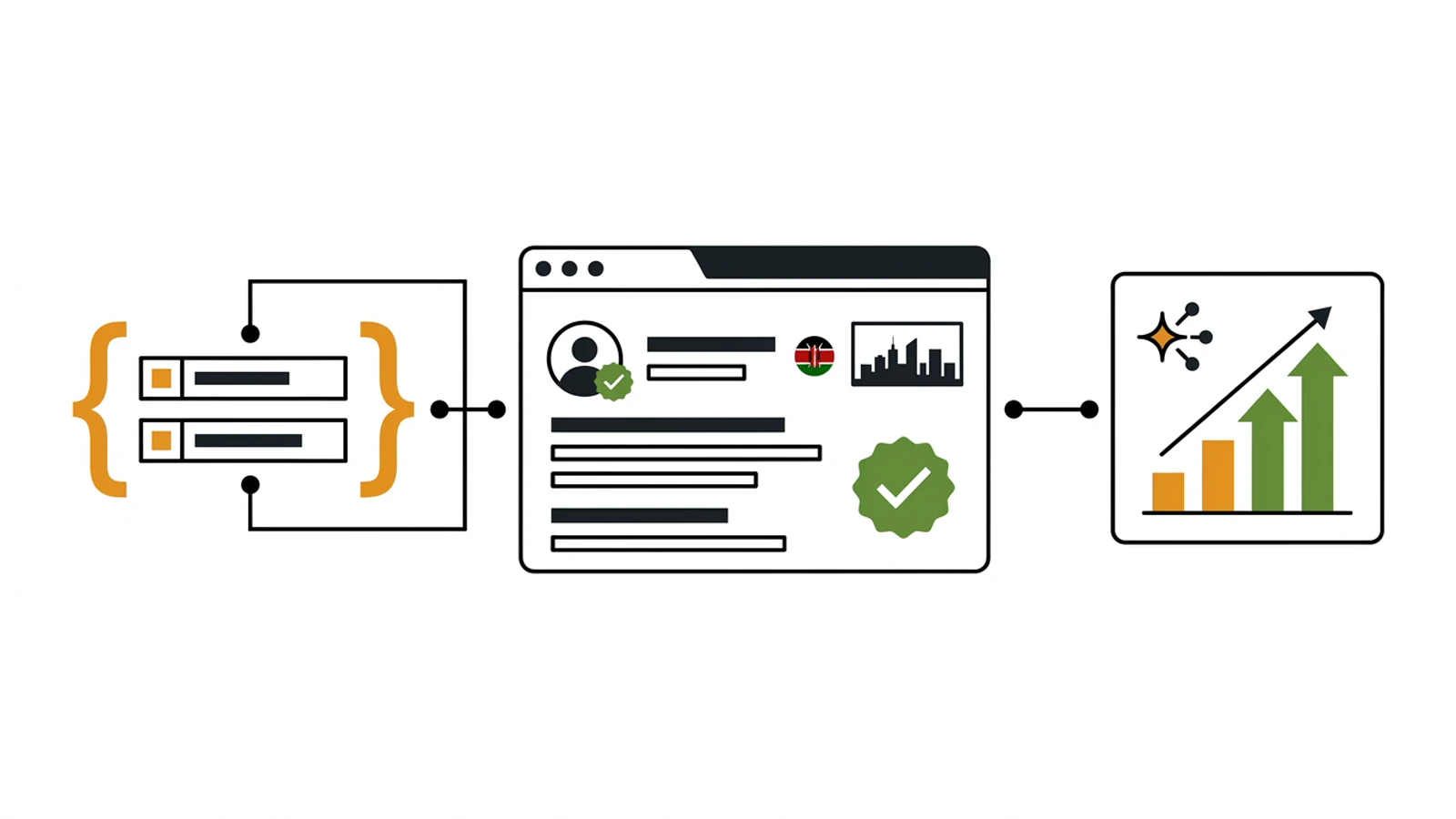
When a Kenyan buyer searches Google or asks an AI assistant for a clinic in Westlands, an accounting firm in Mombasa, or an e-commerce supplier delivering nationwide, the search engine has to answer a deceptively hard question before ranking your page: who is this business, what exact service or product is on this URL, what does it cost, and can we trust it?
Plain HTML paragraphs leave crawlers guessing. A phone number sitting in a footer could belong to a sales branch, a partner, or a stock template. A price in Kenyan Shillings written inside an image banner is invisible to structured parsers. Two businesses with similar names in Nairobi can even get blended together inside AI-generated summaries.
Schema markup—most reliably deployed as JSON-LD structured data—removes that ambiguity. It gives Google Search and generative AI engines a standardized, machine-readable layer of verified facts tied directly to your brand entity.
Quick Answer: What Is Schema Markup (JSON-LD)?
Schema markup is standardized code—published using the shared Schema.org vocabulary and typically embedded in a <script type="application/ld+json"> block—that explicitly labels the entities, services, prices, locations, authors, and FAQs on a web page. While structured data is not a direct ranking shortcut on its own, it helps search engines qualify your pages for rich results and enables AI search engines to disambiguate and cite your business accurately.
Key Takeaways
- Use JSON-LD in a linked @graph: Google recommends JSON-LD because it stays separate from visual HTML templates and connects entities cleanly via @id references.
- Prioritize high-impact Kenyan entity types first: Start with Organization / LocalBusiness, BreadcrumbList, Service, Product / Offer (in KES), Article, and FAQPage.
- Enforce strict parity with visible content: Every address, phone number, service area, price, and FAQ answer in JSON-LD must match what a human visitor can read on the page.
- Check CMS template output before injecting schema: Avoid duplicate Article or LocalBusiness blocks when your theme or CMS already outputs site-level structured data.
- Never mark up fabricated claims: Self-serving fake star ratings or copied city lists risk structured data manual actions and erode trust with both Google and AI models.
Why Schema Markup Matters for Google Search and AI Overviews in Kenya
Kenyan search behaviour has shifted rapidly from simple ten-blue-link browsing to zero-click summaries, map packs, and conversational AI recommendations. When someone searches for a local provider in Nairobi, Kisumu, Nakuru, or Eldoret, Google evaluates both the page text and cross-site entity signals to decide which brands deserve prominence.
According to Google Search Central's introduction to structured data, Google uses structured data to understand page content more precisely and gather verified context about the people, organizations, products, and events mentioned on the web. In practical Kenyan SEO, that delivers three compounding advantages:
- Rich Result Eligibility: Clean markup helps qualifying pages display breadcrumbs, product pricing in KES, stock availability, and clearer brand attribution directly in search snippets.
- AI Search Entity Disambiguation: Answer engines and Google AI Overviews cross-reference your website against your Google Business Profile and social profiles. Explicit @id and sameAs links confirm that your website, LinkedIn page, and physical Nairobi office belong to the same trusted organization.
- Stronger Local & Commercial Context: Explicitly declaring areaServed, opening hours, contact channels, and Service relationships prevents search crawlers from mistaking a Kenyan company for an overseas business with a similar brand name.
If you are already investing in ranking in Google AI Overviews in Kenya or hardening your website trust signals, structured data is the technical glue that turns visible credibility into machine-verifiable authority.
JSON-LD vs. Microdata vs. RDFa: Which Format Should You Use?
Schema.org vocabulary can be written in three syntax formats. Choosing the wrong one creates maintenance headaches whenever your marketing team updates a page layout or switches CMS templates.
| Format | How It Is Implemented | Maintenance Impact | Recommended Use in Kenya |
|---|---|---|---|
| JSON-LD | Placed in a standalone <script type="application/ld+json"> block in the HTML head or body | Low — survives CSS redesigns and component updates cleanly | Primary standard for Cockpit CMS, WordPress, Next.js, and custom sites |
| Microdata | Attributes (itemscope, itemtype, itemprop) woven directly into HTML tags | High — layout edits easily break nested properties | Only keep if a legacy theme already relies on it and cannot output JSON-LD |
| RDFa | HTML5 attribute extensions (vocab, typeof, property) inline in templates | High — complex syntax with minimal tooling support | Not recommended for typical Kenyan SME or agency builds |
Google explicitly recommends JSON-LD wherever possible because it keeps structured data modular, easy to audit, and isolated from visual styling changes.
The 6 Core Schema Types Every Kenyan Business Should Prioritize
You do not need dozens of obscure Schema.org types to build a high-performing site. Focus on the six core entity types that clarify who you are, what you sell, and what questions you answer—linked together through one coherent @graph.
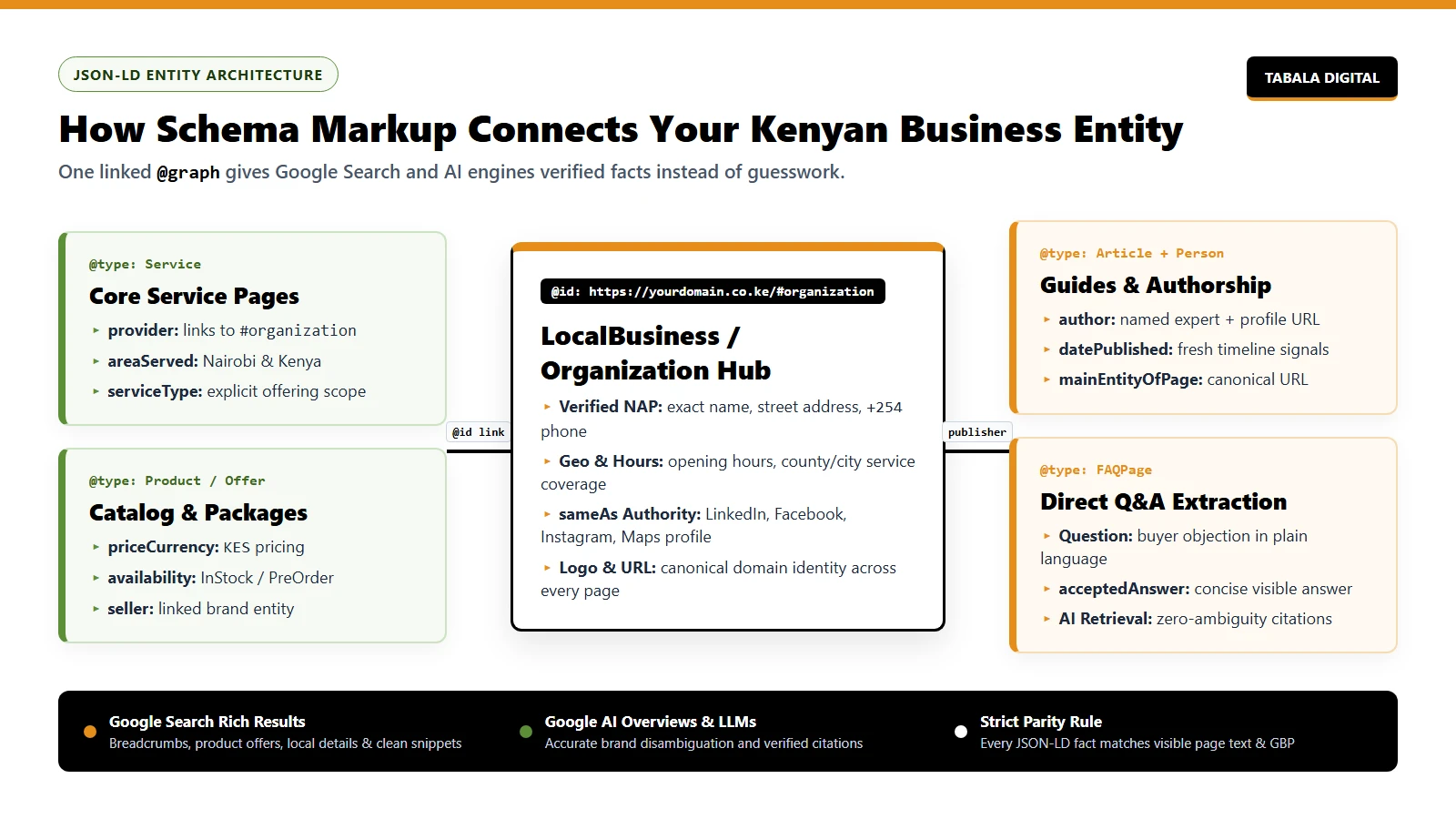
| Schema Type | Best Page Target | Key Kenyan Properties to Include | Primary Search & AI Benefit |
|---|---|---|---|
| Organization / LocalBusiness | Sitewide anchor (#organization) + Contact / About pages | Official name, PostalAddress, +254 telephone, openingHoursSpecification, areaServed, sameAs | Locks brand NAP, aligns with Google Business Profile, prevents entity confusion |
| Service | Dedicated commercial service pages (one core service per URL) | serviceType, provider (@id), areaServed (e.g. Nairobi, Kenya), clear description | Clarifies commercial intent and links offerings to your verified brand |
| Product / Offer | E-commerce product pages & fixed-price packages | name, image, sku, Offer with priceCurrency: "KES" and availability | Enables rich product snippets with accurate KES pricing and stock status |
| Article | Blog posts, guides, and research reports | headline, author (Person + profile URL), datePublished, dateModified, publisher | Demonstrates authorship, freshness, and editorial provenance for AI citations |
| BreadcrumbList | All content, category, and service pages | Ordered ListItem hierarchy matching visible breadcrumb navigation | Replaces raw URL strings in Google results with clean site hierarchy |
| FAQPage | Guides & service pages with visible Q&A sections | Question name and concise acceptedAnswer text matching visible accordions | Provides direct question-and-answer pairs for LLM extraction and AI Overviews |
1. Organization and LocalBusiness
Follow Google's Local Business structured data guidelines so your physical office details—street address, locality, postal code, country code KE, and business hours—match your Google Business Profile and site footer character-for-character. If you serve clients nationwide from a Nairobi headquarters, use areaServed to reflect both your city and Kenya honestly. Pair this with our local SEO in Kenya guide for full map-pack consistency.
2. Service Schema on Commercial Pages
Every standalone commercial offering—whether SEO services in Nairobi, clinic consultations, or legal advisory—should reference your central organization via "provider": { "@id": "https://yourdomain.co.ke/#organization" } using Schema.org Service. That single reference teaches crawlers which entity delivers the service without copying your entire address block onto every URL.
3. Product and Offer in KES
Kenyan online stores frequently lose rich product visibility because plugins default to USD or omit availability. Set priceCurrency to "KES", publish the exact VAT-inclusive price shown on the page, and update availability dynamically when stock changes.
4. Article and Author E-E-A-T
Use Schema.org Article on editorial guides and tie the author field to a named Person with a verifiable LinkedIn or author bio URL. Both Google's quality systems and AI answer engines weigh named, verifiable authorship far higher than anonymous "Admin" posts.
5. BreadcrumbList and FAQPage
BreadcrumbList clarifies site architecture—especially when blog articles sit under /blog/ while service pages sit at root paths. Meanwhile, Schema.org FAQPage packages your visible accordion answers into clean Q&A pairs. Note Google's FAQPage documentation: visual FAQ rich results are now limited mainly to authoritative government and health sites, yet clean FAQPage markup remains valuable for structured Q&A clarity and AI retrieval systems.
Copy-and-Adapt Kenyan LocalBusiness + Service JSON-LD Example
Below is a clean, valid @graph template tailored for a Kenyan service business. Replace the placeholder details with your verified business information before deploying:
<script type="application/ld+json">
{
"@context": "https://schema.org",
"@graph": [
{
"@type": ["LocalBusiness", "ProfessionalService"],
"@id": "https://example.co.ke/#organization",
"name": "Example Kenyan Firm Ltd",
"url": "https://example.co.ke",
"telephone": "+254700000000",
"email": "[email protected]",
"priceRange": "$$",
"address": {
"@type": "PostalAddress",
"streetAddress": "Westlands Road, Suite 4B",
"addressLocality": "Nairobi",
"addressRegion": "Nairobi",
"postalCode": "00800",
"addressCountry": "KE"
},
"areaServed": [
{ "@type": "City", "name": "Nairobi" },
{ "@type": "Country", "name": "Kenya" }
],
"sameAs": [
"https://www.linkedin.com/company/example-kenyan-firm",
"https://www.facebook.com/examplekenyanfirm"
]
},
{
"@type": "Service",
"@id": "https://example.co.ke/tax-advisory-nairobi#service",
"name": "SME Tax Advisory in Nairobi",
"serviceType": "Corporate Tax & KRA Compliance Advisory",
"url": "https://example.co.ke/tax-advisory-nairobi",
"provider": {
"@id": "https://example.co.ke/#organization"
},
"areaServed": {
"@type": "Country",
"name": "Kenya"
}
}
]
}
</script>
4-Step Schema Deployment and Validation Workflow
Whether your site runs on Cockpit CMS, WordPress, Webflow, or a custom React/Next.js stack, structured data works best when treated as part of a repeatable release checklist rather than a one-time plugin toggle.
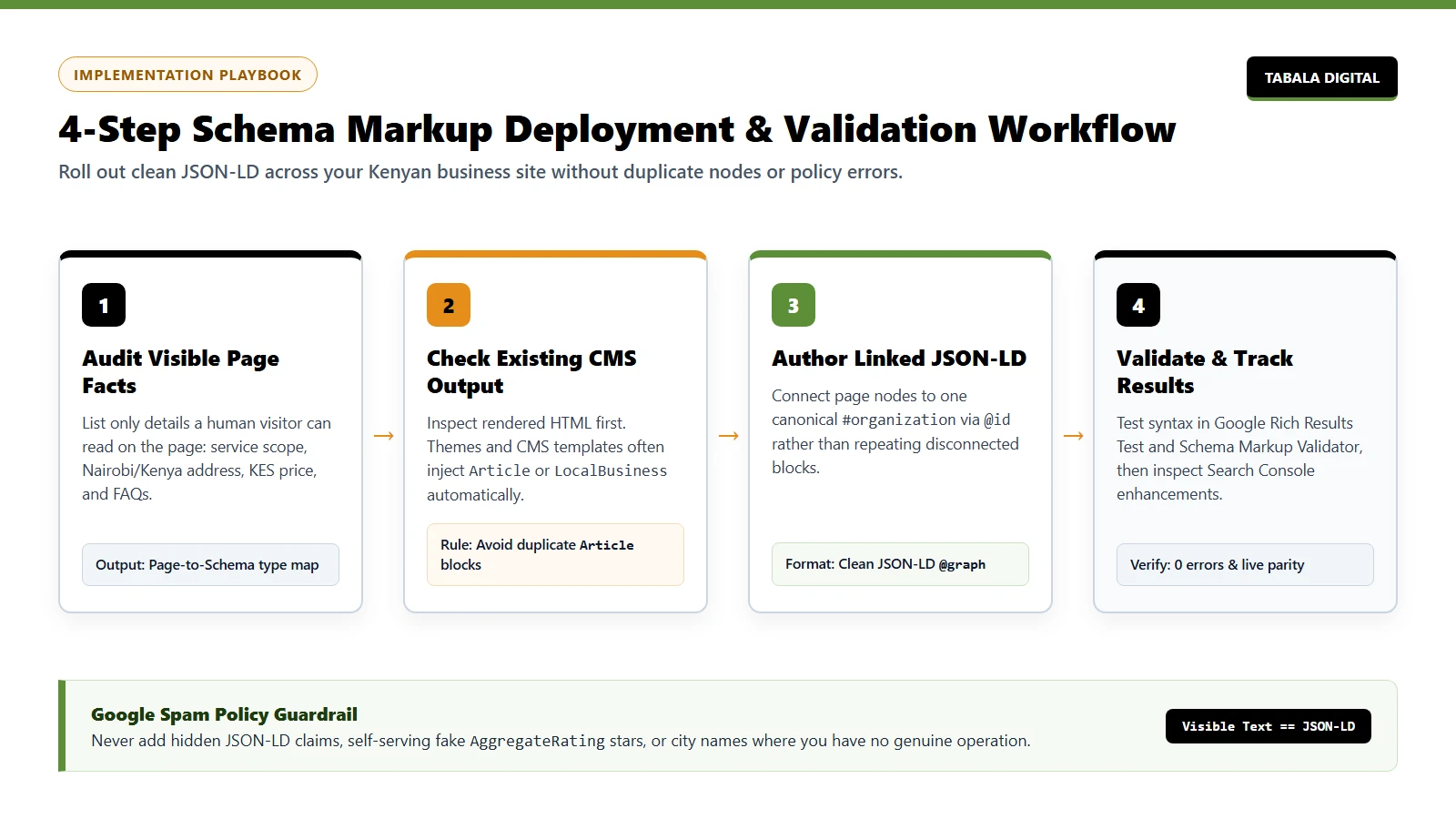
Step 1: Audit Visible Page Facts First
Before writing a single line of JSON-LD, list the facts visible to a human visitor on that URL. If a service page does not mention Mombasa, do not add Mombasa to areaServed. If a product page displays "Request Quote" instead of a fixed figure, do not invent a placeholder KES price in schema.
Step 2: Inspect What Your CMS or Theme Already Outputs
This step prevents the most common technical mistake on modern Kenyan websites: duplicate schema graphs. Many headless setups—including Cockpit CMS frontends—and WordPress SEO plugins automatically inject a site-level LocalBusiness, BreadcrumbList, and Article block into the document head.
View the rendered page source (or inspect the DOM in Chrome DevTools) before pasting extra JSON-LD into your article body. If your template already outputs Article automatically, keep only the page-specific additions—such as FAQPage or Service—or configure the template cleanly so search engines do not receive two conflicting Article nodes for the same URL.
Step 3: Author Linked JSON-LD Using @id References
Avoid pasting three separate, disconnected <script type="application/ld+json"> tags with repeated company names and addresses. Group page entities inside one @graph array and point publisher, provider, and seller back to your canonical #organization URI.
Step 4: Validate Before and After Publishing
Run every new or updated URL through two complementary checks before considering deployment complete:
- Google Rich Results Test: Confirms eligibility for Google rich features and flags missing required fields.
- Schema Markup Validator: Validates full Schema.org syntax—including Service and linked @graph nodes that Google's Rich Results Test does not display as visual enhancements.
Once live, monitor the Enhancements and Unparsable Structured Data reports inside Google Search Console alongside our technical SEO checklist for Kenyan websites and AI-ready website content checklist.
Common Schema Markup Mistakes That Hurt Visibility
Bad structured data is worse than no structured data. Watch out for four patterns that regularly show up in Kenyan site audits:
- Self-serving fake AggregateRating stars: Marking up "5.0 stars from 120 reviews" directly on your homepage or service pages without genuine, user-visible, policy-compliant third-party or product reviews violates Google's structured data spam guidelines.
- Copy-pasted doorway city lists: Listing 30 Kenyan towns inside areaServed when your business only operates in one county or has no supporting service evidence on the page adds noise rather than authority.
- Conflicting NAP or broken URLs in sameAs: Pointing logo to a 404 image, using an old http:// URL, or listing a disconnected phone number undermines entity confidence.
- Unescaped HTML or invalid JSON commas: A single trailing comma or unescaped quotation mark inside a Cockpit CMS or WordPress custom HTML block breaks the entire JSON-LD script silently.
Frequently Asked Questions
No. Schema markup is not a direct ranking factor on its own. Instead, it helps Google Search and AI systems accurately understand your business entity, services, pricing in KES, and authorship—which supports rich result eligibility, stronger search presentation, and more reliable AI citations.
Use JSON-LD. Google recommends JSON-LD because it sits cleanly inside a script tag separate from your HTML layout, making it far easier to maintain in Cockpit CMS, WordPress, Next.js, and custom web builds without breaking during redesigns.
Yes, as long as your CMS template does not already inject an Article block automatically. Inspect your live page source first: if your site header already outputs Article and LocalBusiness in a global graph, add only the FAQPage node inside the post body (or merge them in one template) to avoid duplicate Article records.
Start with Organization or LocalBusiness for verified Nairobi or regional NAP details, BreadcrumbList for site hierarchy, Service on core commercial pages, Article with named Person authorship on guides, and FAQPage for visible buyer questions.
Only if your markup strictly follows Google's review snippet policies. Google restricts self-serving reviews on LocalBusiness and Organization pages—meaning you should never invent ratings or mark up testimonials controlled solely by your own business on service pages.
Test the live URL in both the Google Rich Results Test and the Schema Markup Validator (validator.schema.org), verify zero JSON syntax errors, and confirm that every field in the code matches visible text on the page.
Next Steps
Open your homepage, top three service pages, and latest blog guide in Google's Rich Results Test and the Schema Markup Validator today. Verify that your site outputs one consistent LocalBusiness / Organization entity with accurate Kenyan contact details, zero duplicate Article blocks, and valid Service or Product markup where buyers evaluate your offer.
If you want a practical review of how search engines and generative AI models currently read your website's entities, start with Tabala Digital Solutions' AI Visibility Audit, request a technical SEO Audit, explore our AI Search Optimization services in Nairobi, or contact our team to align your schema architecture with revenue growth.
Dominate Search Results
Rankings are only high-value if they generate inquiries. Our SEO Systems turn search intent into predictable revenue. Explore SEO Systems.

Strategist Profile
Abala Tom
Digital systems strategist specializing in high-performance SEO, Google Ads, and conversion optimization. Mission: to replace marketing 'guesswork' with predictable revenue systems.