AI Search and SEO in Kenya: What Businesses Need to Know
Quick answer
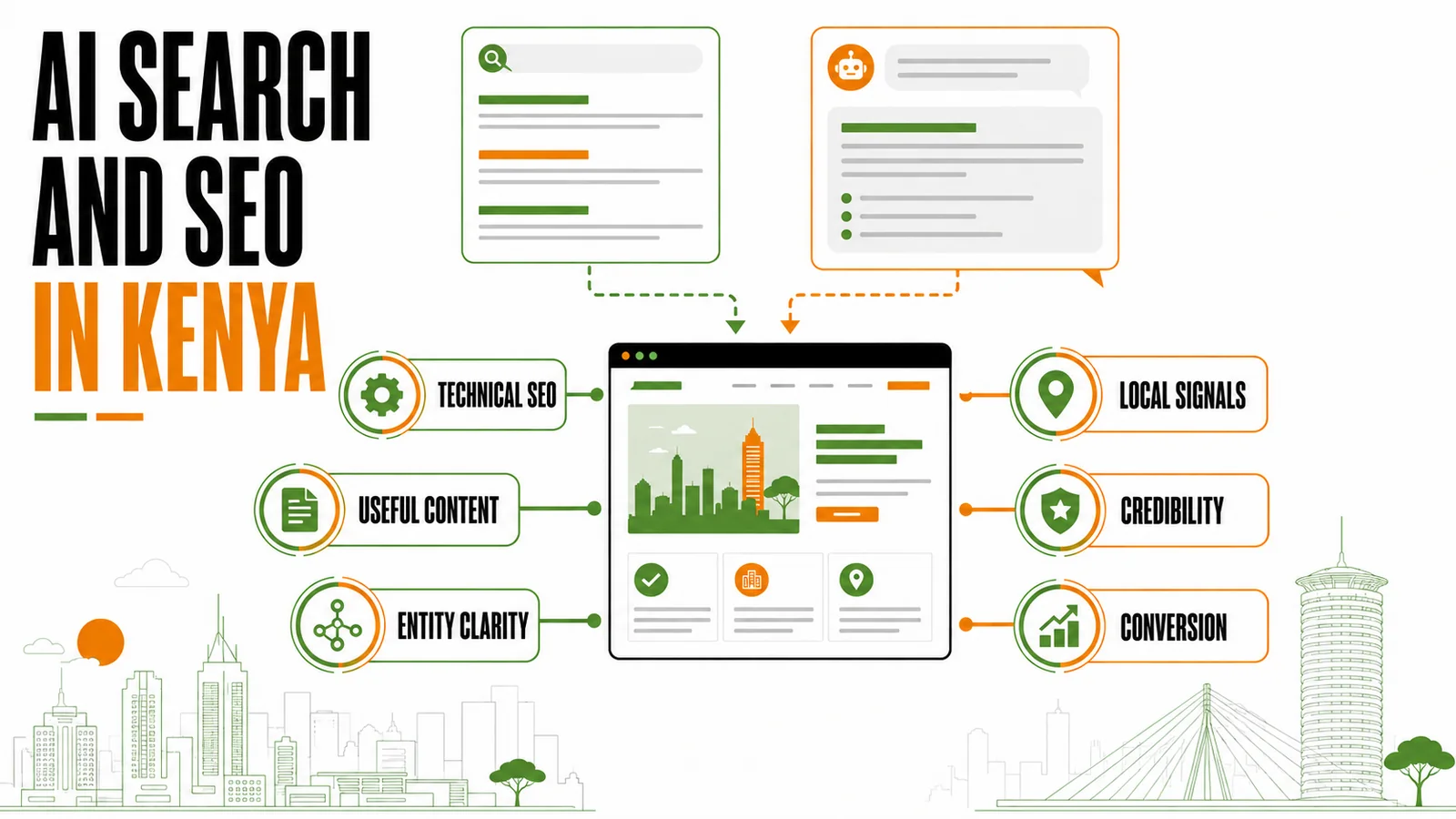
AI search does not make SEO obsolete. It changes the customer journey and increases the value of clear, trustworthy, well-structured information. Kenyan businesses still need crawlable pages, strong service content, local relevance, credible evidence, useful internal links and an accessible conversion path. They should also make their entities, expertise, prices, locations, processes and proof easier to understand and cite.
Do not create hundreds of thin pages for conversational queries, add unsupported claims, or treat schema and llms.txt as shortcuts. Google states that its normal SEO foundations remain relevant for AI Overviews and AI Mode, with no special technical requirement beyond being eligible for Google Search and snippets. For ChatGPT search, OpenAI recommends allowing OAI-SearchBot when a publisher wants its public pages considered for search results. Neither platform guarantees inclusion.
Key takeaways
- SEO remains the foundation for visibility in Google’s AI search features.
- AI search often expands one detailed question into several related searches and comparisons.
- A service page must explain exactly who the business serves, what it offers, where it operates and why it is credible.
- Original experience, evidence and useful Kenyan context are more defensible than generic summaries.
- Structured data can clarify eligible page information, but it does not guarantee a citation or recommendation.
- OAI-SearchBot and GPTBot have different purposes and can be controlled independently.
- Measure qualified visits, enquiries, assisted conversions and cited pages, not a single invented “AI ranking.”
- AI visibility work should support the existing SEO and service-page system, not create duplicate pages for every prompt variation.
Why AI search changes the commercial journey
A prospective customer no longer has to search “accounting firm Nairobi,” open ten websites and compare them manually. They can ask an AI assistant for accounting firms that understand Kenyan tax obligations, serve growing ecommerce companies and offer monthly support within a stated budget.
That question contains several decisions at once:
- service category
- location
- industry fit
- regulatory context
- delivery model
- budget
- evidence and trust
If a business website only says “we provide quality solutions,” the system has little reliable information to use. The company may be technically visible yet commercially difficult to compare.
This is the real AI search problem for many Kenyan businesses. It is not that an algorithm demands a secret file or a new type of keyword. It is that the website does not clearly express the facts a customer needs before choosing.
Google explains that AI Overviews and AI Mode can use a query fan-out process, issuing several related searches across subtopics and data sources to build an answer. Its official guidance also says the same foundational SEO practices remain relevant and that there are no additional technical requirements for appearing in these features beyond normal Search eligibility. Read Google’s current explanation of AI features and your website.
For a Kenyan business, this means one conversational question may cause systems to look for supporting information across service pages, location details, reviews, expert articles, business profiles, product data and third-party references.
The opportunity is not simply “rank for AI.” It is to become a clear, credible candidate at more points in that research journey.
If you do not know whether your website provides those signals consistently, start with Tabala’s free AI Visibility Audit. It checks the foundations before you invest in speculative AI tactics.
How AI search differs from a traditional result page
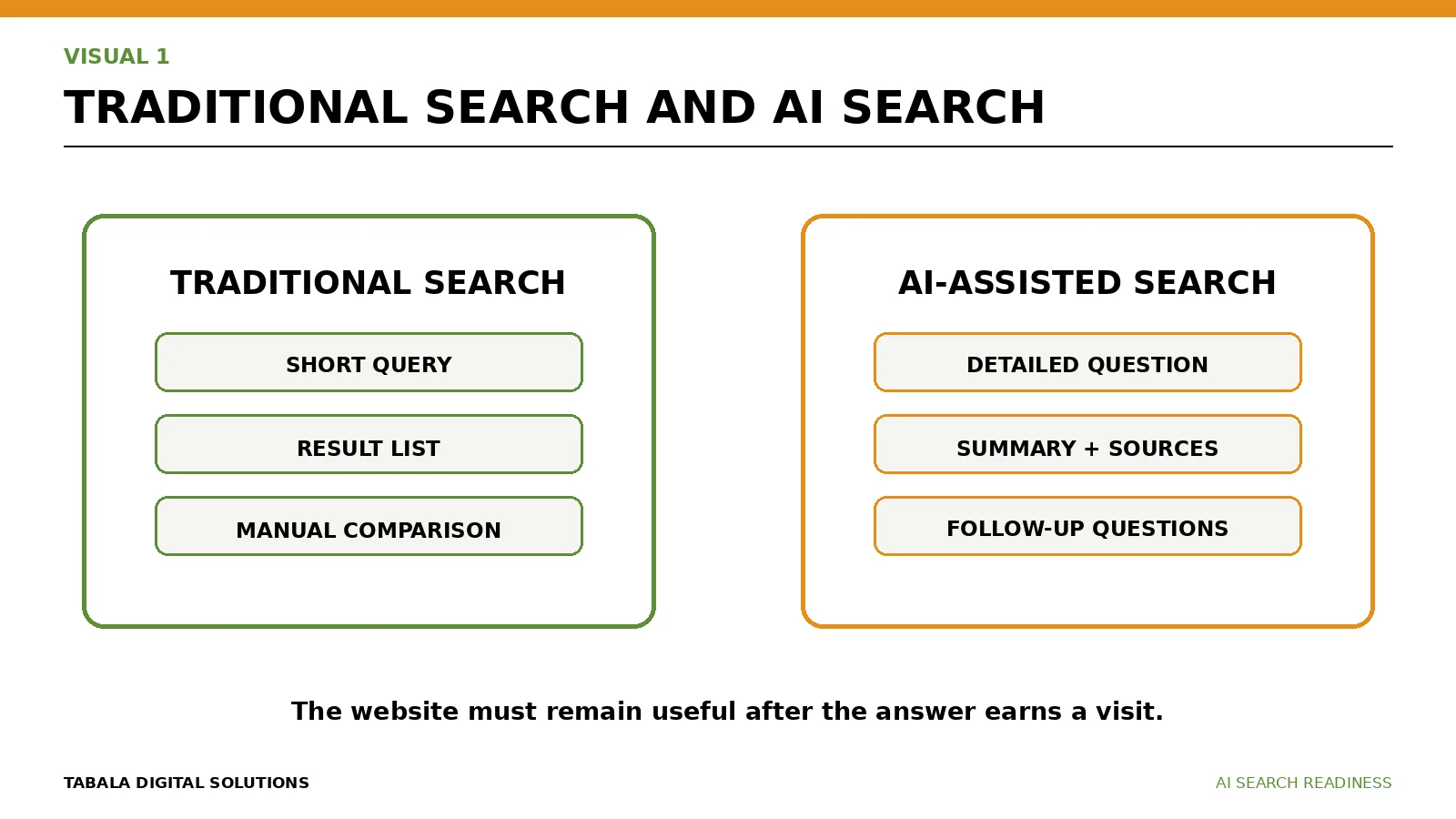
Traditional search and AI-assisted search draw on overlapping web foundations, but the experience is different.
| Decision point | Traditional search | AI-assisted search | Business implication |
|---|---|---|---|
| Query style | Often short and keyword-led | Often detailed, conversational and iterative | Pages must answer the complete buying question, not only repeat a phrase |
| Research path | User opens and compares several results | System may summarize, compare and cite sources | Facts and evidence must be easy to identify and verify |
| Follow-up | User runs another search | User can ask a follow-up in the same conversation | Content needs depth across related questions |
| Visibility | Ranking and result appearance | Citation, supporting link, recommendation or referral | Track more than one position |
| Conversion | Search result leads to a page | AI answer may reduce or qualify the visit before the click | Landing pages must convert better-informed visitors |
AI search can compress research. A customer may arrive on the website after the system has already explained the category, compared alternatives and narrowed the shortlist. That visitor may be closer to a decision, but only if the cited information was accurate and the destination page continues the same promise.
This makes page quality and conversion clarity more important, not less. A citation that lands on an outdated price, unclear service description or broken form wastes the opportunity.
What does not change about SEO
The phrase “AI SEO” sometimes creates the impression that every established search practice has been replaced. Google’s guidance says otherwise.
Its guide to optimizing for generative AI features states that generative features are rooted in core Search ranking and quality systems. A page still needs to be discoverable, crawlable, indexable and useful.
The core work remains:
- resolving crawl and indexing problems
- using one clear preferred URL for each intent
- building descriptive internal links
- creating strong service, category and location pages
- matching content to genuine customer questions
- demonstrating experience and credibility
- earning trustworthy mentions and links
- keeping business details accurate
- providing a usable mobile experience
- measuring meaningful outcomes
AI search optimization should therefore sit on top of a sound SEO system. If important pages are blocked, duplicated, orphaned or vague, adding an AI-specific label will not repair them.
Use the technical SEO checklist for Kenyan websites to confirm that search systems can reach and interpret the pages that matter. Use the on-page SEO guide for Kenyan businesses when the page itself does not clearly communicate its intent.
The seven foundations of AI search readiness
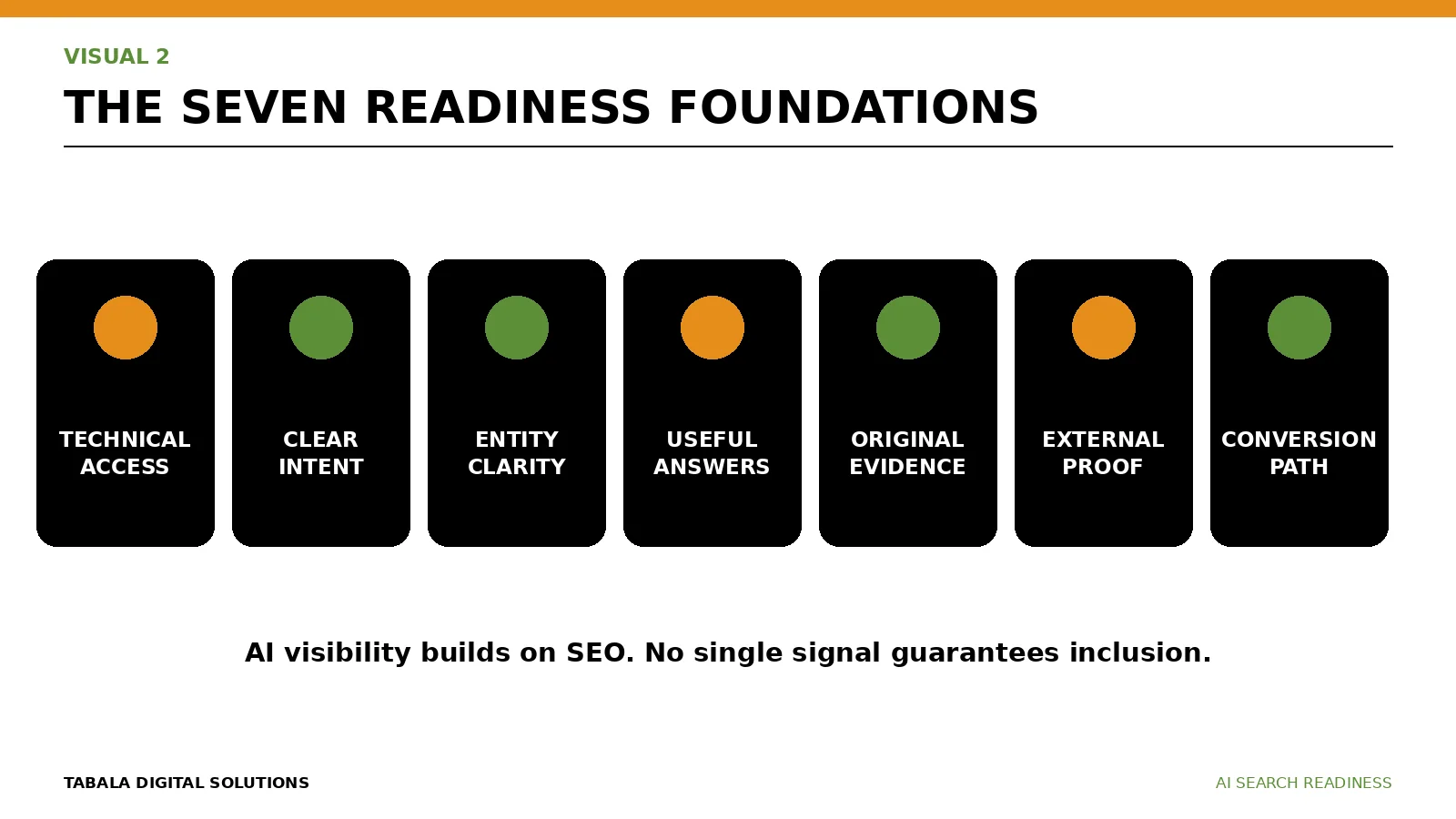
1. Technical eligibility
The page should return a valid response, be crawlable, be indexable where appropriate and expose the important content in a form search systems can process. It should also be eligible to appear with a snippet if the goal is inclusion in Google’s AI search features.
Google does not guarantee crawling, indexing or serving even when a page follows its requirements. Its guide to how Search works separates crawling, indexing and serving into distinct stages. Diagnose the failed stage rather than assuming the page needs more content.
2. Clear search intent
Each important page needs one primary job.
A service page should help a buyer understand and evaluate the service. A guide should educate and direct the reader toward a sensible next step. A location page should prove genuine service coverage and local relevance. A case study should document a real process and outcome.
Mixing several unrelated intents creates a page that is difficult for both customers and retrieval systems to classify.
3. Entity clarity
An entity is a distinct thing that can be identified through its attributes and relationships. For a business, those signals include:
- official name
- service categories
- locations and service areas
- founders or qualified experts
- contact details
- registration or accreditation where relevant
- products and services
- relationships with recognised platforms or partners
- consistent profiles and citations
The goal is not to stuff every page with the company name. It is to make the facts consistent across the website, Google Business Profile and trustworthy external profiles.
4. Answer-led service content
A useful service page should answer the questions a customer asks before contacting the business:
- What exactly is included?
- Who is the service for?
- Which locations are covered?
- What is the process?
- What affects price?
- What evidence supports the claim?
- What are the limitations?
- What happens next?
Tabala’s protected AI Search Optimization services page is the commercial destination for implementation. This article supports it by explaining the strategic change and diagnostic process without duplicating the sales page.
5. Original evidence
Generic explanations are easy to reproduce. First-hand observations, transparent methods and useful local data are harder to replace.
Examples include:
- anonymised patterns from completed audits
- a clearly explained Kenyan pricing framework
- a documented implementation process
- an expert comparison with stated assumptions
- original survey or operational data
- a calculator or checklist based on real customer decisions
- case evidence that names the starting condition, work completed and limitation
Do not invent percentages or present a small convenience sample as a national benchmark. Narrow, transparent evidence is more trustworthy than dramatic unsupported claims.
6. External corroboration
A company’s website is only one source about the company. Reviews, industry memberships, media coverage, partner pages, credible directories and earned citations can help confirm its claims.
This does not justify buying bulk mentions or manipulating anchor text. The practical backlink guide for Kenyan businesses explains how to earn relevant editorial links without treating quantity as the goal.
7. A measurable conversion path
Visibility has business value only when it supports the next step. The page needs a clear action such as:
- request a quotation
- book a consultation
- run an audit
- call the business
- send a WhatsApp enquiry
- check availability
- buy a product
The action should match the visitor’s stage. An early research guide may lead to an audit. A high-intent service page may lead directly to a strategy call.
How to structure pages for people and answer systems
Good structure helps a busy owner scan the page and helps retrieval systems identify the relevant passage. It is not a requirement to turn every answer into a tiny artificial “chunk.”
Google specifically says there is no special chunking requirement for generative AI search. Build the page for the reader and use ordinary editorial discipline:
- Lead with the business problem and consequence.
- Answer the main question early.
- Use descriptive headings that reflect real decisions.
- Explain terms when they affect the decision.
- Use tables for genuine comparisons.
- Support claims with evidence and links.
- State assumptions and limitations.
- Add contextual internal links at the point of need.
- Finish with one relevant next step.
Build around decision questions
Consider a Nairobi solar installer. A weak page may list “solar panels, batteries and installation.” A useful page might answer:
- Which system sizes suit homes, offices and small factories?
- What affects the KES installation price?
- Does the quoted system include batteries and installation?
- Which counties can the company serve?
- What maintenance and warranty terms apply?
- How is consumption assessed before a recommendation?
- Which products are actually stocked or supported?
The second page is easier to compare because it mirrors the customer’s decision.
Use clear answer blocks without oversimplifying
A short answer can introduce a section, but the page should still provide context. For regulated, medical, legal, financial or technical topics, include the relevant qualification and authoritative source. Do not turn a nuanced answer into an absolute claim merely because a snippet sounds cleaner.
Google’s people-first content guidance encourages original, useful content created primarily for people. Its guidance on generative AI content also warns that producing many pages without added value can violate scaled-content rules.
Entity clarity for Kenyan businesses
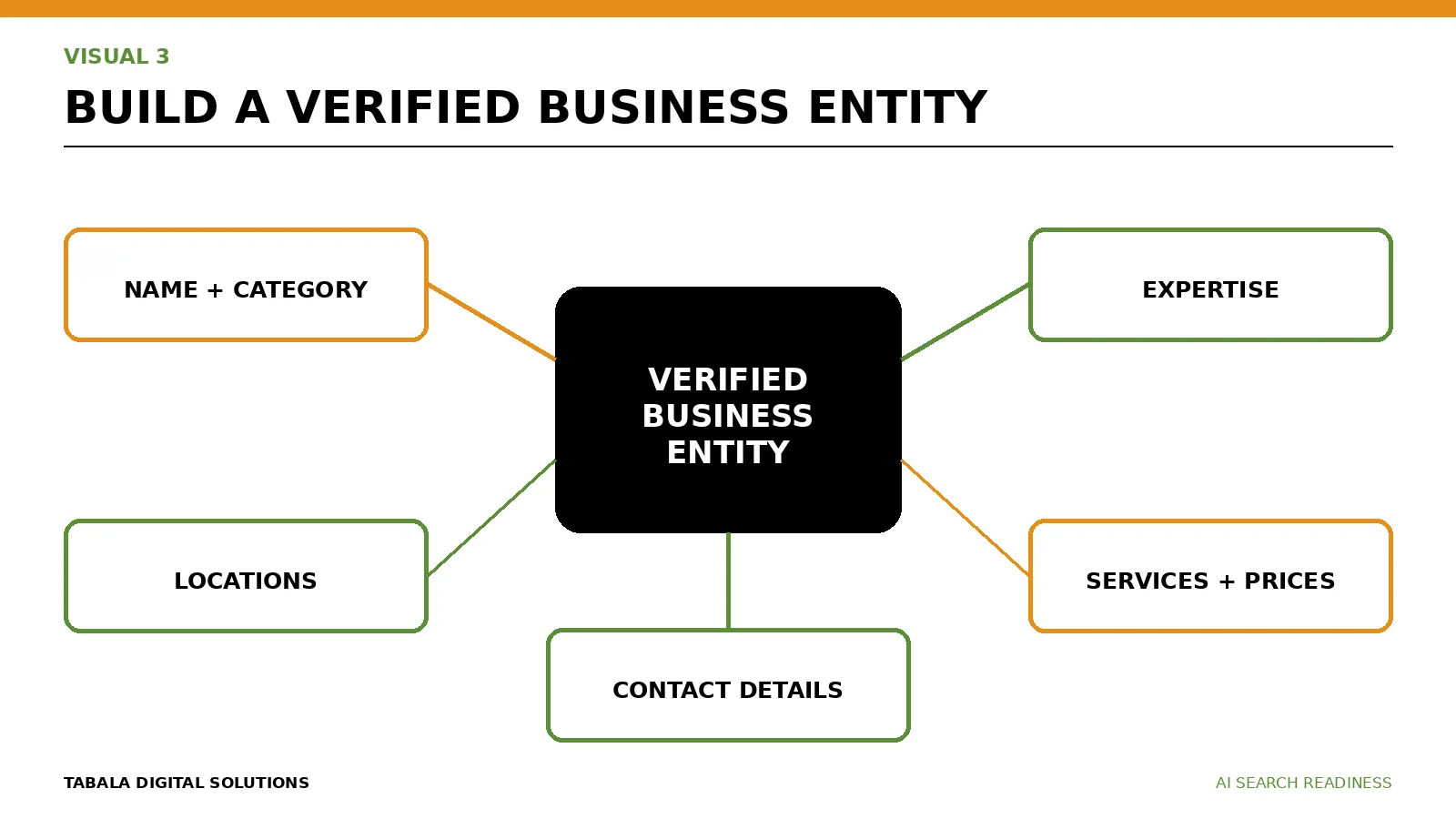
Entity clarity is often a website-governance problem rather than a copywriting problem.
Imagine a company that trades under one name, uses a different legal name on invoices, shows an old phone number on a directory and has two inconsistent Google Business Profiles. An AI system cannot repair that contradiction. Neither can schema pasted onto one page.
Create a verified business fact sheet with:
| Field | Verified source | Where it must remain consistent |
|---|---|---|
| Trading name | Management approval | Website, profile, social accounts and directories |
| Legal name | Registration documents | Legal pages and contracts where appropriate |
| Main category | Actual revenue-generating activity | Homepage, service pages and business profiles |
| Locations | Physical and service-area evidence | Contact page, location pages and profiles |
| Phone and email | Active customer channels | Header, footer, contact page and citations |
| Expertise | Staff qualifications or documented experience | Author bios, service pages and expert content |
| Pricing statements | Current approved pricing | Service pages, FAQs and sales materials |
| Accreditations | Issuing organisation | Relevant service and trust sections |
Only publish claims the business can verify. “Certified,” “authorised,” “leading” and “number one” are not interchangeable. State the issuer, scope and current status where relevant.
Local AI visibility in Kenya
Local discovery may draw on the website, Google Business Profile, reviews, location information and third-party references. For businesses serving Nairobi, Mombasa, Kisumu, Nakuru or Eldoret, location claims should follow operational reality.
Do not create a thin page for every city simply to capture a query. A useful location page should show:
- the service available in that location
- the actual service area or physical address
- local contact or fulfilment information
- relevant projects, customers or operational evidence
- delivery, travel or response limitations
- a clear enquiry path
Google’s generative AI guidance says Merchant Center and Google Business Profile can help product and local-business information appear across Google experiences where relevant. That does not mean a profile guarantees inclusion in an AI response.
Use Tabala’s guide to local SEO and local search visibility to align the website and local profile before creating more location content.
Kenyan language and market context
Use the language customers use naturally. That may include English, Kiswahili, local product terms, recognised neighbourhoods, counties and KES prices. Do not force city names or translations into every paragraph.
Useful context may include:
- mobile and WhatsApp enquiry behaviour
- delivery coverage by county
- M-PESA or supported payment flows
- Kenyan regulatory bodies where directly relevant
- local procurement and quotation requirements
- VAT-inclusive or VAT-exclusive pricing statements
- response times the business can genuinely maintain
The content should help a real Kenyan customer make a decision. Localisation is not the mechanical insertion of “Kenya” into a generic global article.
Content that earns citations and recommendations
The safest long-term strategy is to publish information worth referencing.
Strong content assets
| Asset | What makes it valuable | Kenyan example |
|---|---|---|
| Original research | Transparent method and useful finding | Anonymised delivery-time patterns by county |
| Practical calculator | Solves a repeated planning task | KES campaign or installation budget calculator |
| Expert guide | Explains a high-stakes decision | Procurement checklist reviewed by a qualified specialist |
| Comparison | Uses explicit criteria and limitations | Choosing between service models for a Kenyan SME |
| Case study | Documents starting point, action and evidence | Website indexation repair with before-and-after Search Console evidence |
| Reference page | Maintained facts people repeatedly need | Current application requirements or service coverage |
Google’s newer guidance emphasises valuable, non-commodity content and a unique point of view. A generic “ten AI SEO tips” post adds little if it merely repeats common advice.
Write from experience without inventing proof
Experience can appear through:
- mistakes observed during audits
- constraints encountered during implementation
- customer questions that changed the process
- screenshots or examples with permission
- checklists the team actually uses
- trade-offs and situations where the method does not apply
If no verified result exists, write a framework or hypothesis. Do not turn an illustrative calculation into a client outcome.
Technical access for Google and ChatGPT search
Google Search AI features
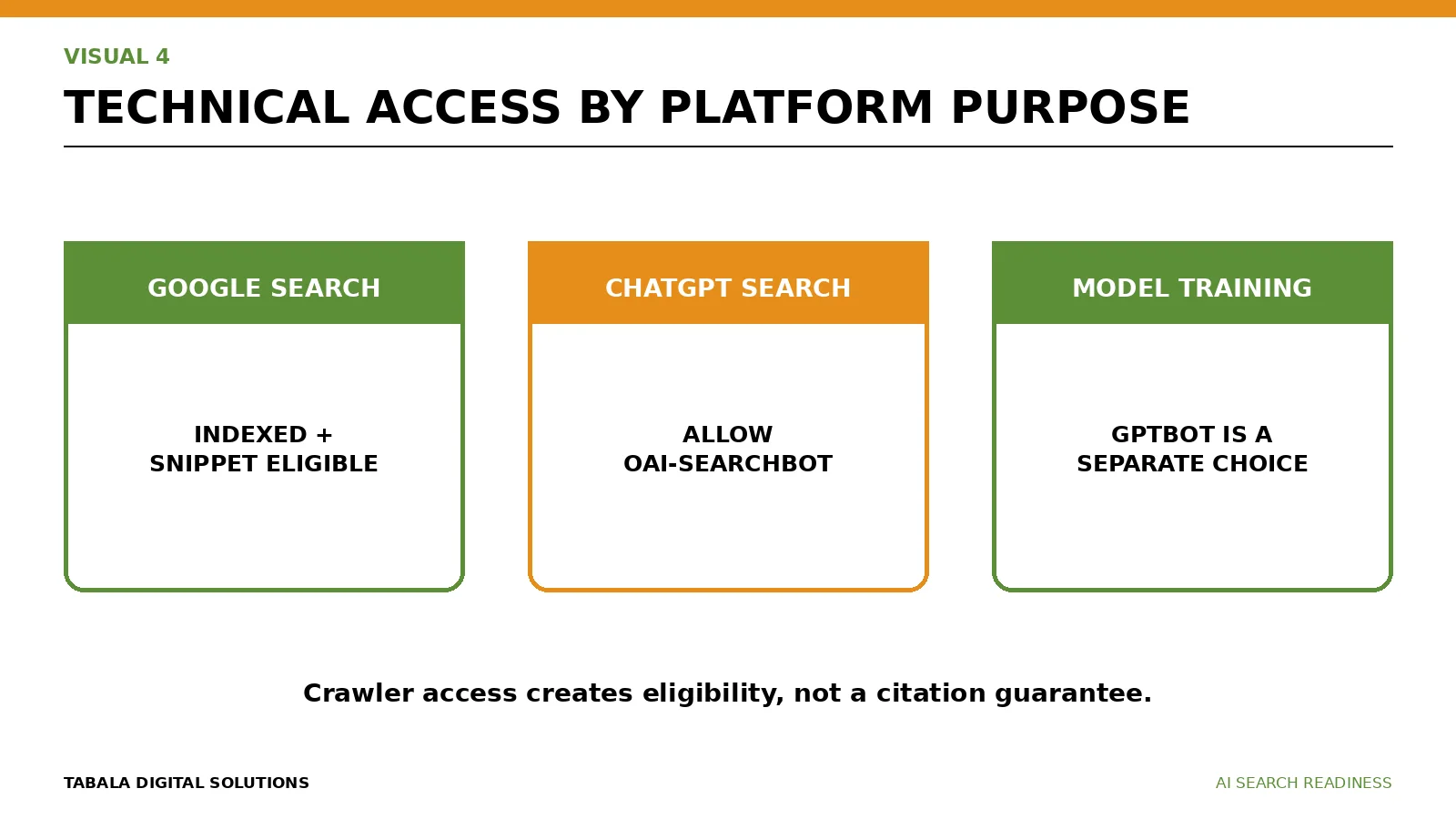
For Google AI Overviews and AI Mode, Google says a supporting page must be indexed and eligible to appear in Search with a snippet. Standard crawl, indexation, preview and policy controls apply.
Do not block important content and then expect it to be cited. Check robots directives, noindex, canonical URLs, page responses and internal links. The SEO foundation matters before any AI visibility experiment.
ChatGPT search
OpenAI documents separate crawler purposes in its overview of OpenAI crawlers:
- OAI-SearchBot is used for ChatGPT search features.
- GPTBot is associated with potential model training.
- The controls are independent.
A publisher may allow OAI-SearchBot for search visibility while disallowing GPTBot for training. OpenAI says sites opted out of OAI-SearchBot will not be shown in ChatGPT search answers, although they may still appear as navigational links in some circumstances.
OpenAI’s publisher and developer FAQ also explains that referral URLs from ChatGPT search include utm_source=chatgpt.com, allowing publishers to analyse that referral traffic.
Crawler access only creates eligibility. It does not guarantee that ChatGPT will cite, summarize or recommend the site.
A safe robots.txt review
Before changing robots.txt:
- Confirm which bot and purpose the business intends to allow or restrict.
- Check whether important pages are accidentally blocked.
- Separate search visibility decisions from training preferences.
- Verify the syntax against the platform’s current official documentation.
- Monitor server logs and referral data after the change.
Do not copy a generic crawler block without understanding its effect.
Schema, llms.txt and common misconceptions
Structured data
Structured data helps search engines understand eligible page information and can support rich-result features. Google’s structured data introduction recommends using supported markup that accurately represents visible page content.
Use the schema type that matches the page:
Organizationfor company identity informationLocalBusinessor an appropriate subtype for eligible local business detailsProductfor product dataArticlefor editorial contentBreadcrumbListfor breadcrumb relationshipsFAQPageonly when the visible content and current feature eligibility justify it
Do not add false ratings, invented prices or hidden FAQs. Structured data describes the page. It does not create evidence that the page lacks.
Google explicitly says there is no special schema required for its generative AI search features and that structured data is not required for inclusion.
llms.txt
llms.txt is a proposed convention used by some website owners to provide AI-oriented site guidance. Google’s official generative AI guide states that Google Search does not use llms.txt and that it neither helps nor harms visibility or rankings in Google Search.
A business may still test it for other systems if it can maintain the file accurately. It should not replace crawlable HTML, sitemaps, internal links, structured data or ordinary content governance.
Common misconceptions
| Claim | Better interpretation |
|---|---|
| “SEO is dead” | AI search still relies on retrieval, indexing, relevance and quality systems |
| “Schema guarantees AI citations” | Schema can clarify supported information but cannot guarantee inclusion |
| “Every prompt needs a separate page” | One comprehensive page can answer related questions without scaled duplication |
| “An AI visibility score is a Google metric” | Third-party scores are directional models, not internal platform metrics |
| “More mentions always improve recommendations” | Relevance, authenticity and source quality matter more than manufactured volume |
| “ChatGPT search and model training use one crawler” | OpenAI documents OAI-SearchBot and GPTBot as separate controls |
A practical AI search content workflow
Step 1: choose one commercial decision
Start with a question tied to revenue or customer confidence, such as:
- Which service fits the customer’s situation?
- What affects cost?
- How should a buyer compare providers?
- Which option is suitable for a specific location or industry?
- What evidence should the customer request?
Step 2: map the query fan-out
List the supporting questions a customer or retrieval system may need to answer:
- definitions
- alternatives
- costs
- risks
- process
- suitability
- location
- proof
- next step
Do not automatically turn each question into a URL. Group questions that belong to the same intent and create separate pages only when the customer task is genuinely different.
Step 3: collect verified facts and experience
Create a source pack before drafting:
- current official documentation
- approved business facts
- real service scope
- verified prices or pricing factors
- expert notes
- customer questions
- relevant local examples
- limitations and exceptions
Step 4: assign the page’s internal role
Decide whether the page should support:
- the AI Search Optimization service
- the SEO service pillar
- a local-search cluster
- an industry cluster
- an audit tool
This prevents orphan content and duplicate targeting. The broader SEO services page for Nairobi businesses remains the parent commercial destination for conventional search strategy, while the AI Search Optimization page owns the specialised service intent.
Step 5: draft for usefulness and extraction
Include:
- a direct answer near the beginning
- clear headings
- explicit facts and limitations
- comparison tables where useful
- descriptive links
- relevant entities and relationships
- a practical checklist
- FAQs based on real questions
- one clear CTA
Step 6: run collision and evidence QA
Before publishing, check:
- Does an existing page already own this intent?
- Is the new page supporting or competing with the service page?
- Are claims backed by a named source or clearly marked as examples?
- Are every internal and external destination live?
- Are reverse links planned from older cluster pages?
- Does the page offer something original?
Step 7: publish, measure and improve
Record the baseline, publish the page, inspect indexing, monitor search and referral behaviour, and update the page when evidence changes. Avoid rewriting the page after every unverified ranking fluctuation.
How to measure AI search visibility
AI visibility measurement is still developing. Use a layered system rather than a single score.
| Layer | What to inspect | Limitation |
|---|---|---|
| Technical eligibility | Indexing, snippets, crawler access and server responses | Eligibility does not guarantee citation |
| Google Search performance | Queries, pages, clicks, impressions and conversions | Platform reporting may aggregate AI-feature activity according to current product design |
| Referral analytics | chatgpt.com and other identifiable referral sources | Some influence may not produce a click |
| Prompt observation | Whether defined customer questions surface the brand or page | Results can vary by time, location, user and model |
| Citation quality | Which page is cited and whether the summary is accurate | Manual review is resource-intensive |
| Business outcome | Qualified enquiries, sales and assisted conversions | Attribution across research journeys is imperfect |
Google’s current generative AI optimization guide references a Generative AI performance report in Search Console. Availability and reporting behaviour can change, so verify the current interface in the property rather than assuming every account has identical access.
For ChatGPT search referrals, create an analytics exploration or report for utm_source=chatgpt.com and referral traffic from ChatGPT. Compare landing pages, engagement, conversions and lead quality. Do not judge the channel from sessions alone.
A practical monthly review
- Check indexing and crawl errors on priority pages.
- Review organic queries and landing pages.
- inspect identifiable AI-search referrals.
- Test a stable set of high-value customer questions.
- Record cited sources and summary accuracy.
- Compare enquiries with CRM or sales records.
- Update weak facts, unclear pages and broken conversion paths.
Do not claim an “AI ranking” without naming the tool, prompt set, location, model, date and method.
A 90-day implementation plan
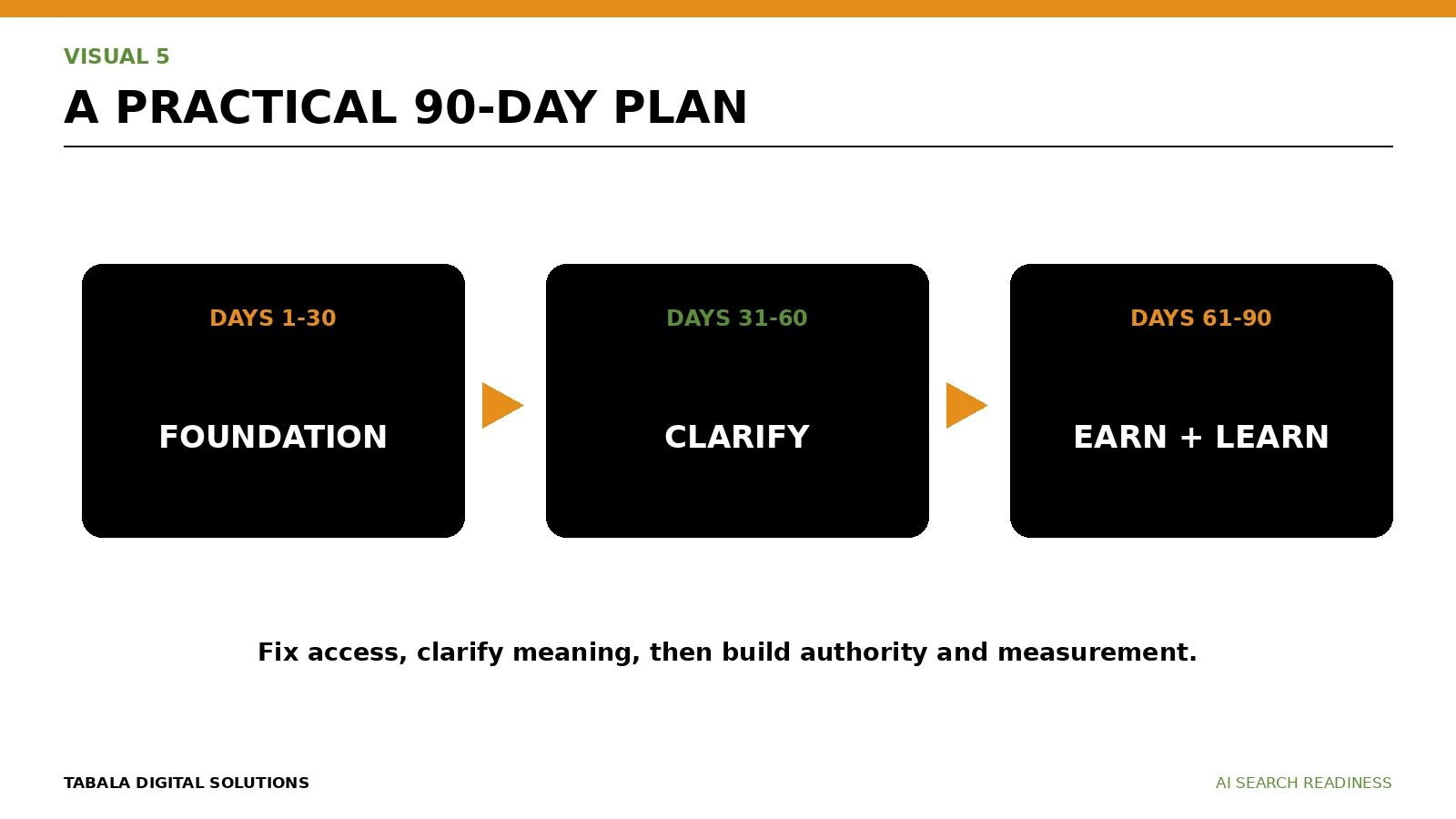
Days 1 to 30: establish the foundation
- Run an SEO and AI visibility audit.
- Confirm the pages that generate revenue.
- Resolve crawl, indexation, canonical and duplication problems.
- Verify service, location and contact facts.
- Review OAI-SearchBot and other crawler controls.
- Define the most valuable customer decision questions.
- Establish baseline analytics and conversion tracking.
Days 31 to 60: improve the information system
- Strengthen priority service pages.
- Add useful author and organisation information.
- Publish one evidence-led supporting article.
- Create or improve comparison and pricing sections.
- Add accurate supported structured data.
- Improve internal links among service, audit and supporting pages.
- Align Google Business Profile and website information.
Days 61 to 90: build corroboration and learn
- Earn relevant mentions and links through real relationships.
- Test a stable set of commercial research prompts.
- Review Search Console, analytics and lead-quality data.
- Identify frequently cited competitors and source types.
- Improve one weak content or evidence gap.
- Add reverse links from established pages.
- Document findings and next-quarter priorities.
This plan is a framework, not a promise of inclusion. The pace should reflect website size, technical condition, available evidence and commercial priority.
Complete AI search and SEO checklist
Strategy
- The target customer and commercial decision are clear.
- The page has one primary intent.
- Existing pages have been checked for overlap.
- The supporting article does not duplicate the protected service page.
- The target service page and audit tool are assigned.
Technical access
- The preferred URL returns a valid response.
- The page is crawlable and indexable where intended.
- Canonical, sitemap and internal links agree on the preferred URL.
- Important content is available on mobile.
- Snippet and preview controls match the visibility goal.
- OAI-SearchBot access reflects the business’s search-visibility decision.
- GPTBot is treated as a separate training preference.
Content and evidence
- The main question is answered near the beginning.
- Claims have sources or are clearly marked as examples.
- Kenyan examples improve the decision rather than decorate the page.
- Original experience, data or method is included where available.
- Limitations and exceptions are stated.
- Headings follow the reader’s decision path.
- Tables compare real criteria.
- Images explain the content and have descriptive alt text.
Entity and local clarity
- Business name, category and contact details are consistent.
- Service areas reflect actual operations.
- Staff expertise and accreditations are verifiable.
- Google Business Profile and website information agree.
- Price and process statements are current.
- Appropriate structured data describes visible facts.
Authority and conversion
- The page links to the relevant service and audit tool.
- It links to two or more related published articles.
- Older cluster pages have reverse-link actions recorded.
- The CTA matches the reader’s stage.
- Forms, calls and WhatsApp paths work on mobile.
- Qualified outcomes can be measured.
Frequently asked questions
Is AI search optimization the same as SEO?
No. It is best treated as an extension of SEO. Technical accessibility, useful content, internal links, authority and search intent remain the foundation. AI search work adds stronger entity clarity, answer coverage, corroboration and measurement across conversational search experiences.
Is traditional SEO still worth investing in?
Yes. Google states that its generative AI features use core Search systems and that normal SEO best practices remain relevant. Businesses still need pages that can be crawled, indexed, understood and selected for relevant searches.
How can a Kenyan business appear in Google AI Overviews?
There is no submission form or guaranteed tactic. Keep important pages eligible for Google Search and snippets, follow Search policies, publish helpful original content, strengthen technical and local foundations, and make the business’s services and evidence clear. Inclusion remains a platform decision.
How can my website appear in ChatGPT search?
OpenAI recommends allowing OAI-SearchBot when a publisher wants public pages considered for ChatGPT search. The pages should also be publicly accessible, useful and trustworthy. Allowing the crawler creates eligibility, not a guarantee of citation.
Should I allow GPTBot?
That is a separate content-training decision. OpenAI documents GPTBot for potential model training and OAI-SearchBot for search. A publisher can set independent controls based on its policy and goals.
Does llms.txt improve Google rankings or AI Overviews?
Google says it does not use llms.txt for Search and that the file neither helps nor harms Google Search visibility. It may be tested for other systems, but it should never replace standard SEO foundations.
Does schema guarantee an AI citation?
No. Structured data can clarify eligible information and support Search features, but it does not guarantee ranking, citation or recommendation. It must accurately represent visible page content.
Do I need a page for every question people ask AI?
No. Group related questions by intent and create a separate page only when the customer task is genuinely different. Publishing many near-duplicate pages can create cannibalisation and may become scaled, low-value content.
How should AI search visibility be measured?
Use indexing data, Search Console, identifiable referral traffic, a stable prompt-observation set, citation accuracy, conversions and lead quality. Any third-party score should be labelled with the tool, prompt set, location, model and date.
How long does AI search optimization take?
There is no universal timeline. Technical fixes may be implemented quickly, while stronger content, entity clarity, authority and citations develop over time. Results depend on the existing website, competition, platform behaviour and available evidence. No agency can credibly guarantee inclusion.
Summary and next step
AI search changes how customers research, compare and narrow their options. It does not remove the need for SEO.
Kenyan businesses need a website that clearly explains what they do, who they serve, where they operate, what the offer includes and why the claims should be trusted. They need technical access, accurate entities, useful service pages, original evidence, contextual internal links, relevant external corroboration and a measurable next step.
Start with the commercial pages that matter most. Fix their technical eligibility. Strengthen the information customers use to choose. Publish supporting content only when it adds a distinct decision or evidence layer. Then measure citations and referrals against qualified enquiries, not vanity scores.
If you want to identify the exact gaps first, run Tabala Digital Solutions’ free AI Visibility Audit. For implementation across SEO foundations, entity clarity, answer-led content and structured data, review Tabala’s AI Search Optimization services in Nairobi.
Accelerate Your Revenue
While Revenue Intelligence builds long-term authority, Google Ads delivers immediate, high-intent traffic. Combine both for maximum market dominance.

Strategist Profile
Abala Tom
Digital systems strategist specializing in high-performance SEO, Google Ads, and conversion optimization. Mission: to replace marketing 'guesswork' with predictable revenue systems.