Google AI Overviews and SEO in Kenya: What Businesses Should Do
A Kenyan business can keep its traditional Google ranking and still lose attention before the searcher reaches the familiar list of links.
The customer asks a detailed question such as “Which solar system suits a three-bedroom home in Nairobi?” or “What should a small company budget for SEO in Kenya?” Google may answer with an AI-generated summary, supporting links and follow-up options. If that summary resolves the basic question, the customer may never visit the pages below it. If it cites a competitor, that competitor gains credibility before the buyer has compared providers.
That changes the commercial job of SEO. A page still needs to be crawlable, indexed, relevant and useful, but ranking is no longer the only visibility outcome to watch. A business also needs to understand whether its pages are being used as sources, whether Google can identify the organization and its offers accurately, and whether the visits that do arrive convert into enquiries or sales.
The answer is not a secret “AI keyword,” a new text file or mass-produced question pages. Google’s own guidance says its generative search features use core Search ranking and quality systems. The practical response is stronger SEO: clearer answers, reliable evidence, technically accessible pages, consistent business information and content that earns trust beyond the company’s own website.
This guide explains what Google AI Overviews mean for Kenyan businesses, what helps a page become eligible, what does not work, and how to measure progress without claiming guaranteed inclusion.
Quick answer
Google AI Overviews are AI-generated summaries that may appear in Google Search when Google determines that a synthesized answer can help the user. The summaries can include links to supporting web pages and may lead into follow-up exploration.
For a Kenyan business, the best preparation is not to replace SEO with a new discipline. Keep important pages indexable and eligible to show a snippet, answer real customer questions clearly, support material claims with evidence, strengthen entity and local-business information, use appropriate structured data, and measure generative-search visibility in Google Search Console.
No tactic can guarantee a citation. The objective is to improve eligibility, usefulness and trust while protecting the broader search and conversion system.
Key takeaways
- AI Overviews are available to users in Kenya and can appear when Google considers them useful.
- Google says normal SEO fundamentals remain relevant to AI Overviews and AI Mode.
- A page must be indexed and eligible to show a snippet before it can appear as a supporting source.
- There is no special AI schema, guaranteed content format or required llms.txt file for Google Search.
- Direct answers help comprehension, but depth, originality, evidence and page quality still matter.
- Structured data should describe visible page content accurately; it does not buy inclusion.
- Local businesses should maintain accurate website and Google Business Profile information.
- Search Console’s Generative AI performance report can show impressions, pages, countries, devices and dates when data is available.
- AI visibility should be connected to qualified enquiries, bookings and sales, not treated as a vanity metric.
What Google AI Overviews are
Google describes AI Overviews as AI-generated snapshots that help people understand a topic or question quickly and provide links for further exploration. They do not appear for every query. Google’s systems decide when the feature is likely to add value beyond the normal results.
The feature is part of Google Search, not a separate search engine. Google’s AI features guidance explains that AI Overviews and AI Mode draw on content in the Search index and use Google’s existing ranking and quality systems.
AI Overviews versus traditional results
Traditional organic results normally present a list of pages. The searcher chooses a result, visits the page and assembles the answer.
An AI Overview may do some of that assembly first. It can summarize several aspects of a question, show supporting sources and allow the user to continue exploring. The cited pages can differ from the highest visible traditional results because the generated response may select different supporting sources for different parts of the answer.
AI Overviews versus AI Mode
AI Overviews and AI Mode are related but not identical experiences.
| Search experience | Primary role | Typical user behaviour | Business implication |
|---|---|---|---|
| Traditional results | Present ranked links and search features | Choose a result and visit a page | Compete for rankings, attention and clicks |
| AI Overview | Summarize a question within the results page | Read the summary, inspect sources or continue searching | Compete to become a credible supporting source |
| AI Mode | Support a deeper conversational search journey | Ask follow-up questions and refine the task | Build content and entity signals that remain useful across multi-step exploration |
Google’s Search Help documentation lists Kenya among locations where AI Overviews are available. However, availability does not mean every Kenyan user, query or device will show the same experience.
How AI Overviews change SEO
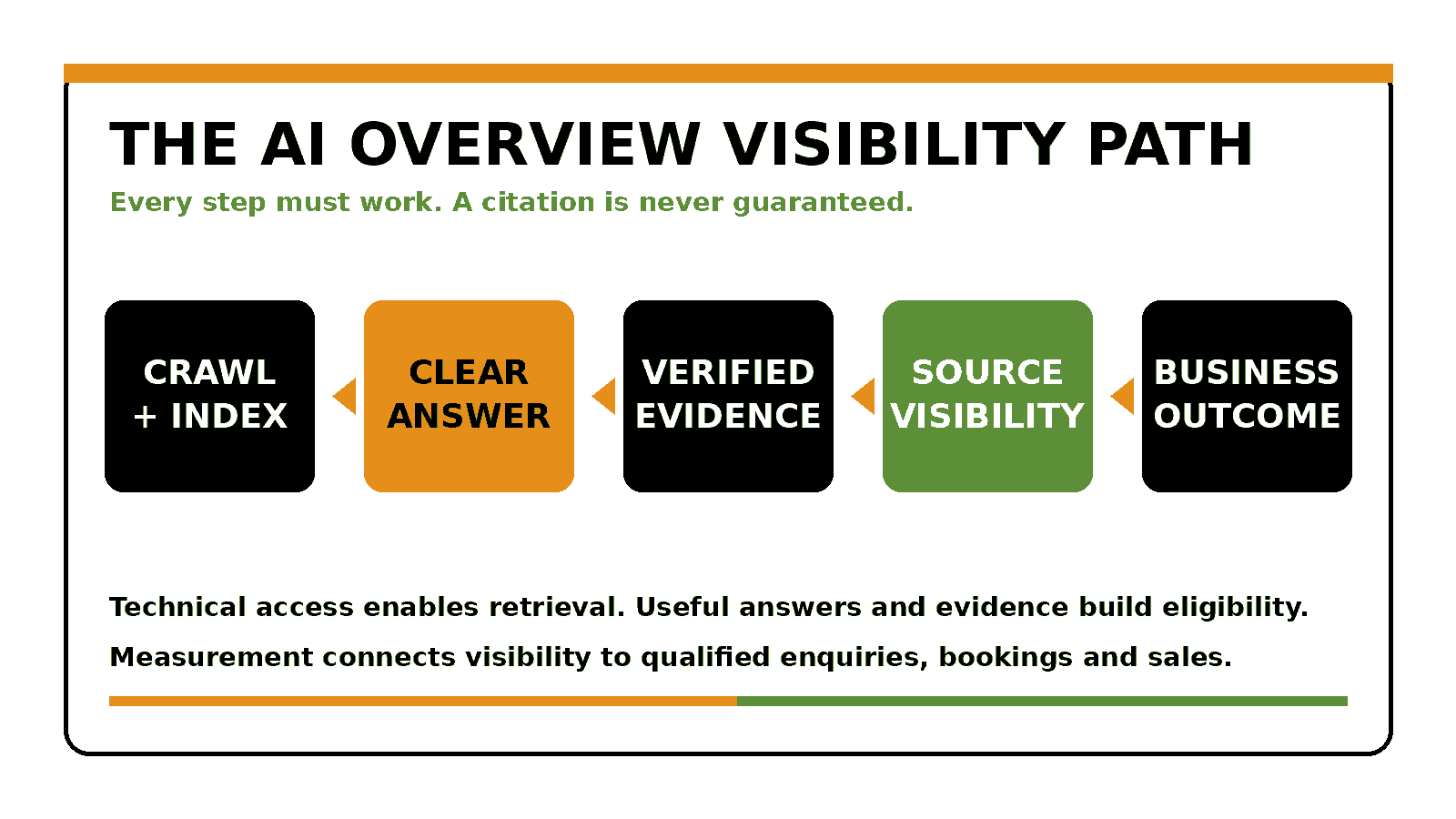
AI Overviews change what happens between the query and the click. They do not remove the foundations of search visibility.
Visibility can occur without a visit
A page may support an answer even when the searcher does not click. That means a business can gain source visibility but see fewer visits than it expected from an informational query.
This is why raw traffic cannot remain the only measure of SEO value. Businesses should monitor visibility, branded demand, qualified visits and downstream conversions together.
A single answer can cite several pages
One overview may use different sources for definitions, comparisons, local context, prices, steps or evidence. A smaller site does not need to be the definitive source for an entire industry to be useful. It can earn visibility by providing the clearest, best-supported answer to a specific sub-question.
For example, a Nairobi accounting firm may not become the primary source for “how to start a business.” It may still publish the strongest explanation of the records a Kenyan SME should prepare before a tax consultation, provided the advice is accurate, appropriately qualified and regularly reviewed.
Search intent becomes more important
Basic informational questions can sometimes be satisfied on the results page. Pages that merely repeat a definition are therefore vulnerable.
Content remains more valuable when it helps the reader make a decision or complete a task. Useful additions include:
- local requirements and constraints;
- original examples;
- comparison criteria;
- diagnostic steps;
- pricing logic rather than unsupported price claims;
- downloadable or usable checklists;
- first-hand experience;
- clear next actions;
- evidence that can be checked.
The visit must work harder
When a user clicks from a generated answer, the page should justify the click immediately. The visitor needs to see the promised detail, source, example, tool or next step without searching through filler.
Tabala’s guide comparing Google Ads and SEO in Kenya demonstrates this principle by helping the reader choose a channel using urgency, economics and measurement readiness rather than repeating generic definitions.
What Google says matters
Google’s guide to optimizing for generative AI features is deliberately conservative. It says SEO remains relevant because AI features use core Search ranking and quality systems.
The most important implications are practical.
The page must meet normal technical requirements
To become eligible as a source, a page must be indexed and eligible to appear in Google Search with a snippet. A blocked, noindex, inaccessible or low-quality URL does not become visible because it contains AI-related wording.
Begin with Tabala’s technical SEO checklist for Kenyan websites if the site has unresolved crawling, indexing, canonical, mobile or structured-data issues.
People-first content remains the standard
Google’s people-first content guidance asks whether content serves an intended audience, demonstrates useful experience and leaves the reader feeling that they have learned enough to achieve their goal.
The test is not whether AI helped produce the draft. The test is whether the published result is accurate, original, useful and accountable.
There is no special AI markup requirement
Google states that websites do not need special AI files or new machine-readable formats to appear in its generative search features. It specifically says llms.txt is not required for Google Search.
Structured data still has value when it accurately describes visible content and uses supported types. It can help Google understand products, organizations, local businesses, articles and other entities, but it is not an AI Overview application form.
Supporting formats still matter
Google can use normal Search ecosystem information in generative experiences. For suitable businesses, this includes Google Business Profile details and Merchant Center product information.
This matters in Kenya because a buying journey may move from an answer to a map listing, product result, phone call, WhatsApp conversation or physical location. The website is one part of a wider entity footprint.
How to improve eligibility
Eligibility is a system, not a copywriting trick. Work through the following layers in order.
1. Make the important pages accessible
Confirm that Google can discover, crawl, render and index the pages that answer valuable customer questions.
Check:
- HTTP status codes;
- robots.txt rules;
noindexdirectives;- canonical tags;
- sitemap inclusion;
- internal links;
- mobile rendering;
- JavaScript-dependent content;
- snippet controls;
- duplicate URL variants.
A service page hidden behind client-side interactions or isolated from internal links is a weak candidate regardless of how well it is written.
Use Tabala’s free SEO visibility audit to identify foundational visibility problems before investing in advanced AI-search work.
2. Match one page to one clear job
A page should have a defined audience, question and outcome. Trying to make one article rank for every AI, SEO and marketing term usually produces vague content.
For this article, the job is to explain how Google AI Overviews affect SEO decisions in Kenya. It does not replace the commercial AI Search Optimization service, which explains Tabala’s implementation support.
3. Answer the main question early
State the useful answer before expanding the background. A reader and a retrieval system should not need to cross six paragraphs to learn the central recommendation.
The answer should remain qualified. “Follow these steps and you will appear” is not defensible. “These steps improve eligibility and evidence, but inclusion is not guaranteed” is accurate.
4. Cover the sub-questions that affect a decision
Create depth around the user’s next questions:
- What is the feature?
- Is it available in my market?
- What technical conditions apply?
- What content should change?
- What evidence is needed?
- How will I measure it?
- What should I avoid?
- What should I do first?
This is not permission to generate hundreds of shallow FAQ pages. Consolidate closely related questions into one coherent resource when they share intent.
5. Add evidence that can be verified
Material claims should point to primary sources, regulations, original records or transparent methodology.
A software company can publish product documentation and change logs. A manufacturer can provide specifications, warranty terms and installation requirements. A professional firm can identify the law, standard or official process behind its advice.
Do not create impressive statistics without a source. If a number is an internal result, define the dates, sample, starting point and measurement method before presenting it as evidence.
6. Clarify the business entity
Search systems need consistent information about who the business is, what it offers, where it operates and why it is credible.
Align:
- legal and trading name;
- address or service area;
- phone and contact details;
- service descriptions;
- author and expert profiles;
- organization information;
- Google Business Profile details;
- reputable third-party profiles and citations.
Entity clarity is not keyword repetition. It is consistency and corroboration.
7. Build meaningful internal relationships
Internal links show how concepts and services relate. Use descriptive anchors and link at the point where the next resource answers a real question.
For unfamiliar terminology, Tabala’s digital marketing terms guide explains SEO, AEO, GEO and related concepts. For broader implementation, the AI Search service page provides the commercial next step.
8. Strengthen authority outside the website
A company cannot manufacture independent trust by publishing only about itself. Useful authority can come from:
- legitimate press coverage;
- professional associations;
- partner and supplier profiles;
- customer reviews;
- expert contributions;
- original research;
- credible citations;
- consistent local listings.
Avoid buying fake mentions or producing self-serving “best company” pages disguised as independent comparisons.
Content that AI search can use
Clear structure improves usability, but structure alone is not authority.
Use direct answers and descriptive headings
Headings should reflect the reader’s real questions. Each section should answer the heading before expanding into examples and limitations.
Avoid headings such as “Unlocking the future” that provide no information about the section.
Separate facts, examples and recommendations
A reliable page makes it clear whether a statement is:
- an official requirement;
- an observed pattern;
- an illustrative example;
- a professional recommendation;
- a hypothesis that requires testing.
This distinction reduces the risk of a scenario being repeated as a fact.
Keep source links close to material claims
Do not add a generic resources list and expect the reader to work out which source supports which statement. Link the official source in the sentence or paragraph where the claim appears.
Use tables when the relationship is comparative
Tables are useful for comparing features, roles or measurement layers. They should not be used to compress long explanations into unreadable cells.
Keep content current
AI search features and reporting can change quickly. Record the modified date, revisit time-sensitive sections and remove claims that are no longer supported.
Google announced its dedicated Generative AI performance reports in Search Console on 3 June 2026 and stated that the views had rolled out worldwide by 31 August 2026. A guide written before that change may incorrectly say AI visibility cannot be separated at all.
Local and ecommerce visibility
AI Overview readiness depends on the type of business.
Local service businesses
A plumber in Nairobi, a hotel in Mombasa or a training provider in Nakuru should maintain clear service areas, contact details, opening information, reviews and location relevance.
The website should explain what is offered, who it suits, where it is available, what affects price and how a customer can take the next step. Google Business Profile should agree with the website rather than presenting a second version of the business.
Tabala’s local SEO guide for Kenyan businesses explains the Maps, location-page and review foundations that support this wider local footprint.
Ecommerce businesses
An ecommerce store should keep product information complete and consistent:
- product name and category;
- price in KES;
- availability;
- variant information;
- delivery coverage and cost;
- return or warranty terms;
- original product images;
- merchant and organization details.
Use supported Product structured data and Merchant Center where appropriate. The page’s visible information, feed and checkout must agree.
Professional and regulated services
Legal, medical, financial and other sensitive advice requires stronger review. Identify the qualified author or reviewer, cite current primary sources, explain limitations and avoid replacing professional assessment with a generic AI-generated answer.
What not to do
AI-search anxiety creates a market for shortcuts. Several are unhelpful or risky.
Do not publish mass-produced question pages
Creating hundreds of near-identical pages for every wording variation adds little value and can weaken site quality. Consolidate related intent and invest in the page that deserves to exist.
Google’s guidance on generative AI content says automation can support research and structure, but generating many pages without adding value may violate spam policies.
Do not treat llms.txt as a Google ranking requirement
Google says it does not use llms.txt as a special requirement for its search features. Creating the file is not a substitute for crawlability, indexing, useful content or authority.
Do not add schema that the page does not support
Markup should match visible content. Fabricated reviews, false author credentials or unsupported organization claims can create policy and trust problems.
Do not rewrite every page into short fragments
Concise answers help, but users still need context, evidence and detail. A page made entirely of disconnected two-sentence blocks can become shallow and unpleasant to read.
Do not promise AI Overview rankings
No agency controls whether Google generates an overview or selects a specific source. Evaluate providers by their technical process, content quality, measurement and honesty rather than a guaranteed citation claim.
How to measure performance
Google Search Console is the primary source for Google Search visibility. Google Analytics or another analytics platform measures what people do after reaching the site.
Use the Generative AI performance report
Google’s Generative AI performance report documentation says the report can show:
- impressions over time;
- pages receiving generative-search impressions;
- countries where visibility occurs;
- devices used for Search visibility;
- date-based trends.
The report may not show useful data if the site has insufficient impressions or is not eligible for inclusion. Do not invent an “AI share of voice” from a tiny sample.
Connect visibility to website outcomes
Measure the full chain.
| Layer | Example measure | Business question |
|---|---|---|
| Eligibility | Indexed pages, snippet eligibility, technical issues | Can the page participate? |
| AI visibility | Generative-search impressions, visible pages, countries, devices | Where is the site appearing? |
| Organic response | Clicks, branded searches, landing-page sessions | Does visibility create further interest? |
| On-site quality | Engaged visits, key actions, form starts, useful page paths | Does the visitor find value? |
| Commercial outcome | Qualified enquiries, bookings, purchases, revenue | Does the search system contribute to growth? |
Use Tabala’s AI Visibility Audit to assess technical, content, entity and trust gaps before choosing an implementation priority.
Track a controlled query set
Create a small list of customer questions across awareness, comparison and commercial intent. Test them periodically in the Kenyan market, record whether an AI Overview appears, identify cited sources and note whether the answer represents your business accurately.
Treat the observations as a sample, not a complete market census. Results can vary by time, location, device and account context.
Review conversions, not only citations
A citation for a broad definition may produce less business value than a normal result for a high-intent service query. Weight visibility by the role it plays in the customer journey.
A 90-day implementation plan
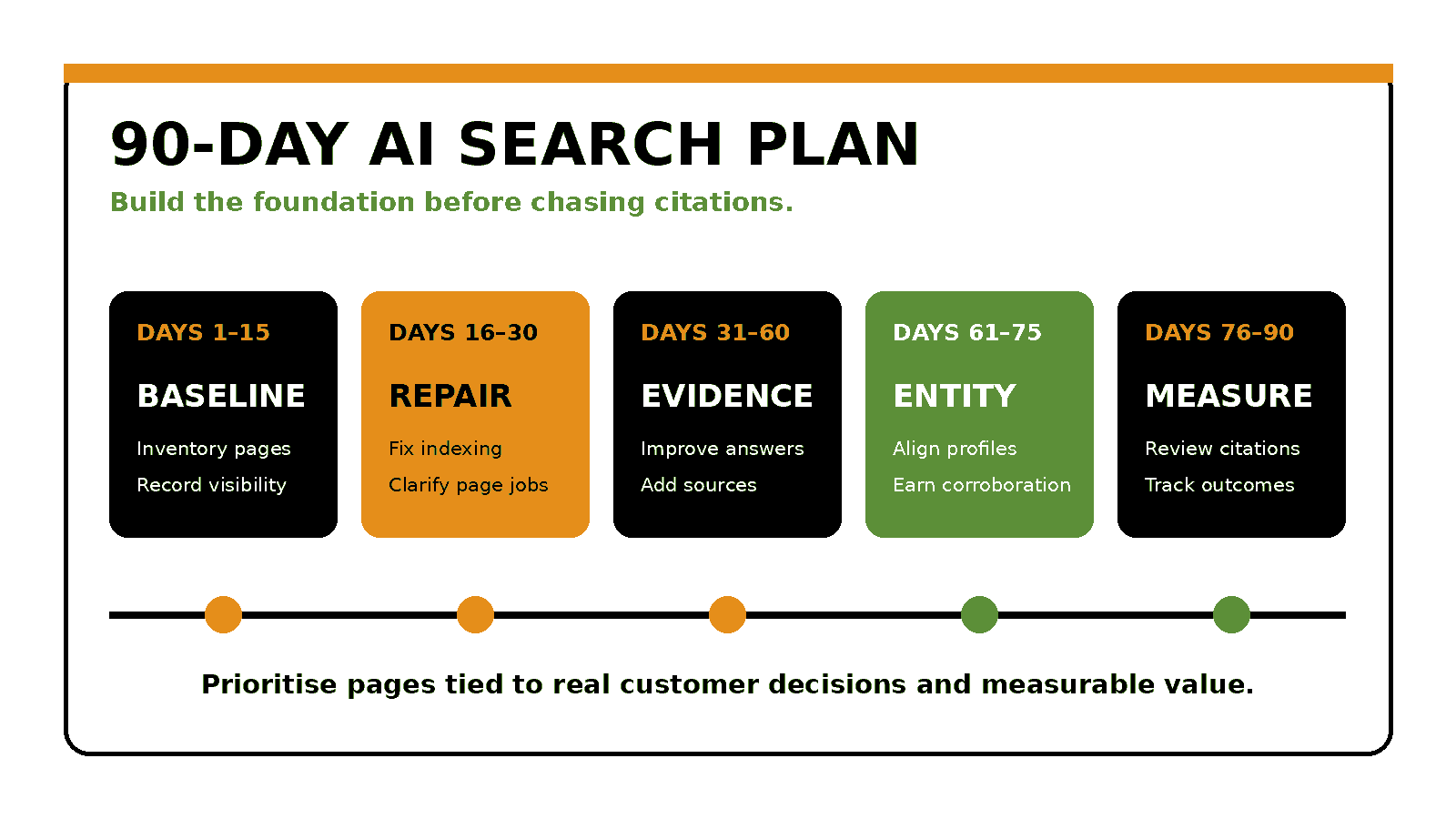
Days 1 to 15: establish the baseline
- Export the Search Console Search results and Generative AI reports.
- Identify important service, product and informational pages.
- Check indexation, snippet eligibility and canonical status.
- Record the customer questions that matter commercially.
- Run a sample AI visibility check for Kenya.
- Document current leads, bookings or sales from organic search.
Days 16 to 30: repair eligibility
Fix blocked pages, broken internal links, weak canonicals, thin service pages and inconsistent organization information.
Prioritize pages connected to real demand. Do not begin by rewriting the entire blog.
Days 31 to 60: improve the evidence layer
For each priority page:
- add a direct answer;
- expand decision-relevant sub-questions;
- verify material claims;
- add original Kenyan examples;
- improve author or reviewer information;
- apply accurate supported schema;
- connect related pages through contextual internal links;
- strengthen the next conversion step.
Days 61 to 75: build corroboration
Align Google Business Profile, directory profiles, partner pages, product feeds and other legitimate third-party sources. Correct conflicting names, addresses, categories and descriptions.
Days 76 to 90: compare and decide
Review changes in eligibility, generative-search impressions, cited pages, qualified visits and business outcomes. Keep improving pages that show useful demand. Consolidate weak duplicates. Stop tactics that create output without evidence.
Kenyan business examples
These are illustrative scenarios, not Tabala case studies or performance guarantees.
Nairobi cybersecurity consultancy
Problem: The website claims broad expertise but provides few concrete explanations or named specialists.
Action: Publish reviewed guides around common security decisions, clarify services and sectors, add expert bios, cite official standards and connect the guidance to relevant assessment services.
Measure: Generative-search impressions for relevant pages, qualified consultation requests and branded searches.
Mombasa hotel
Problem: Room information, location details and amenities differ between the website and third-party listings.
Action: Align the entity details, update room and policy pages, maintain the Google Business Profile and answer high-intent questions about transfers, parking, family suitability and conference facilities.
Measure: Visibility for travel-planning questions, direct booking enquiries and assisted bookings.
Kisumu ecommerce retailer
Problem: Product pages use supplier descriptions and omit delivery, availability and warranty details.
Action: Add original product information, KES prices, stock status, delivery coverage, return terms, Product markup and consistent Merchant Center data.
Measure: Product visibility, qualified product visits, completed purchases and revenue.
Nakuru training provider
Problem: The site lists courses but does not answer schedule, eligibility, certification or payment questions.
Action: Build complete course pages with verified details, trainer information, intake dates and a clear enquiry or application path.
Measure: Course-page visibility, application starts and qualified enrolment enquiries.
Eldoret manufacturer
Problem: Search engines can find the company but cannot easily understand product applications, specifications or service coverage.
Action: Publish product and application pages, technical specifications, delivery areas, installation requirements and expert-reviewed comparisons.
Measure: Visibility for technical questions, quotation requests and sales-qualified leads.
AI Overview readiness checklist
Technical eligibility
Content and evidence
Entity and trust
Measurement
Frequently asked questions
What are Google AI Overviews?
Google AI Overviews are AI-generated summaries that may appear in Search when Google determines that a synthesized response can help the user. They can include links to web sources and follow-up exploration.
Are Google AI Overviews available in Kenya?
Yes. Google’s Search Help documentation includes Kenya among supported locations. Availability can still vary by query, user, device and Google’s assessment of whether an overview is useful.
Does SEO still work with AI Overviews?
Yes. Google says its generative search features use core Search ranking and quality systems. Crawlability, indexation, relevance, useful content, internal links and authority remain important.
How can a Kenyan website appear in an AI Overview?
Make the page indexable and eligible for a snippet, answer a specific question clearly, provide verifiable evidence, strengthen entity information and follow normal SEO best practices. These actions improve eligibility but do not guarantee inclusion.
Do I need special schema for Google AI Overviews?
No special AI Overview schema exists. Use supported structured-data types only when they accurately describe visible content, such as Organization, LocalBusiness, Product, Article or FAQPage where appropriate.
Does Google require llms.txt?
No. Google’s official generative-search guidance says llms.txt and similar special AI files are not required for Google Search.
Can I track AI Overview visibility in Search Console?
Google Search Console’s Generative AI performance report can show impressions, pages, countries, devices and time trends when the property has sufficient eligible data.
Does ranking first guarantee an AI Overview citation?
No. Traditional ranking can support discoverability, but Google may generate no overview, cite different pages for different claims or select sources that best support the generated response. No position guarantees a citation.
Do AI Overviews reduce website clicks?
They can satisfy some informational needs without a click, while source links can also create discovery. Measure your own query, page, generative-search and conversion data rather than applying a universal traffic assumption.
Summary and next step
Google AI Overviews do not make SEO obsolete. They raise the standard for what useful visibility means.
A Kenyan business still needs technically accessible pages, accurate information, helpful content and authority. It also needs clearer answers, stronger entity consistency, evidence that can be checked and measurement that distinguishes impressions from commercial outcomes.
Begin with eligibility. Confirm that priority pages can be crawled, indexed and shown with snippets. Improve the pages that answer commercially relevant questions. Align the business information across the website and wider search ecosystem. Then measure generative-search visibility alongside qualified enquiries, bookings and sales.
If you are unsure where the constraint sits, run Tabala’s AI Visibility Audit. It helps identify whether the main weakness is technical access, content clarity, entity consistency, trust or measurement.
For implementation support across technical SEO, structured data, entity clarity and answer-led content, review Tabala’s AI Search Optimization Services in Nairobi.
Accelerate Your Revenue
While Revenue Intelligence builds long-term authority, Google Ads delivers immediate, high-intent traffic. Combine both for maximum market dominance.

Strategist Profile
Abala Tom
Digital systems strategist specializing in high-performance SEO, Google Ads, and conversion optimization. Mission: to replace marketing 'guesswork' with predictable revenue systems.