AI-Ready Website Content Checklist for Kenyan Businesses
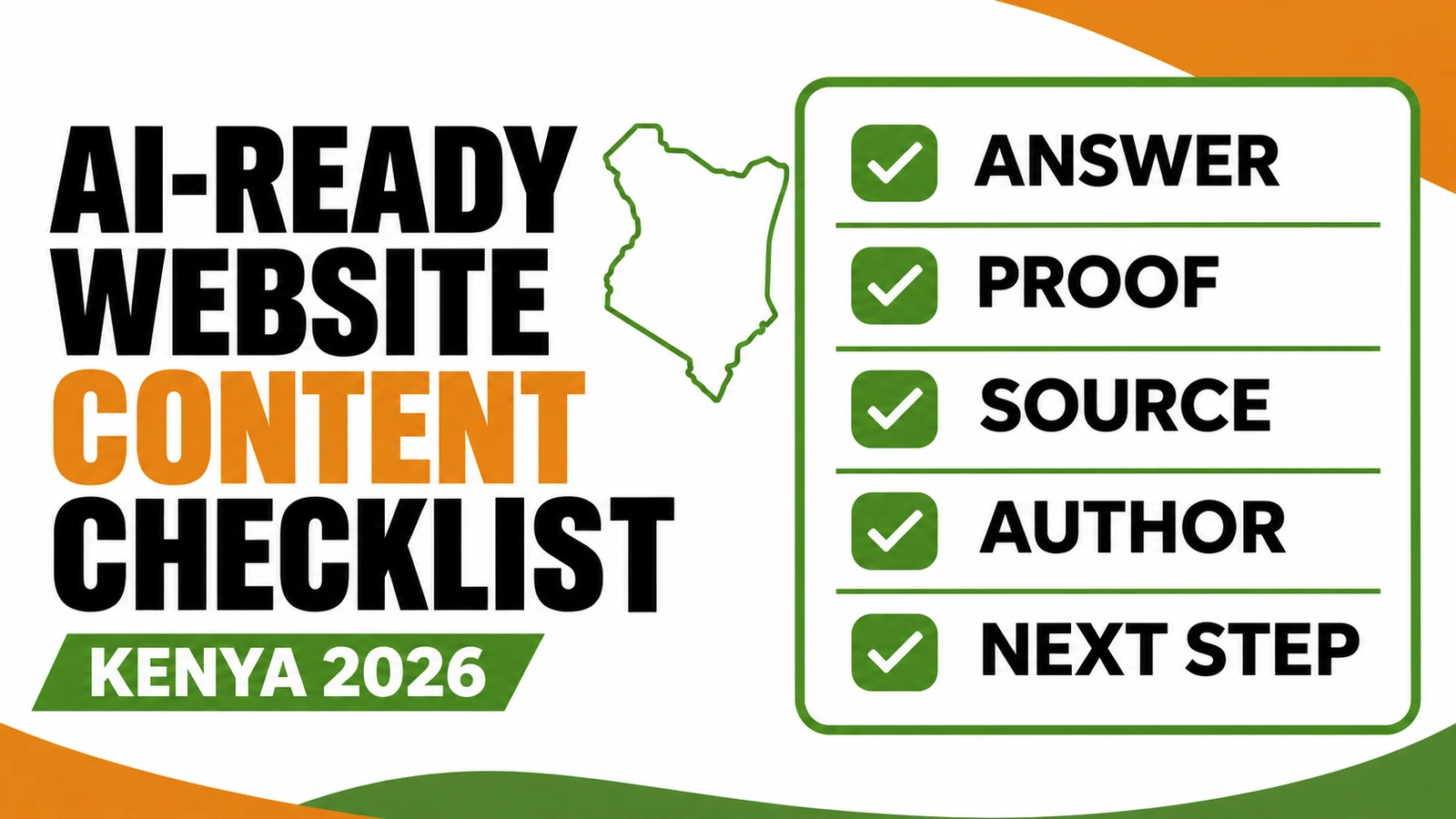
AI-Ready Website Content Checklist for Kenyan Businesses
A polished website can still fail the moment a buyer asks an AI-assisted search tool for advice. The page may bury the answer under generic marketing copy, describe the business differently from one section to another, cite no evidence, show important facts only inside images, or leave the reader unsure who wrote the content and what to do next.
The commercial cost is wider than losing an AI citation. The same weaknesses make it harder for Google to understand the page, harder for a potential customer to trust it and harder for the website to turn visibility into an enquiry.
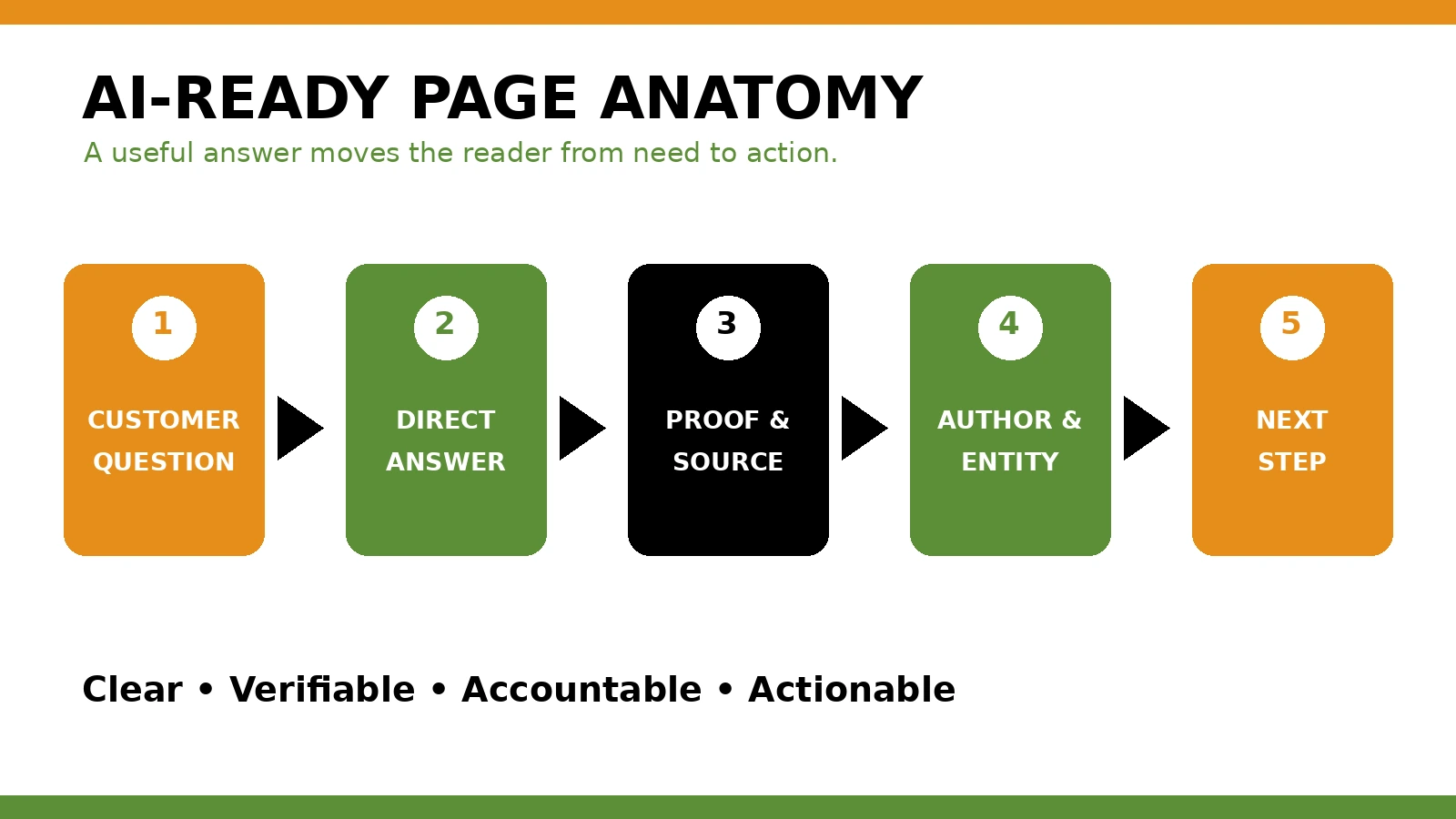
An AI-ready content check therefore should not ask whether a page sounds robotic enough for a machine. It should ask whether a real customer can quickly find an accurate answer, verify the proof, understand who provides the service and take the next appropriate step.
This checklist gives Kenyan businesses a practical pre-publish and refresh process for service pages, location pages, articles, product guides and high-value landing pages.
Quick answer
AI-ready website content is clear, original, accurate, well sourced and easy to navigate. It answers a real customer need, gives enough context to complete the task, identifies the author or responsible business, uses consistent entity information, links to relevant supporting pages and offers an appropriate next step.
For Google Search, there is no special AI schema, compulsory llms.txt file, ideal word count or required writing style. Google’s 2026 guidance says normal SEO foundations remain relevant, unique non-commodity content matters, and content should be made for people rather than rewritten for a generative system.
Use this 12-part check:
- confirm the page’s audience, intent and unique role;
- answer the main question early;
- add original experience, proof or analysis;
- make important facts specific and consistent;
- show who created or reviewed the content;
- use a clear heading and section structure;
- support current claims with authoritative sources;
- keep essential information in accessible text;
- connect the page to its topic cluster;
- apply accurate structured data where eligible;
- assign an owner and review date; and
- give the reader a useful next step.
Key takeaways
- AI-ready content starts with reader usefulness, not an AI writing trick.
- A direct answer helps only when the rest of the page provides enough evidence and context.
- Original experience, analysis, examples and first-party evidence are stronger than a rewritten summary of existing search results.
- Important service facts should be consistent across the page, website and external business profiles.
- Authorship, review responsibility and source links help readers assess trust.
- Structured data must match visible content and does not guarantee a rich result or AI citation.
- Technical eligibility still matters, but this checklist complements the existing technical SEO audit instead of duplicating it.
- A page should end with a next step that matches the reader’s intent, such as an audit, consultation, quote, visit, purchase or related guide.
What AI-ready website content means
AI-ready website content is content that people can understand and verify, and that search or answer systems can access within a technically eligible page. It makes the subject, audience, business, evidence and next step unambiguous.
Google’s current guide to optimizing for generative AI features says its generative Search experiences use core Search ranking and quality systems. The guide prioritises unique, useful, non-commodity content and warns against producing many pages for minor query variations.
That leads to a useful operating principle:
A page is AI-ready when it is good enough to help the intended customer even if no AI system ever quotes it.
This definition prevents a checklist from becoming a set of extraction tricks. Short sections, lists and direct answers can improve usability, but they cannot compensate for thin advice, unsupported claims or a page that exists only to capture traffic.
For a Nairobi law firm, an AI-ready employment-law guide should identify the legal question, state which jurisdiction it covers, use current official sources, show who reviewed it and explain when a reader needs individual advice. For a Mombasa hotel, a location page should state the real location, room or event offer, access details, booking conditions and contact path. For a Kisumu equipment supplier, a product guide should distinguish specifications, installation requirements, warranty terms and availability.
Different pages need different evidence. The checklist evaluates whether the page provides the evidence its decision requires.
How this checklist differs from technical SEO
Content readiness and technical eligibility work together, but they are not the same task.
The technical SEO checklist for Kenyan websites checks whether search systems can crawl, render, index and canonicalise a page correctly. It covers status codes, robots directives, JavaScript rendering, sitemaps, internal architecture, mobile behaviour and related technical risks.
This article checks the page after that foundation:
| Technical SEO asks | Content readiness asks |
|---|---|
| Can the page be crawled and indexed? | Does the page answer a useful customer need? |
| Is the canonical URL correct? | Is this the right page to own the topic? |
| Can Google render the main content? | Are important facts visible and understandable? |
| Does structured data validate? | Does the markup accurately represent the visible page? |
| Do internal links expose the page? | Do those links guide the reader through a useful topic journey? |
If a page is blocked, duplicated or non-canonical, fix the technical problem first. The free SEO audit can identify common eligibility and content-structure gaps. If the page is technically accessible but generic, inaccurate or commercially unclear, use this checklist.
Check 1 Define the page role and search intent
Every page needs one primary job. A service page should help a qualified buyer understand and evaluate the service. An article should answer a specific question or help complete a task. A location page should prove local relevance and explain how the offer applies there. A product guide should support comparison or use.
Before editing, write down:
- the primary audience;
- the problem or decision;
- the main intent;
- the page type;
- the one topic the page should own;
- the service or cluster it supports; and
- the intended next action.
Check for an existing owner
Search the live site and the editorial inventory before creating a new URL. If another page already satisfies the intent, refresh or consolidate it. Publishing two similar pages about AI content for Kenyan businesses can split internal links, confuse the reader and make it unclear which page should rank.
The protected AI Search Optimization service page owns the commercial service query. This checklist owns the practical page-review task. It supports the service page without changing the service URL, canonical, navigation position or conversion role.
Do not force every city into one page
Mention Nairobi, Mombasa, Kisumu, Nakuru or Eldoret when the example, service area or buyer condition genuinely differs. City repetition is not local proof. A useful local page needs specific delivery information, relevant examples, accurate contact details and a reason the location matters.
Check 2 Answer the main question early
A reader should not need to cross three paragraphs of scene-setting before learning what the page will help them do.
Use the opening to establish:
- the business problem;
- the consequence of leaving it unresolved;
- the direct answer or recommended action; and
- what the page covers.
An answer-first opening does not mean every page must begin with a dictionary definition. For commercial pages, lead with the buyer’s problem and the outcome. For guides, provide a concise answer after the problem is clear.
Replace vague claims with useful specifics
Weak copy:
We provide innovative, world-class digital solutions tailored to your needs.
Stronger copy:
We help Nairobi service businesses improve Google and AI search visibility by fixing crawlability, service-page structure, entity consistency and answer-led content.
The stronger version identifies the audience, location, outcome and work involved. It gives the reader information that can be checked.
Complete the task, not just the snippet
A direct answer is the start of the page, not the whole page. Google’s helpful content guidance asks whether readers leave feeling they learned enough to achieve their goal. Add the conditions, steps, risks, examples and decision criteria needed to complete the task.
Check 3 Add original evidence and experience
Generic summaries are easy to reproduce. A useful page adds something that comes from the organisation’s work, analysis or direct knowledge.
Original value can include:
- a documented process;
- a decision framework;
- a before-and-after explanation;
- a real implementation constraint;
- a Kenyan market example;
- first-party research or anonymised data;
- an expert interpretation of official guidance;
- an original diagram;
- a checklist developed from repeated delivery; or
- a clear explanation of what did not work and why.
Do not invent a case study, client result or statistic to make the page feel authoritative. If client permission or reliable measurement is missing, use a labelled hypothetical example.
Show the evidence behind numbers
For every number, ask:
- Where did it come from?
- What period does it cover?
- What sample or account does it represent?
- Is it still current?
- Does the linked source support the exact claim?
- Is it a general benchmark or a selected internal result?
A Nairobi ecommerce store should not treat another market’s conversion benchmark as a Kenyan guarantee. Explain the context and use KES when discussing local budgets or prices.
AI-assisted drafting still needs human value
Google’s guidance on generative AI content says automated content must meet accuracy, quality and relevance standards. It specifically calls for fact-checking the page and its metadata, structured data and image alt text.
Use AI for research support, structure or alternative phrasing where appropriate. A knowledgeable human should still verify facts, remove generic claims, add the organisation’s experience and accept responsibility for publication.
Check 4 Make facts and entities consistent
Entity consistency means the page describes the organisation, people, service, product and location in a stable and accurate way.
Check the page against:
- the homepage;
- service pages;
- About and contact pages;
- Google Business Profile;
- social profiles;
- professional or sector directories;
- product or service documentation; and
- current legal business details.
Review names, spelling, office location, service area, phone number, opening hours, qualifications, pricing conditions, product specifications and availability.
Distinguish similar services
If a business offers SEO, AI Search Optimization and Google Ads, explain the role of each service instead of treating them as interchangeable. Clear boundaries help buyers choose correctly and reduce contradictory descriptions across the site.
State conditions
Facts often depend on a location, package, customer type or date. Write those conditions into the page.
For example:
- “In-person consultations are available in Nairobi; other Kenyan engagements are delivered remotely.”
- “The KES price excludes media spend.”
- “Delivery time begins after content and access are received.”
- “This guidance applies to Kenya as of November 2026.”
Conditions reduce ambiguity and make future updates easier.
Check 5 Make authorship and accountability visible
Readers should know who created or reviewed content when authorship is relevant.
Google recommends evaluating content through “Who, How and Why.” Its guidance encourages accurate bylines that lead to information about the author’s background where readers would expect them.
For an expert article, include:
- author name;
- relevant role or subject expertise;
- link to an author or About page;
- publication date;
- material update date;
- reviewer where specialist review is needed; and
- a short method or disclosure when automation materially shaped the content.
Do not add an impressive title that the author does not hold. Do not use a generic “Admin” byline for advice where accountability matters.
Match the reviewer to the risk
A marketing strategist can explain content structure. A lawyer should review legal interpretation. A clinician or qualified health professional should review medical claims. A tax adviser should review tax advice.
For regulated or high-stakes topics, the page should also explain that general information does not replace individual professional advice.
Check 6 Structure the page for people
Use structure to help the reader scan, understand and return to the page.
Check that:
- the title describes the page accurately;
- there is one clear H1;
- H2 headings divide the major decisions or steps;
- H3 headings organise supporting detail;
- headings are meaningful outside the table of contents;
- paragraphs develop one main idea;
- lists are used for genuinely parallel items;
- tables are reserved for comparisons and structured records; and
- the page avoids repeated introductions or conclusions.
There is no required AI-friendly sentence length or ideal word count. Google explicitly says there is no ideal page length for generative Search. Use the length needed to satisfy the intent.
Use question headings selectively
Question headings work well for genuine customer questions, especially FAQs and decision points. They should not replace every descriptive heading. “Pricing and exclusions” may be clearer than forcing “What pricing and exclusions do you have?”
Keep meaning around the answer
Do not cut every idea into tiny fragments because someone claimed AI systems require chunking. Google’s current guidance says there is no such requirement. Use natural sections that hold a complete idea and remain easy for people to follow.
Check 7 Source claims properly
Link to the original or authoritative source when a claim depends on policy, law, product documentation, research or current platform behaviour.
Source priority should usually be:
- official government or regulator;
- original platform documentation;
- primary research or dataset;
- recognised professional body;
- credible secondary analysis.
Use descriptive anchor text so the reader knows what supports the claim. “Google’s structured data guidelines” is more useful than “read more.”
Verify the source supports the sentence
A source can be reputable and still fail to support the claim. Open it, check the date and confirm that the linked section says what the page asserts.
Keep current claims current
Platform features, regulations and prices can change. Add a review date to pages that depend on them. If the claim is no longer verifiable, update or remove it rather than changing the page date without changing the content.
Check 8 Make media support the answer
Images, diagrams and video should explain something the text cannot convey as efficiently.
For every image:
- give it a clear purpose;
- use descriptive alternative text;
- keep essential facts in the surrounding HTML text;
- compress the file appropriately;
- use suitable dimensions;
- avoid placing long paragraphs inside graphics;
- avoid decorative filler between every section; and
- verify that captions and alt text match the final image.
If a graphic contains a checklist, repeat the actionable items as text. A reader using assistive technology and a search system parsing the page should not depend on pixels to access the core information.
For a service process, an original diagram can clarify sequence and ownership. For a product, accurate photos and labelled specifications may matter more. For a location page, genuine premises or service-area imagery is stronger than a generic skyline.
Check 9 Build useful internal links
Internal links should help the reader take the next logical step and help the site maintain clear topic relationships.
Each page should usually connect to:
- its relevant service page;
- the relevant audit or diagnostic;
- a parent or pillar article;
- a supporting guide that explains a concept in more depth; and
- a cross-cluster page where the journey genuinely overlaps.
Use descriptive anchors. Link “technical SEO checklist for Kenyan websites” instead of “click here.”
Make the cluster bidirectional
After publishing a supporting article, review older live pages for a useful reverse link. Add the link only when the new destination is public and verified. Do not link to a guessed or package-ready URL.
This checklist should eventually receive reverse links from the AI Search service page, the technical SEO checklist and relevant AI marketing pillar content. Yesterday’s measurement article should link here only after both URLs are live.
The AI marketing pillar can provide broader context, but it should remain the strategic overview rather than repeat the full checklist.
Check 10 Use structured data accurately
Structured data can help Google understand eligible page information and support rich-result features. It is not a general AI citation switch.
Google’s structured data guidelines require markup to represent visible page content accurately. Correct markup does not guarantee a rich result.
For a guide like this, suitable types may include:
- BlogPosting or Article;
- BreadcrumbList; and
- FAQPage when the visible page contains matching questions and answers.
Use Service, Product, LocalBusiness, Organization or other types only when the page and required properties justify them.
Validate the final page
Check:
- required and recommended properties;
- dates and author information;
- canonical URL;
- image URL;
- visible FAQ matches;
- business name and URL;
- duplicate or conflicting schema blocks; and
- Rich Results Test and Search Console reports after publication.
Do not put claims, ratings or FAQs in JSON-LD that users cannot see on the page.
Check 11 Govern freshness and updates
Freshness is not a date label. It is a content-management process.
Every important page should have:
- an owner;
- an evidence source;
- a review trigger;
- a review frequency;
- a last material update date; and
- a record of what changed.
Review triggers may include a platform update, legal change, price change, product change, office move, new case study, performance decline or inaccurate AI-generated answer.
Prioritise pages by risk and value
| Page type | Suggested review trigger | Why |
|---|---|---|
| Legal, tax or medical guidance | Regulatory or professional update | Accuracy risk is high |
| Service and pricing page | Offer, scope or fee change | Direct buyer impact |
| Software or platform guide | Material interface or policy change | Instructions can expire quickly |
| Evergreen strategy guide | Search performance or evidence change | Insight can remain valid longer |
| Location page | Address, hours or service-area change | Local trust depends on accuracy |
Do not change the date merely to make an old page appear new. Google lists that behaviour as a warning sign when the content has not materially changed.
Check 12 Match the call to action to intent
The next step should fit what the reader is ready to do.
| Reader intent | Useful next step |
|---|---|
| Learning a concept | Related guide or checklist |
| Diagnosing a problem | Audit or self-assessment |
| Comparing providers | Service process, proof and consultation |
| Evaluating a product | Specification, demo, quote or purchase |
| Seeking local help | Call, WhatsApp, directions or booking |
For this article, the primary next step is the AI Visibility Audit, because it helps the reader identify which content, entity and technical gaps matter first. The secondary path is the AI Search Optimization service for implementation.
A strong CTA states what happens next. “Run the AI Visibility Audit” is clearer than “Learn more.” Do not promise a guaranteed citation, ranking or revenue result.
Score an existing page
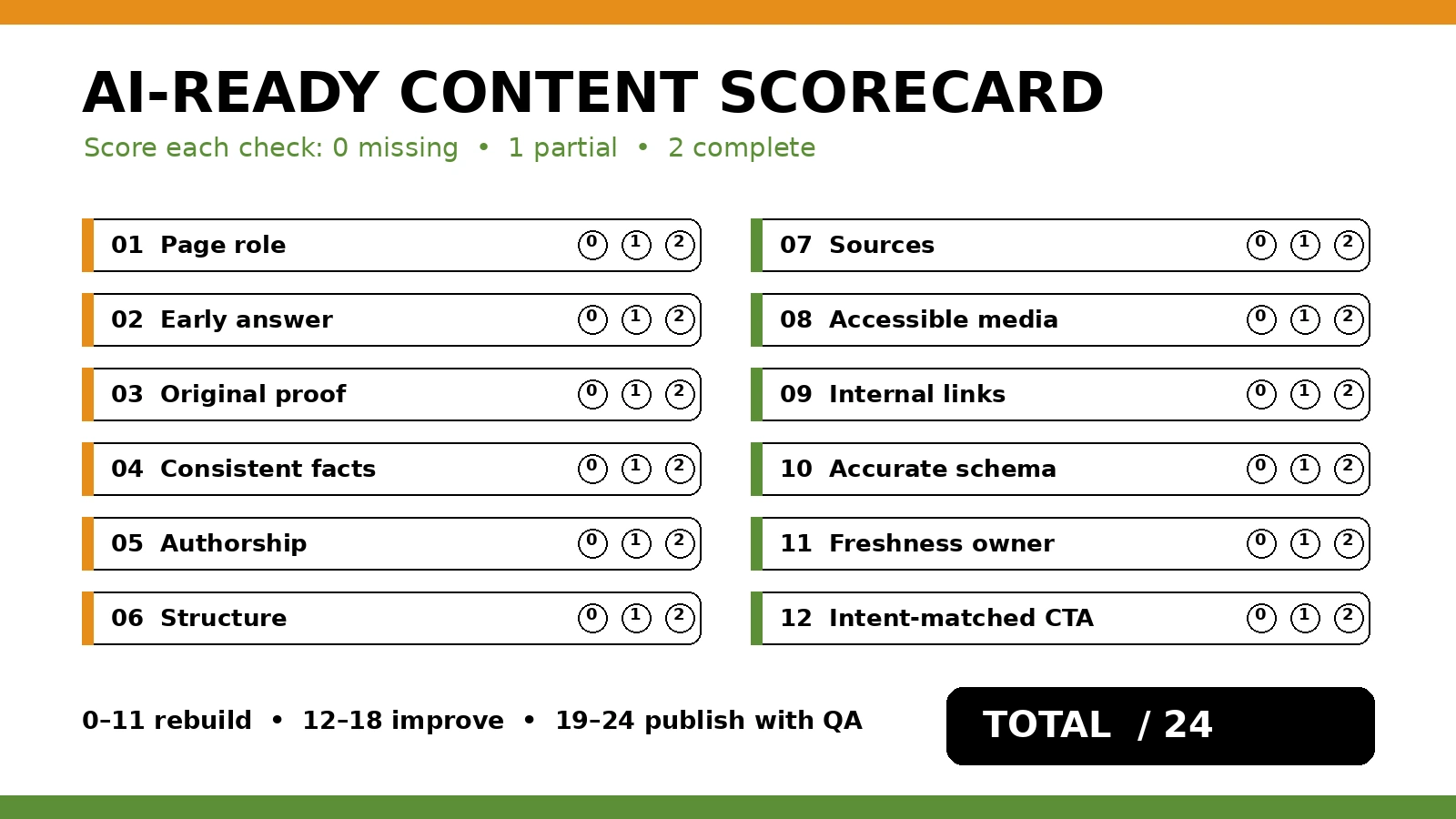
Use a simple 0 to 2 score for each of the 12 checks:
- 0: missing or materially incorrect;
- 1: present but incomplete, unclear or unverified;
- 2: complete, accurate and useful.
| Score | Interpretation | Action |
|---|---|---|
| 0 to 8 | Not ready | Correct foundational content and technical blockers |
| 9 to 16 | Partly ready | Prioritise evidence, clarity and consistency gaps |
| 17 to 21 | Strong base | Improve the lowest-scoring sections and measurement |
| 22 to 24 | Publishing ready | Publish, monitor and maintain |
This is a Tabala editorial diagnostic, not an official Google or AI-platform score. It should guide work, not become a ranking guarantee.
Review the highest-value pages first
Start with:
- pages that generate qualified enquiries;
- pages with existing impressions but weak clicks or conversions;
- pages near page one for valuable queries;
- service pages needed by sales;
- pages cited or surfaced in AI features;
- outdated high-authority articles; and
- pages that conflict or compete with each other.
Without current Search Console and SEMrush exports, this prioritisation remains provisional. The SEO services team in Nairobi can combine content remediation with query, page and technical evidence once the required exports are available.
Kenyan page examples
Nairobi professional service page
A Nairobi executive-recruitment page should specify the roles served, employer profile, search process, confidentiality boundaries, geographic coverage, evidence of experience and how a qualified employer starts a conversation. A broad “we find the best talent” claim is too generic.
Mombasa hospitality page
A Mombasa hotel event page should state venue capacity, accommodation options, location access, what is included, booking conditions, image captions and enquiry path. Seasonal offers need valid dates and exclusions.
Kisumu product guide
A Kisumu solar or equipment guide should separate product specifications, installation conditions, warranty, service coverage, pricing assumptions and safety guidance. Important specifications should appear as text, not only inside a brochure image.
Nakuru location page
A Nakuru location page should contain unique local service information. Changing only the city name across copied pages creates little value and increases duplication risk.
Eldoret healthcare content
Healthcare information for Eldoret readers should use qualified review, current authoritative sources, careful limitations and a clear path to professional care. It should not use AI-generated claims without clinical verification.
For businesses rebuilding both content and the conversion journey, website development services in Nairobi can align page structure, mobile usability, forms, tracking and content presentation.
Common AI-ready content mistakes
Treating direct answers as a formula
A direct answer helps orientation. Repeating short definitions under every heading without insight creates thin content.
Adding FAQ schema to hidden or invented questions
FAQ markup should match visible questions and answers. Do not add questions only inside schema.
Publishing many city variations
Location pages need unique service evidence, not only a changed place name.
Mistaking a plugin for readiness
No plugin can replace clear intent, accurate content, expert review, internal linking and technical eligibility.
Treating llms.txt as a Google requirement
Google’s current generative Search guide says it does not use llms.txt and that the file does not improve Google rankings or generative visibility.
Hiding key information in graphics
Prices, hours, specifications and service conditions should also exist as accessible page text.
Using fabricated proof
Invented statistics, testimonials, awards or case studies create legal, trust and reputational risk.
Rewriting content only for AI systems
Google says website owners do not need a special writing style for generative Search. Write for the intended customer and maintain normal SEO foundations.
In-body diagnostic
Find the highest-priority gaps before rewriting every page. Run Tabala’s AI Visibility Audit to assess content clarity, entity consistency, technical readiness and AI-search visibility. Use the results to decide which service pages and articles need attention first.
Complete pre-publish checklist
Page role and intent
Answer and usefulness
Originality and proof
Entity and authorship
Sources and media
Internal links and structured data
Conversion and maintenance
Frequently asked questions
What makes website content AI-ready?
AI-ready website content clearly answers a real customer need, provides original and accurate information, identifies relevant people or organisations, links to reliable evidence, uses a helpful structure and remains accessible on a technically eligible page.
Does AI-ready content need a special writing style?
No. Google says website owners do not need to rewrite content in a special style for generative Search. Use clear language and a natural structure that helps the intended reader.
Do I need an llms.txt file for Google AI Overviews?
No. Google’s current guidance says Google Search does not use llms.txt, and the file does not help or harm visibility in Google Search or its generative features.
Does schema make a page appear in AI answers?
No. There is no special schema required for generative Search, and valid structured data does not guarantee a rich result or AI citation. Use accurate schema to represent visible page content and support eligible search features.
How long should an AI-ready article be?
There is no ideal word count. The page should be long enough to satisfy the intent without filler. A narrow answer may be short; a high-stakes or complex decision may require more explanation and evidence.
Should every heading be a question?
No. Use questions for real customer questions and descriptive headings for sections such as pricing, exclusions, implementation steps or evidence. Clarity matters more than a fixed template.
Can AI write the whole page?
AI can assist with research, structure and drafting, but a responsible human should verify facts, sources, examples, metadata, structured data and alt text before publication. The final page should add expertise or experience beyond a generic generated summary.
How often should website content be reviewed?
Review frequency depends on risk and change. Legal, medical, tax, pricing and platform guidance need review when the underlying rules change. Evergreen strategic content can follow a longer cycle, with performance or factual changes acting as triggers.
What should a Kenyan business audit first?
Start with high-value service and product pages, pages already receiving Search impressions, pages close to page one, pages supporting sales and outdated articles with authority. Use Search Console and SEMrush data where available rather than choosing by search volume alone.
Summary
AI-ready content is not a new format placed on top of weak website copy. It is a quality and governance standard.
Define the page’s job. Answer the customer early. Add original evidence. Keep business facts consistent. Show who owns the content. Use sources, media, internal links and structured data accurately. Give the reader a next step that matches the intent, then assign someone to keep the page current.
The same work supports human trust, conventional search visibility, AI-assisted discovery and conversion.
Run Tabala’s AI Visibility Audit to identify the pages and signals that need attention first. When implementation requires coordinated content, entity, technical SEO and measurement work, review Tabala’s AI Search Optimization services in Nairobi.
Accelerate Your Revenue
While Revenue Intelligence builds long-term authority, Google Ads delivers immediate, high-intent traffic. Combine both for maximum market dominance.

Strategist Profile
Abala Tom
Digital systems strategist specializing in high-performance SEO, Google Ads, and conversion optimization. Mission: to replace marketing 'guesswork' with predictable revenue systems.