12 AI Marketing Mistakes Kenyan Businesses Must Fix

12 AI Marketing Mistakes Kenyan Businesses Must Fix
AI can make a weak marketing system fail faster.
A business buys several tools, publishes more content, switches on automated ads and installs a chatbot. Activity rises, but sales do not. The website still has an unclear offer. Lead tracking still treats every WhatsApp click as revenue. Customer information is copied into tools without a policy. The chatbot answers questions it cannot verify. Nobody owns the final review.
The commercial problem is not that artificial intelligence failed. The business accelerated work it had not defined, measured or governed.
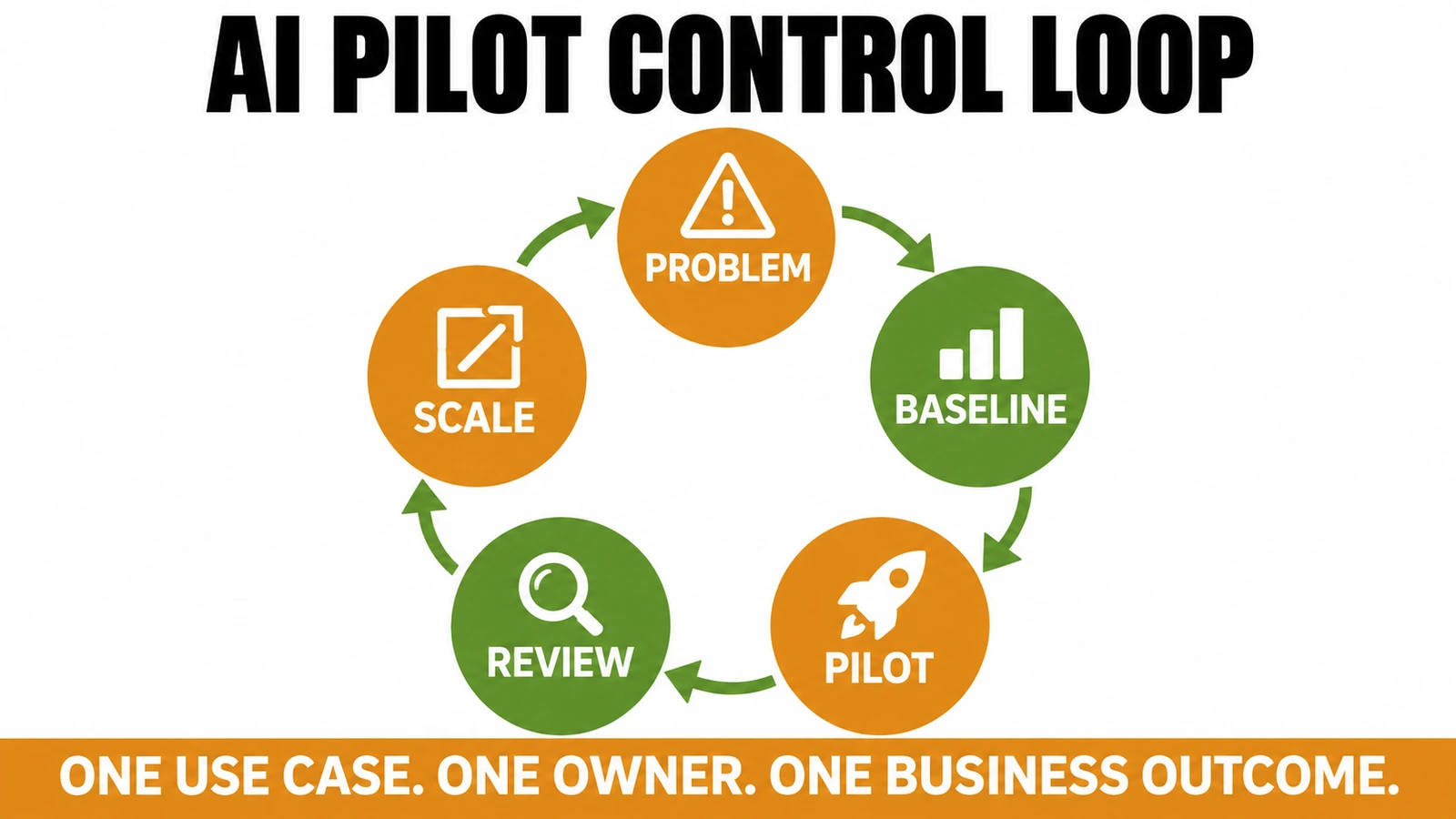
For a Kenyan SME with limited cash and a small team, that mistake can consume marketing budget, weaken trust and create privacy or compliance exposure. The safer approach is to choose one business problem, establish a baseline, run a controlled pilot, keep a human accountable and scale only after the result is proven.
This guide explains 12 common AI marketing mistakes Kenyan businesses make, how to diagnose each one and what to do instead.
Quick answer
The most expensive AI marketing mistake is adopting a tool before defining the business problem and the outcome that should improve. That error creates the others: generic content, unsafe data handling, poorly governed automation, bad ad signals, inconsistent brand information and reporting that counts output instead of revenue.
Use this control sequence:
- define one commercial problem;
- record the current baseline;
- choose the smallest appropriate tool;
- set data, review and approval rules;
- run a limited pilot;
- measure qualified business outcomes; and
- scale only after the pilot works.
Key takeaways
- AI is an execution capability, not a marketing strategy.
- More content is not useful when the offer, audience or evidence is unclear.
- A human reviewer should be named before any AI-assisted asset is published.
- Customer, employee and confidential business data need a documented handling rule.
- Ad automation learns from the conversion signals supplied to it. Weak signals can produce efficient-looking waste.
- A chatbot needs approved knowledge, boundaries and a clear handoff to a person.
- Brand, service, location and contact facts must remain consistent across channels.
- The useful measurement chain is output to response to qualified opportunity to sale, not output alone.
- One controlled pilot produces better learning than five disconnected subscriptions.
What AI marketing means in practice
AI marketing is the use of machine-learning or generative systems to support decisions and tasks across research, content, advertising, customer communication, personalization, lead management and reporting.
For a Nairobi professional-services firm, that might mean drafting first versions of articles, summarising sales calls or grouping enquiries by service. For a Mombasa hotel, it could mean preparing multilingual response drafts, analysing booking questions or improving campaign assets. A Kisumu retailer might use product-description assistance, demand forecasting or ad automation. A Nakuru clinic might use approved reminder workflows, while an Eldoret B2B supplier might use lead research and proposal support.
These examples have different risk levels. Formatting a draft is not the same as answering a medical question, deciding who qualifies for credit or automatically changing an advertising budget. The workflow, evidence and human review should match the risk.
The live Tabala AI marketing pillar explains the broader opportunity and risks. This article has a narrower job: finding operational mistakes before they damage trust, budget or results.
Mistake 1: Buying tools before defining the problem
The business starts with a product category: “We need an AI chatbot,” “We need an AI content tool,” or “We should automate our ads.” It has not defined the delay, cost or missed revenue the tool should correct.
That makes every result hard to judge. A chatbot may reduce response time while producing poor answers. A content tool may double output while qualified traffic stays flat. An automation platform may save an employee three hours but add a larger review burden.
Fix it with a business-case sentence
Complete this sentence before selecting a tool:
We will use AI to improve [one process] for [one audience], moving [one baseline metric] toward [one target] within [one review period], while [named owner] remains accountable.
An example for a Nairobi property firm:
We will use an approved response assistant to help the sales desk answer common rental questions during working hours, reducing median first-response time from the measured baseline over a four-week pilot, while a sales representative approves any pricing, availability or contract answer.
The target must come from the business’s baseline. Do not invent an industry benchmark and present it as a guarantee.
If the problem spans the website, ads, search visibility and follow-up, use the Business Diagnostic before buying another tool. It helps identify the constraint that needs attention first.
Mistake 2: Asking AI to fix an unclear strategy
AI can produce options quickly. It cannot decide what the business should stand for when the leadership team has not agreed on the audience, offer, proof, price, market and next action.
An unclear prompt often exposes an unclear business decision:
Write a social media campaign for our company. Make it engaging and viral.
The system can generate attractive copy, but it does not know which buyer matters, what commercial problem the offer solves, what evidence can be used or what a qualified enquiry looks like.
Fix the strategy inputs first
Define:
- the priority audience;
- the problem and buying trigger;
- the offer and exclusions;
- the evidence available;
- the channel’s role;
- the conversion action; and
- the sales follow-up process.
The digital marketing services framework treats content, search, paid media and website conversion as parts of one revenue system. That integration is more useful than asking separate AI tools to generate disconnected activity.
Mistake 3: Publishing generic content at scale
The business uses AI to turn one broad topic into dozens of articles, service pages or city variations. The pages repeat common advice, add no local evidence and exist mainly to capture search traffic.
Google’s spam policies define scaled content abuse as producing many pages primarily to manipulate rankings rather than help users, regardless of whether the pages were created by AI, humans or both. Google’s generative AI content guidance says AI can help with research and structure, but pages still need accuracy, quality, relevance and added value.
Add value that cannot come from a generic prompt
Useful additions include:
- a documented operating process;
- a Kenyan customer or market constraint;
- original analysis;
- a permissioned case example;
- a decision framework;
- a calculator or checklist;
- direct experience with implementation;
- a comparison based on defined criteria; and
- current primary sources.
The question is not whether AI touched the draft. The question is whether the final page gives the intended reader a useful reason to trust and use it.
Mistake 4: Removing human review
Speed creates a tempting shortcut: publish the output because it reads well. That is especially dangerous when the content includes prices, legal obligations, health information, product specifications, financial claims, client results or current platform rules.
A fluent sentence can still be wrong, outdated, unsupported or inappropriate for the audience.
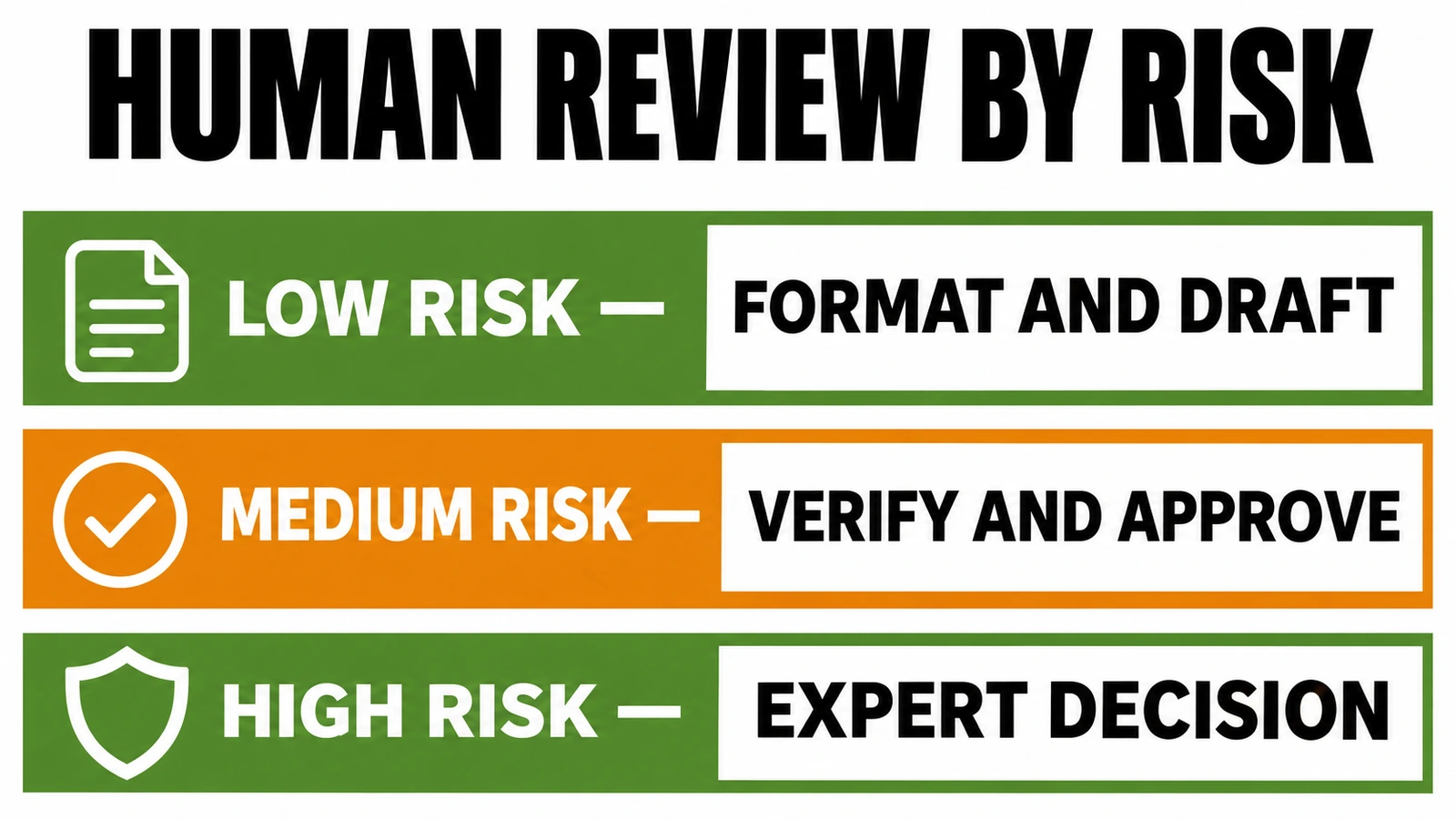
Assign review by risk
| Risk level | Example | Required control |
|---|---|---|
| Low | Reformatting approved copy | Spot-check and brand review |
| Medium | Article, email or advert draft | Source verification and named approval |
| High | Legal, health, financial or eligibility guidance | Qualified expert review before use |
Google’s people-first content guidance recommends making it clear who created content, how it was produced when that matters, and why it exists. A named author or reviewer should accept responsibility for the final asset.
Mistake 5: Using customer or confidential data carelessly
An employee pastes a customer spreadsheet, medical message, sales call, contract, payroll file or unpublished campaign plan into an unapproved tool. The output may be useful, but the business has not checked the product terms, account type, retention controls, access permissions or legal basis for processing.
Kenya’s Office of the Data Protection Commissioner has warned about increased collection, lack of informed consent and unauthorised use of personal data in AI systems. It recommends assessing the relationship between the processing activity and AI, protecting data-subject rights, implementing safeguards and conducting a Data Protection Impact Assessment where necessary.
Create a data-handling rule
Classify information before use:
| Data category | Examples | Default action |
|---|---|---|
| Public | Published website copy, public product details | May be used within the approved workflow |
| Internal | Draft strategy, internal performance notes | Use only in approved business tools and accounts |
| Confidential | Contracts, pricing models, credentials | Do not upload without explicit approval and controls |
| Personal or sensitive | Customer records, health, ID, payroll | Apply legal, security and minimum-necessary review |
Product and account type matter. OpenAI, for example, states that data from its business products and API is not used to train its models by default. That statement should not be copied to every consumer tool or plan. Review the actual terms and settings of the product being used.
This section is general operational guidance, not legal advice. High-risk processing should be reviewed by a qualified data-protection professional.
Mistake 6: Launching a chatbot without boundaries
A chatbot is connected to WhatsApp or a website and told to “answer customer questions.” It has no approved knowledge base, no list of prohibited answers, no confidence threshold and no human handoff.
That system may invent availability, quote the wrong price, overstate a refund policy, give unsafe advice or continue arguing with a frustrated customer.
Define what the bot may do
A controlled assistant should have:
- an approved source of answers;
- a clear identity as an automated assistant where appropriate;
- a limited scope;
- a list of subjects that require a person;
- a human-escalation route;
- a transcript and incident-review process;
- consent and communication rules; and
- an owner who updates the knowledge.
For a Mombasa hotel, the bot may explain published room types and collect booking details. A person should confirm current availability, special rates, complaints and exceptions. For a clinic, the bot may provide approved administrative information but should not diagnose a patient.
Mistake 7: Automating ads with bad conversion signals
Google Ads and other platforms can automate bids, audiences, assets and budget allocation. The automation is only as commercially useful as the objective and signals supplied.
Google states that Smart Bidding uses conversion tracking data to optimize for conversions or conversion value. If page views, WhatsApp clicks, duplicate forms or test purchases are treated as primary conversions, the system can become efficient at generating the wrong action.
Repair measurement before scaling
Separate:
- page visits;
- engaged sessions;
- contact clicks;
- completed enquiries;
- qualified leads;
- appointments or proposals;
- purchases; and
- revenue or margin.
Use the Google Ads conversion-tracking checklist for Kenya to verify completed outcomes, values, currency, transaction IDs and duplicate prevention before relying on automated bidding.
Mistake 8: Creating inconsistent brand and entity facts
Different teams use different prompts and data. One page describes the company as Nairobi-only, another says East Africa. Prices, service names, phone numbers, staff titles and opening hours vary across the website, Google Business Profile, proposals and social channels.
The inconsistency confuses customers and makes it harder for search and answer systems to understand the organisation.
Maintain a source-of-truth record
Document approved:
- legal and trading names;
- service names and definitions;
- locations and service areas;
- contact details and hours;
- pricing conditions;
- qualifications and biographies;
- proof claims;
- prohibited claims; and
- current calls to action.
When AI is used to draft content, give it approved facts and require the reviewer to compare the output against the record. For search-specific entity and answer readiness, review the protected AI Search Optimization service and run the AI Visibility Audit.
Mistake 9: Generating thin location and SEO pages
A business creates near-identical pages for Nairobi, Mombasa, Kisumu, Nakuru and Eldoret by replacing the city name. The pages contain no unique service conditions, examples, directions, availability or local proof.
That is not meaningful localization. It creates duplication and can dilute the site’s internal signals.
Localize only where the market changes the answer
A location page should explain what is genuinely different:
- service coverage and response time;
- delivery, booking or access conditions;
- relevant local examples;
- office or facility information;
- local regulations or market behaviour; and
- a location-specific next step.
If those details do not differ, one strong national or service-area page may serve the reader better. The website development service can align information architecture, mobile experience, content and conversion paths when a site has accumulated duplicate pages.
Mistake 10: Measuring output instead of business outcomes
The AI project reports articles written, images generated, chatbot messages answered or hours saved. Those figures describe activity. They do not show whether the work produced better customers or better economics.
Build an outcome chain
| Level | Example measure |
|---|---|
| Output | Drafts produced, conversations handled |
| Quality | Approval rate, factual corrections, escalation rate |
| Customer response | Qualified visits, completed forms, booked calls |
| Sales | Accepted leads, proposals, purchases |
| Economics | Cost per qualified lead, revenue, margin, payback |
A content workflow that produces twice as many posts but sends no qualified visitors is not automatically successful. A chatbot that handles 500 conversations but loses high-value enquiries may be harmful.
The digital marketing budget guide for Kenyan SMEs explains why platform metrics need to be connected to operating capacity, sales and cash flow.
Mistake 11: Operating without ownership and access controls
Several employees create personal tool accounts. Prompts, customer data, subscriptions and automations are scattered. When a staff member leaves, the business may lose access or discover that nobody knows which workflow is still running.
Assign accountable roles
Every AI workflow should record:
- business owner;
- technical administrator;
- content or subject reviewer;
- approved users;
- connected data sources;
- billing owner;
- publication authority;
- incident contact; and
- review or shutdown date.
Use company-controlled accounts, least-necessary permissions and multi-factor authentication where available. Remove unused access and test the shutdown process before an incident.
Mistake 12: Scaling before the pilot is proven
The business connects several channels, imports a large database and expands the automation before it knows whether the small version is accurate, safe or commercially useful.
Scaling multiplies both value and error.
Use a stop, fix or scale decision
At the end of the pilot:
- Stop if the use case has no meaningful business value or creates unacceptable risk.
- Fix if the problem is valuable but data, workflow, training or review is inadequate.
- Scale when quality, governance and commercial evidence meet the agreed threshold.
Do not keep a weak pilot alive because the subscription has already been paid. Treat the previous cost as spent and make the next decision using current evidence.
In-body diagnostic
Find the constraint before adding another AI tool. Run Tabala’s Business Diagnostic to review visibility, acquisition, conversion and revenue leaks. Use the result to choose one controlled improvement instead of automating every channel at once.
A 30-day AI marketing correction plan
Week 1: Inventory and baseline
- list every AI tool, owner, user, cost and connected data source;
- identify one high-value business problem;
- record the current time, cost, quality and commercial baseline;
- classify the data involved; and
- identify current policy or access gaps.
Week 2: Design the controlled workflow
- define approved inputs and sources;
- write the human-review rule;
- choose one output and audience;
- set escalation and incident rules;
- configure measurement; and
- document the stop condition.
Week 3: Run the pilot
- limit the channel, audience or data volume;
- review every high-risk output;
- record corrections and exceptions;
- test customer and staff experience; and
- confirm that tracking captures the intended business action.
Week 4: Decide
- compare the result with the baseline;
- calculate total tool, management and review cost;
- review quality, privacy and brand incidents;
- stop, fix or scale; and
- assign the next review date.
Pre-launch checklist
Business case
Content and brand
Data and risk
Measurement and operations
Frequently asked questions
What is the biggest AI marketing mistake for a Kenyan SME?
Starting with a tool instead of a defined business problem. Without a baseline, owner and commercial outcome, the business cannot judge whether the tool is helping.
Is AI-generated marketing content bad for SEO?
AI assistance is not automatically a problem. Google focuses on whether content is useful, accurate and created to help people. Producing many low-value pages mainly to manipulate rankings may violate its scaled content abuse policy.
Can staff paste customer information into an AI tool?
Not without an approved data-handling process. The business should assess the information, legal basis, product terms, retention, security and access controls. Personal or sensitive data needs stronger review.
Should a Kenyan business use an AI chatbot?
It can be useful for a defined, repetitive and low-risk workflow. The bot needs approved knowledge, boundaries, monitoring and a direct path to a person.
Can AI manage Google Ads automatically?
Google Ads can automate bidding and other functions, but the business must supply accurate conversion goals and values. Automation cannot correct a broken sales offer, landing page or measurement setup by itself.
How many AI tools should a small business start with?
Start with the smallest toolset needed for one use case. A single controlled pilot usually creates more useful evidence than several disconnected subscriptions.
How should AI marketing ROI be measured?
Measure the full chain from cost and output to quality, customer response, qualified opportunity, sale and margin. Time saved is useful, but it should not replace commercial evidence.
Does every AI-generated asset need disclosure?
Disclosure depends on context, expectation, risk and applicable rules. At minimum, the business should keep an internal record of how the asset was created and who reviewed it. Where a customer would reasonably need to know, make the automation clear.
What should a business audit first?
Audit high-value customer journeys first: the offer, website conversion path, lead capture, tracking, sales follow-up and data handling. Then choose the AI use case that addresses the most valuable confirmed constraint.
Summary
AI marketing works best when it is attached to a clear business decision.
Define the problem. Establish the baseline. Protect the data. Keep a human accountable. Give ad and chatbot systems accurate inputs. Measure qualified business outcomes. Scale only after the pilot proves its value.
The goal is not to make every marketing activity automated. It is to make the customer journey more useful, measurable and commercially effective.
Run Tabala’s Business Diagnostic to find the constraint that should be fixed first. If the problem spans search, paid media, content, website conversion and measurement, review Tabala’s digital marketing services in Nairobi.
Accelerate Your Revenue
While Revenue Intelligence builds long-term authority, Google Ads delivers immediate, high-intent traffic. Combine both for maximum market dominance.

Strategist Profile
Abala Tom
Digital systems strategist specializing in high-performance SEO, Google Ads, and conversion optimization. Mission: to replace marketing 'guesswork' with predictable revenue systems.