Digital Marketing Budget for Kenyan SMEs
Excerpt A practical framework for Kenyan SMEs to budget for digital marketing using business economics, channel roles, measurement and cash-flow controls.
How to Build a Digital Marketing Budget for a Kenyan SME
A weak marketing budget can drain cash before it produces results. The business pays an agency fee, boosts social posts, runs Google Ads, commissions videos, and subscribes to several tools. Thirty days later, the owner sees reach, clicks, and enquiries but still cannot explain which activity deserves another shilling.
The commercial damage is bigger than a disappointing campaign. A Nairobi professional-services firm can spend across five channels while its sales team follows up slowly. A Mombasa hospitality business can fund beautiful content while its booking page loses mobile visitors. A Kisumu retailer can increase paid traffic while purchase tracking records incomplete values. In each case, the budget looks like a channel problem, but the real constraint lies elsewhere in the customer journey.
That is why a Kenyan SME shouldn't start with a generic rule like “spend a fixed percentage of revenue on marketing.” A percentage may help finance set an outer guardrail, but it cannot decide which offer to promote, how many qualified leads the business needs, whether the website can convert them, or how long the business can afford to test.
A useful digital marketing budget begins with business economics. It works backwards from the revenue or gross-profit gap, the number of customers required, the sales close rate, operational capacity, and an allowable acquisition cost. It then funds the smallest complete system capable of answering a commercial question. This guide shows how to build that system in KES without treating public rate cards or platform recommendations as universal benchmarks.
Quick answer
To build a digital marketing budget for a Kenyan SME:
-
Define the revenue or gross-profit outcome you need.
-
Calculate how many additional customers would produce that outcome.
-
Estimate the qualified leads required using your actual close rate.
-
Set an allowable customer-acquisition cost from gross profit, cash flow, and payback tolerance.
-
Identify the biggest constraint: visibility, offer, website conversion, tracking, follow-up, or retention.
-
Fund the foundation, measurement, and one controlled channel test before expanding.
-
Separate agency fees, media spend, production, tools, website work, tracking, and contingency.
-
Review qualified leads, sales, and gross profit before scaling.
There is no responsible universal Kenyan minimum or percentage. A business with a KES 20,000 average sale, 15% gross margin and limited fulfilment capacity has a different safe budget from a firm selling a KES 500,000 service at a 60% gross margin. Build from your economics and evidence.
Key takeaways
-
Revenue percentage is a financial ceiling or planning reference, not a channel strategy.
-
Budget should follow the current constraint in the customer journey.
-
Separate working media from agency fees, content production, tools, and conversion infrastructure.
-
A limited budget should answer one important commercial question before it is divided across many channels.
-
Gross profit, close rate, sales cycle, and operational capacity matter more than competitor spending rumours.
-
SEO, paid search and social media play different roles; the correct mix depends on demand and time horizon.
-
Measurement and lead follow-up deserve explicit budget lines.
-
Platform budgets should be planned around billing behaviour and cash-flow tolerance.
-
Scale only after qualified leads and sales provide evidence.
Table of contents
Why percentage-based marketing budgets fail
“What percentage of revenue should we spend?” sounds like the sensible first question. It is useful for setting a broad affordability boundary, but it hides the decisions that determine whether the money can work.
Two Kenyan businesses with the same monthly revenue may need entirely different plans. One could have strong margins, repeat customers, and unused capacity. The other could have thin margins, long payment delays, and an operations team already at its limit. Giving both the same marketing percentage ignores the economics that marketing must serve.
Percentages do not identify the constraint
If a business receives enough enquiries but closes very few, additional media may amplify the wrong problem. The first investment may need to improve qualification, sales follow-up, or offer clarity. If traffic is relevant but the website confuses buyers, the budget should strengthen the conversion path. If the business cannot say which leads became customers, measurement must come before expansion.
Tabala’s digital marketing services in Nairobi are structured around the complete path from demand capture and demand generation to conversion infrastructure and data. The same logic should shape the budget.
Percentages do not show whether the test is large enough
A budget can be affordable but too fragmented to answer anything. Spreading KES 60,000 across Google Ads, Meta Ads, SEO, email, influencer activity and video production may give every channel a line in the report while giving none enough focus to test a clear proposition.
Public rate cards answer a different question
Competitor rate cards can help a buyer understand possible fee ranges. They do not tell the business what it can afford to acquire a customer, how many leads its sales team needs, or whether the website is ready. Use public pricing as procurement context after the commercial model is clear.
The budget must survive the sales cycle
A cash-sale ecommerce store may receive purchase evidence quickly. A B2B service in Nairobi or an industrial supplier in Eldoret may need several weeks or months to turn an enquiry into revenue. If the budget expires before the normal decision window, management may stop a viable test too early or scale based on weak signals.
Start with business economics
The budget should connect four numbers: required customers, required qualified leads, allowable acquisition cost and available cash.
Step 1: define the commercial gap
Choose one outcome for the planning period:
-
additional gross profit;
-
additional recurring revenue;
-
new customers in a profitable service line;
-
filled capacity for a specific branch, product or season;
-
reduced dependence on one acquisition source.
Revenue is easy to discuss, but gross profit is usually a safer planning base because it accounts for direct delivery or fulfilment cost. Finance should define the margin used in the model.
Step 2: calculate required customers
Use:
Required customers = target additional revenue ÷ average collected revenue per new customer
If a Nairobi consulting business wants KES 1,200,000 in additional collected revenue and the average new engagement is KES 120,000, it needs ten additional customers. That is an illustrative scenario, not a performance benchmark.
Step 3: calculate required qualified leads
Use the business’s actual sales close rate:
Required sales-qualified leads = required customers ÷ close rate
If the business closes 25% of genuine sales-qualified opportunities, ten new customers require approximately forty sales-qualified leads. If only half of initial enquiries become sales-qualified, it would need around eighty valid enquiries.
This calculation exposes operational reality. Can the sales team respond to eighty enquiries? Does it have a qualification process? Can operations serve ten additional customers at the promised standard? Marketing should not purchase demand the business cannot handle.
Step 4: set an allowable acquisition cost
There is no single safe formula for every company. A practical decision considers:
- gross profit from the first transaction;
- expected repeat gross profit, discounted for uncertainty;
- sales and fulfilment costs;
- refunds, cancellations and bad debt;
- cash collected and payment delay;
- the payback period the business can tolerate;
- the return required by owners or finance.
The allowable acquisition cost should be approved before campaigns start. If a customer produces KES 30,000 in gross profit but the business can safely allocate only KES 10,000 of that value to acquisition, a KES 18,000 acquisition cost is not made acceptable by a high click-through rate.
Step 5: build a range, not a false point estimate
Use conservative, expected, and strong cases. Vary close rate, lead quality, average value and cost. A range shows management how fragile the plan is.
|
Input |
Conservative |
Expected |
Strong |
|
Average collected revenue |
Enter actual |
Enter actual |
Enter actual |
|
Gross margin |
Enter actual |
Enter actual |
Enter actual |
|
Enquiry-to-qualified rate |
Enter actual |
Enter actual |
Enter actual |
|
Qualified lead close rate |
Enter actual |
Enter actual |
Enter actual |
|
Allowable acquisition cost |
Calculated |
Calculated |
Calculated |
Do not fill this table with a generic online benchmark. Use finance, CRM, and sales records.
Fund the system in the right order
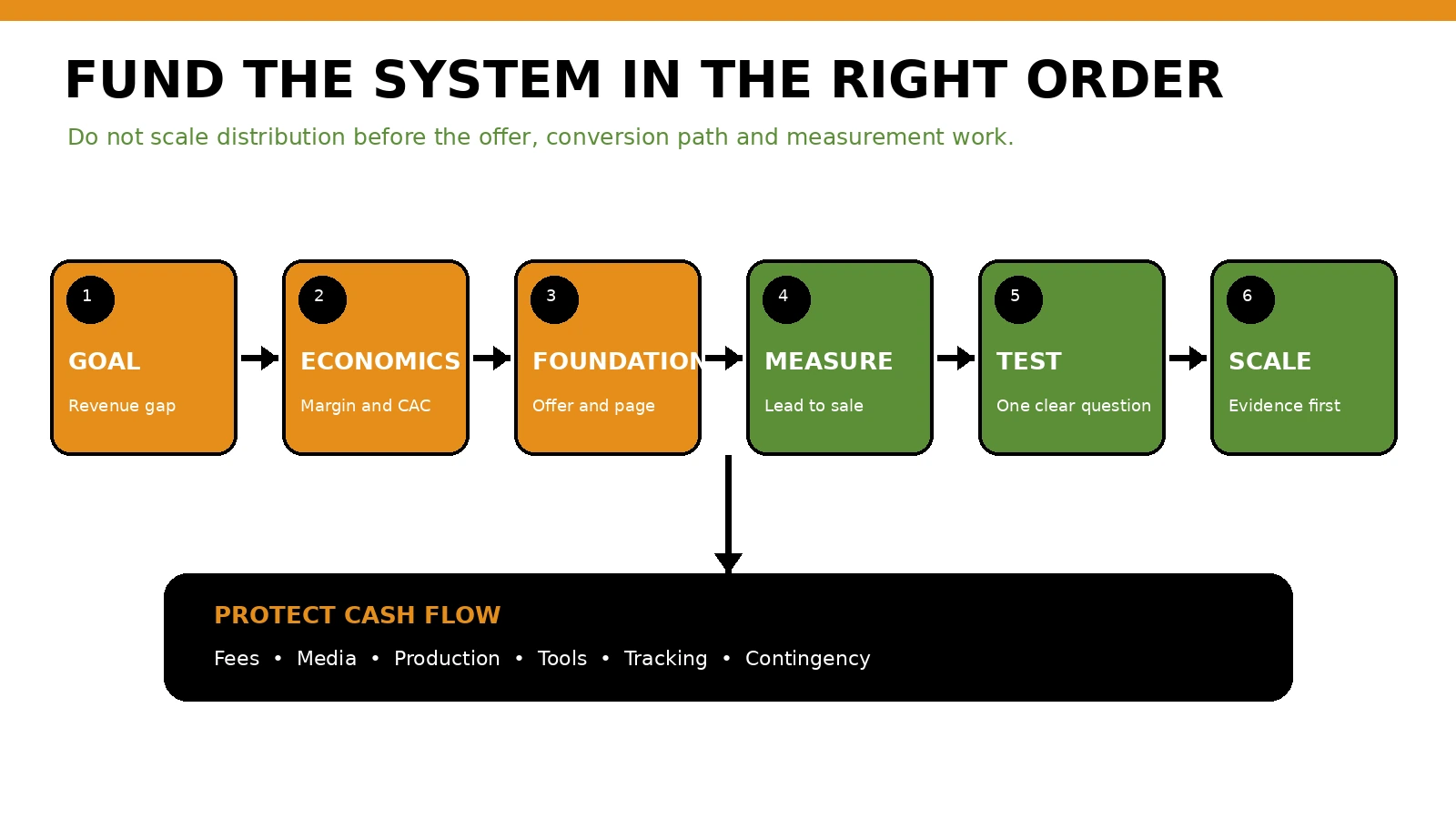
Digital marketing budget funding order
The strongest budget funds the complete path to revenue. The order matters.
1. Goal and offer
Define the profitable offer, audience, service area, and reason to choose the business. A larger media budget cannot repair a vague offer, poorly priced, or difficult to deliver.
2. Conversion infrastructure
Fund the page, form, checkout, call route, or WhatsApp flow that turns interest into a measurable next step. Sending paid traffic to a slow, generic or confusing page transfers budget from acquisition into leakage.
3. Measurement
Define the primary outcome and test it end to end. Google Analytics distinguishes key events from advertising conversions: key events represent important business actions, while conversions are used to measure and optimise advertising. A lead-generation business should also connect later qualification and sales outcomes through its CRM or sales register.
The Google Ads conversion-tracking checklist explains how weak actions, duplicate events and missing values can distort paid-media decisions.
4. Controlled demand test
Choose one offer, one audience, one geography, and a primary conversion. The question might be: “Can high-intent Google Search demand for this service produce sales-qualified leads below our allowable cost?” or “Can a focused social campaign generate qualified consultations from owners of growing Nairobi SMEs?”
5. Follow-up and sales capacity
Assign an owner, response standard, qualification method, and loss-reason field. The budget should include the people or systems required to handle enquiries. A lead that receives no useful follow-up is still wasted acquisition spend.
6. Evidence-led scale
Add locations, services, audiences or channels after the test shows reliable lead quality and a commercially acceptable acquisition cost. Scale should follow evidence, not the pressure to appear active on every platform.
Separate every budget line
A monthly “marketing budget” often mixes expenses that behave differently. Separate them so management can see what is being purchased.
|
Budget line |
What it pays for |
Typical behaviour |
|
Strategy and diagnosis |
Research, offer, audience, channel and measurement plan |
Often heavier at the start |
|
Agency or specialist fees |
Management, optimisation, reporting and expertise |
Recurring or project-based |
|
Working media |
Google, Meta, LinkedIn, TikTok or other distribution |
Variable and platform-billed |
|
Content and production |
Copy, design, photography, video and landing assets |
Project or recurring |
|
Website and conversion |
Landing pages, forms, checkout, speed and UX improvements |
Project plus maintenance |
|
Tools and data |
CRM, email, call tracking, analytics and reporting |
Subscription or usage-based |
|
Sales follow-up |
People, scripts, call time and lead management |
Recurring operational cost |
|
Testing reserve |
New creative, experiments and controlled iteration |
Planned contingency |
|
Compliance and governance |
Privacy review, consent controls, access and vendor checks |
Project and recurring |
Separate fees from media
Ask whether a quote includes ad spend, agency fees, production, tools and taxes. A low management quote may exclude the landing page, tracking repair, original assets and reporting needed to make the media useful. A high quote may include work that another supplier lists separately.
Plan for platform billing behaviour
Google describes an average daily budget as the amount an advertiser is roughly comfortable spending per day over a month. For most campaigns, actual daily spend can vary, and the monthly spending limit is generally calculated as 30.4 times the average daily budget. Review the current Google Ads budget guidance and spending-limit rules when planning cash flow.
Do not assume every platform will spend each day evenly. Keep sufficient payment capacity, monitor billing, and define who can change budgets.
Treat one-off repairs separately
Month one may require tracking, page, feed, or account work that will not repeat at the same level. Show these as setup or remediation costs. This prevents management from treating a repair-heavy first month as the permanent cost of acquisition.
Choose the first channel by constraint
Channel choice follows buyer behaviour and the missing part of the journey.
Google Ads: capture existing demand
Use paid search when buyers actively search for the offer and the business needs demand now. It suits a focused, profitable service with a clear location and measurable conversion. A constrained budget should start with one commercial priority. The Google Ads starter guide for Kenyan small businesses explains why concentration is stronger than spreading a limited budget across many campaigns.
Use Tabala’s Google Ads services in Nairobi when the commercial need is immediate demand capture with structured tracking and optimisation.
SEO: build compounding demand capture
Use SEO when profitable buyers search repeatedly, the business can wait for compounding results, and useful expertise can be published. Budget for technical work, service-page improvement, content, internal links, and authority. Google Search Console’s Performance report shows clicks, impressions, CTR, and average position by query, page, country, and device. That data should guide later allocation.
The SEO services page explains how technical stability, intent alignment and authority support long-term acquisition.
Social media: create and nurture demand
Use social when buyers need education, trust, proof, or repeated exposure before they search. Budget for original content, distribution, community response and a conversion path. Posting volume alone is not a commercial outcome.
Tabala’s social media marketing services position organic content and paid amplification as one demand system tied to enquiries and sales.
Website conversion: improve the yield from existing demand
If the business already receives relevant visits but few enquiries or sales, conversion work may produce more value than additional traffic. Fund message clarity, mobile usability, trust, forms, checkout and speed before expanding media.
Use website development services in Nairobi when the current site prevents marketing channels from converting demand.
Email, CRM and retention: increase customer value
If acquisition works but repeat purchase, follow-up or renewal is weak, invest in customer data quality, segmentation, lifecycle communication and service processes. When personal data is used for direct marketing, budget for consent, opt-out, and governance controls. Kenya’s Data Protection (General) Regulations include requirements relevant to direct marketing and opt-out mechanisms.
Build a controlled test budget
A test budget should be large enough and long enough to answer a defined question. It should also be small enough that a failed hypothesis does not threaten the business.
Define the decision before the amount
Write the decision statement:
We will invest in [offer + audience + channel] for [evaluation window] to determine whether it can produce [qualified outcome] within [commercial limit], while protecting [cash-flow or quality guardrail].
Illustrative Nairobi B2B scenario
Assume a business needs ten additional customers over a quarter. Its actual qualified-lead close rate is 25%, so it requires forty sales-qualified leads. Half of valid enquiries typically qualify, so the demand target is eighty valid enquiries.
The business does not yet know the cost of producing a valid enquiry from the chosen channel. It should not invent one from a competitor’s result. It can instead fund a controlled pilot that:
- promotes one high-margin service;
- targets one serviceable market;
- uses one conversion-focused page;
- captures source and campaign data;
- records qualification and loss reasons;
- runs for a period suited to the buying cycle;
- defines a stop-loss and a review point.
After enough outcomes mature, management can compare actual lead cost, qualification rate, close rate, and gross profit with the allowable acquisition cost.
Illustrative budget architecture
The following is a planning structure, not a recommended Kenyan price list:
|
Layer |
Purpose |
Funding decision |
|
Foundation |
Offer, tracking and conversion path |
Fix critical gaps before media |
|
Test execution |
Management, assets and one channel |
Fund one complete hypothesis |
|
Working media |
Distribution |
Cap by cash-flow tolerance and learning goal |
|
Sales handling |
Response and qualification |
Ensure lead capacity exists |
|
Measurement |
CRM, reporting and reconciliation |
Protect decision quality |
|
Reserve |
Creative or technical correction |
Release only against documented need |
Use the budget scorecard
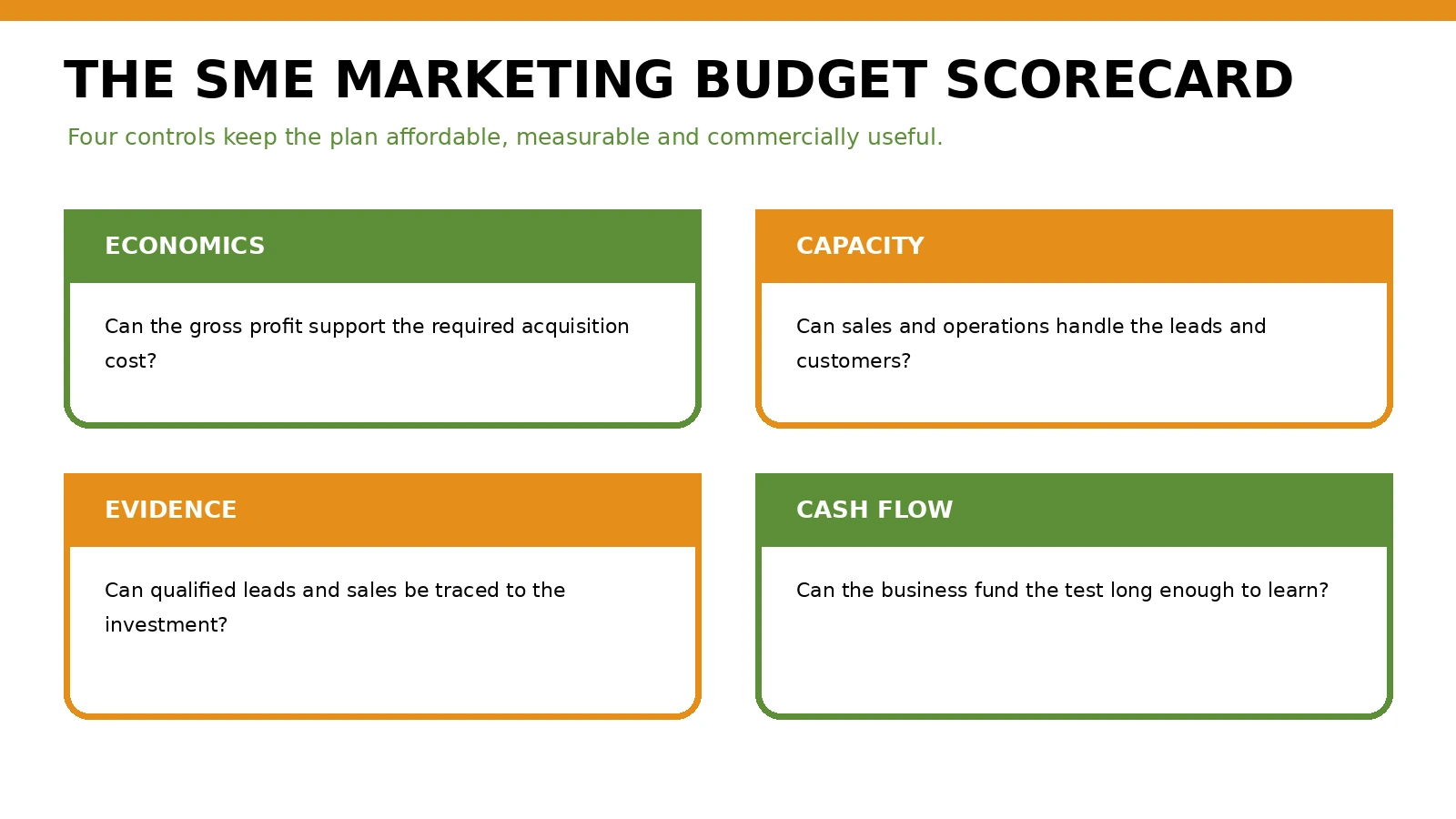
Digital marketing budget scorecard
Review the budget against four controls.
Economics
- What gross profit does a new customer create?
- What acquisition cost can the business safely tolerate?
- How long can cash remain unrecovered?
- Which offer has enough margin to fund learning?
Capacity
- How many leads can sales contact quickly?
- How many additional customers can operations serve?
- Which locations can be served profitably?
- Is stock, appointment, or delivery capacity available?
Evidence
- Is the primary conversion tested?
- Can source data reach the lead record?
- Are qualified, lost, and won outcomes recorded?
- Can finance reconcile collected revenue and gross profit?
Cash flow
- Can the business fund the full evaluation window?
- Are media, fees, production and taxes separated?
- Is there a defined stop-loss?
- Who can approve a budget change?
Use a monthly review table:
|
Measure |
Plan |
Actual |
Decision |
|
Working media |
Enter KES |
Enter KES |
Hold, reduce or expand |
|
Total programme cost |
Enter KES |
Enter KES |
Reconcile all lines |
|
Valid enquiries |
Enter target |
Enter actual |
Check volume and source |
|
Sales-qualified leads |
Enter target |
Enter actual |
Check quality |
|
Won customers |
Enter target |
Enter actual |
Respect sales-cycle lag |
|
Gross profit |
Enter target |
Enter actual |
Compare with full cost |
Avoid eight common budget mistakes
1. Funding every channel at once
Fragmentation creates activity without learning. Start with the channel and constraint most connected to the commercial goal.
2. Treating media spend as the whole budget
Media cannot replace the offer, page, tracking, assets, management, or sales response. Separate the lines.
3. Buying traffic before fixing conversion
More visits amplify a weak path. Test forms, calls, checkout, and mobile experience before scaling.
4. Copying a competitor’s spend
You do not know its margins, discounts, tracking quality, fulfilment capacity, or tolerance for loss. Competitor activity is context, not your budget model.
5. Measuring all enquiries equally
A WhatsApp click, completed form, qualified opportunity, and sale are different outcomes. Track the progression.
6. Ignoring sales-cycle timing
Do not judge a long-cycle B2B campaign using only same-week revenue. Set the decision window before launch.
7. Scaling on platform metrics alone
Clicks, impressions, and platform conversions are useful signals. Scale when CRM and finance outcomes support the decision.
8. Leaving no correction reserve
Early tests often expose a page, creative, tracking, or offer problem. A controlled reserve lets the business fix the constraint without raiding operations cash.
Follow a 30-day budget-planning checklist
Days 1–5: define the business case
- Choose the profitable offer and target market.
- Set the collected-revenue or gross-profit goal.
- Calculate required customers and qualified leads.
- Confirm margin, capacity, and allowable acquisition cost.
- Define the evaluation window.
Days 6–10: audit the journey
- Review current visibility, traffic and lead sources.
- Test the website, form, call, and WhatsApp paths.
- Check whether source, qualification, and sales outcomes are recorded.
- Identify the largest constraint.
- Run the 360 Digital Growth Diagnostic if the failure point is unclear.
Days 11–15: build the budget
- Separate strategy, fees, media, production, tools, and conversion work.
- Mark one-off and recurring costs.
- Add sales handling and measurement costs.
- Add a controlled correction reserve.
- Confirm payment timing and approval authority.
Days 16–20: design the test
- Select one primary channel and commercial question.
- Define the audience, location, offer, and conversion.
- Set the stop-loss and review point.
- Assign campaign, sales, and finance owners.
- Document what would justify scaling.
Days 21–30: launch and govern
- Test every conversion before increasing distribution.
- Review spend and lead quality on a fixed cadence.
- Record loss reasons and response time.
- Reconcile platform, CRM, and finance outcomes.
- Decide whether to stop, repair, continue, or scale.
Frequently Asked Questions
Answers to common questions about digital marketing budgets, advertising costs, and allocating marketing spend for Kenyan SMEs.
Build a budget that answers a business question
A digital marketing budget is a commercial operating plan. It should explain what outcome the business needs, which constraint prevents that outcome, what complete system will be funded, how evidence will be captured, and what would justify the next shilling.
Start with economics. Protect cash flow. Fund the offer, conversion path, and measurement. Test one priority with enough focus to learn. Then allocate more only when qualified demand and revenue support the decision.
If your current channels, website, and sales process are disconnected, use the 360 Digital Growth Diagnostic to identify where the budget is leaking before you expand it.
Accelerate Your Revenue
While Revenue Intelligence builds long-term authority, Google Ads delivers immediate, high-intent traffic. Combine both for maximum market dominance.

Strategist Profile
Abala Tom
Digital systems strategist specializing in high-performance SEO, Google Ads, and conversion optimization. Mission: to replace marketing 'guesswork' with predictable revenue systems.