SEO Reporting for Kenyan Businesses: What to Track

An SEO report should change a business decision
Many Kenyan businesses receive SEO reports that are technically busy and commercially empty. The document lists hundreds of keywords, a higher visibility score, more impressions and several completed tasks. It still fails to answer the question management cares about: did search performance create more qualified demand, and what should we do next?
That gap creates two risks. A weak programme can look healthy because traffic is rising. A strong programme can look unproductive because early technical and indexing gains have not yet reached revenue. In both cases, the report fails because it presents numbers without showing the chain between search demand, website behaviour, leads and business outcomes.
A useful SEO report does not need more charts. It needs a clear measurement model, consistent definitions and honest interpretation.
Quick answer
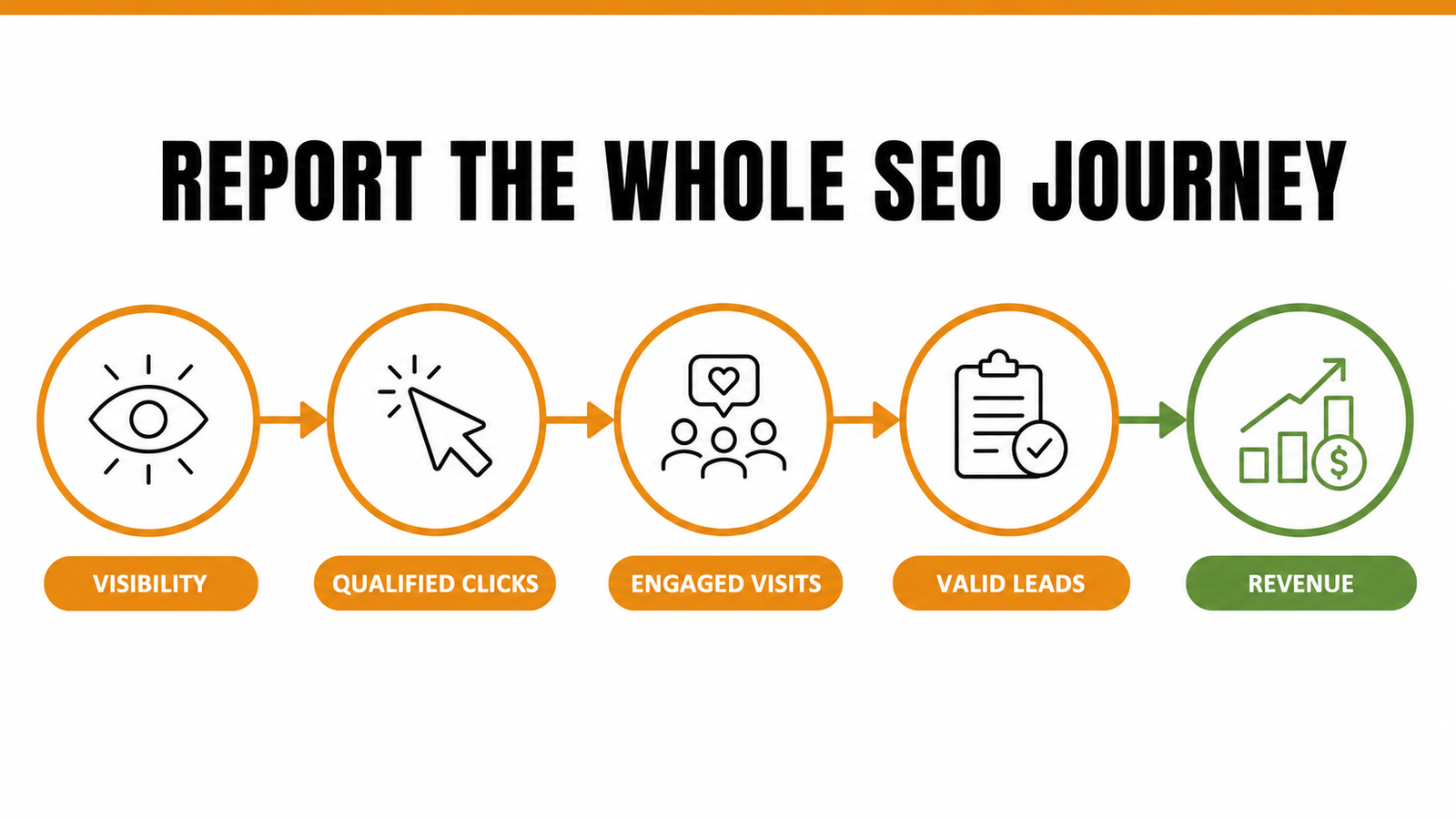
Kenyan businesses should track SEO in five connected layers:
- Business outcomes: valid leads, qualified opportunities, sales and revenue.
- Search demand: impressions, clicks, click-through rate and the queries creating visibility.
- Page performance: landing-page traffic, engagement and key events.
- Technical health: indexation, crawling, mobile experience and structured-data issues.
- Execution and decisions: what changed, what was completed, what evidence emerged and what happens next.
Never report rankings or traffic alone. Compare trends by query, page, device, country and business outcome. State data limitations, separate observation from explanation and finish each report with decisions, owners and deadlines.
Run the free SEO Visibility Audit if you need an evidence-based baseline before evaluating monthly performance.
Key takeaways
- An SEO KPI is useful only when it informs a decision.
- Search Console and GA4 measure different parts of the journey. Their totals should not be expected to match.
- Average position can hide large differences across queries, pages, devices and locations.
- Traffic growth is not a commercial win if valid leads or revenue remain flat.
- Lead quality belongs in the SEO report, even when the sales team owns qualification.
- Technical warnings should be prioritised by affected pages and business risk, not by the number of errors.
- AI search visibility requires observation beyond one traffic chart.
- A monthly report should explain change, evidence, work completed and next actions in plain language.
Start with the business question, not the dashboard
Before selecting metrics, define what SEO is expected to do for the business. A Nairobi professional-services firm may need qualified consultation requests. A Mombasa hotel may need direct bookings and calls. A Kisumu retailer may need store visits, product discovery and ecommerce sales. A multi-location organisation may need visibility by branch and service area.
The objective determines the report.
If the goal is qualified leads, a report dominated by blog sessions misses the commercial question. If the goal is national brand visibility, reporting only on form submissions may ignore valuable growth in category discovery. If the website is rebuilding its technical foundation, revenue may be too late a signal for the first reporting period.
Use three levels of success:
| Level | Question | Example measure |
|---|---|---|
| Business outcome | Did SEO contribute to valuable demand? | Qualified opportunities, direct bookings, ecommerce revenue |
| Search performance | Did the site earn more relevant visibility and clicks? | Non-brand clicks to priority pages, commercial-query visibility |
| Delivery and health | Did we remove constraints and complete agreed work? | Priority pages indexed, internal links added, critical issues repaired |
The levels should connect. Delivery creates a change in search performance, which may contribute to a business outcome. The report must avoid claiming causation when the evidence only shows correlation.
Define the terms before reporting them
Agree on definitions for:
- brand and non-brand search
- contact action, valid lead and qualified opportunity
- commercial and informational landing pages
- target market and irrelevant locations
- priority keyword or query group
- completed task and verified outcome
A WhatsApp-button click is a contact action, not automatically a lead. A form submission is not automatically qualified. A ranking is not automatically visible to the right customer. Without shared definitions, each month becomes a debate about the numbers rather than a decision about performance.
Build one SEO measurement chain
SEO does not happen inside one platform. Google Search Console explains how a property performs in Google Search. Google Analytics 4 explains what tagged visitors do on the website. A CRM, booking system or order database explains whether those actions become customers.
Google’s official guide to using Search Console and Google Analytics together recommends combining the tools for a more complete view of discovery and on-site experience. It also notes that differences between the tools require interpretation rather than forced reconciliation.
The minimum measurement chain
| Stage | Primary source | What it should answer |
|---|---|---|
| Search exposure | Search Console | Which queries and pages appeared, and where did clicks change? |
| Website visit | GA4 or equivalent analytics | Which landing pages received sessions and engaged users? |
| Contact or purchase | GA4 key events plus website records | Which valuable actions occurred? |
| Lead quality | CRM or reviewed lead log | Were the contacts real, relevant and commercially useful? |
| Revenue | CRM, booking or ecommerce system | Which opportunities became sales and at what value? |
If a stage is missing, label it. Do not use traffic as a substitute for leads or form submissions as a substitute for revenue.
Why Search Console and GA4 totals differ
The tools do not count the same thing. Search Console reports Google Search clicks using its own aggregation rules. GA4 reports website sessions and users when the Google tag runs and consent, browser conditions and implementation allow collection. One search click can behave differently from one analytics session.
The goal is not to make the totals identical. The goal is to understand what each source measures, watch directional changes and investigate material gaps.
Track Search Console metrics correctly
The Search Console Performance report includes clicks, impressions, average click-through rate and average position. It can group data by query, page, country, device, date and search appearance.
Clicks
Clicks show how often people clicked a result from Google Search to the property. Report total clicks, but separate them where the business decision requires it:
- brand versus non-brand queries
- commercial versus informational pages
- priority services versus the rest of the site
- target countries or cities where data is sufficient
- mobile versus desktop
A rise in branded clicks may reflect wider brand demand rather than SEO work alone. A rise in informational clicks may build awareness but should not be presented as immediate pipeline without evidence.
Impressions
Impressions show how often the property appeared in eligible search results under Search Console’s rules. Growth can indicate expanding visibility, but an impression is not a visit or lead.
Use impressions to identify emerging query groups, new pages gaining exposure and pages that appear often but fail to earn clicks. Compare impressions with clicks and relevance, not as a standalone success metric.
Click-through rate
CTR is clicks divided by impressions. A low or falling CTR may point to weak titles, poor query fit, changing search-result layouts, brand competition or visibility across broader, lower-ranking queries.
Do not impose one site-wide “good CTR.” Expected behaviour varies by query, position, device, brand familiarity and search appearance. Compare the page or query against its own history and business role.
Average position
Average position is not a fixed rank. Search Console reports an average based on eligible impressions and its aggregation rules. Google’s definitions of impressions, clicks and position explain why position must be interpreted in context.
Report position for coherent query groups and pages. Avoid a single site-wide ranking number that blends unrelated topics, locations and devices.
Query and page segments
The most useful Search Console report often pairs a query group with the page earning visibility. Google’s Performance report analysis guidance explains how to sort and compare queries and pages.
For a Kenyan SEO programme, useful segments may include:
- core commercial services
- local-intent searches
- comparison and pricing research
- branded demand
- support content by topic cluster
- Nairobi versus wider Kenya where the data supports the split
Do not force Mombasa, Kisumu, Nakuru or Eldoret into reporting when the business does not serve those locations or when the data is too thin to support a conclusion.
Connect GA4 landing pages, engagement and key events
Search Console stops at the search result and click. GA4 helps examine what happened after the visitor reached the website.
The GA4 Landing page report shows the first page a visitor reached during a session. It is useful for comparing organic landing pages, engagement and important actions.
Landing-page performance
Report priority landing pages with:
- organic sessions or users
- engaged sessions where useful
- average engagement time as supporting context
- relevant key events
- valid leads or purchases from business records
- meaningful change against the previous period and an appropriate longer baseline
Do not punish an informational page because it does not convert like a service page. Judge each page according to its search intent and expected next step.
Key events
Google defines a GA4 key event as an action important to the business. Examples may include a completed contact form, purchase or confirmed booking action.
Marking every page view, scroll or button click as a key event inflates performance. Use micro-actions for diagnosis, but reserve primary business reporting for actions that represent real progress.
Tabala’s conversion-tracking checklist for Kenyan businesses explains how forms, WhatsApp clicks, calls and transaction values should be validated. Although the article focuses on Google Ads, the measurement discipline also protects SEO reporting.
Engagement is supporting evidence
Engagement metrics can help diagnose page experience and intent match. They do not prove content quality or revenue impact on their own. A visitor may read quickly and call later. Another may spend several minutes confused. Use engagement alongside the page’s purpose, key events and lead outcomes.
Measure valid leads, qualified opportunities and revenue
SEO reporting becomes commercially useful when website actions are reconciled with what the business received.
Use a lead-quality table:
| Measure | Definition | Owner |
|---|---|---|
| Contact action | A tracked attempt to call, message, submit or book | Marketing |
| Received lead | The message, call or form reached the business | Marketing or operations |
| Valid lead | Real, reachable and relevant to an offered service | Sales |
| Qualified opportunity | Need, fit, authority, timing and commercial path are credible | Sales |
| Sale or revenue | The opportunity became a completed transaction | Finance or sales |
Marketing cannot report qualified-lead performance if sales never records quality. Sales cannot fairly judge SEO if source and landing-page context are lost. The reporting process should assign ownership to both teams.
Use KES where the business has reliable values
For ecommerce, report organic revenue, transactions and average order value only when purchase tracking is tested and reconciled. For service businesses, report pipeline value or closed revenue when the CRM definitions are consistent.
Do not invent an “SEO revenue” figure by multiplying every form submission by an assumed customer value. If the value is modelled, state the formula and label it as an estimate.
Calculate commercial ratios carefully
Useful ratios include:
- valid-lead rate = valid leads divided by received leads
- qualified-opportunity rate = qualified opportunities divided by valid leads
- close rate = customers divided by qualified opportunities
- organic lead value = attributable organic revenue divided by valid organic leads
Ratios become misleading when volumes are small or definitions change. Always show the underlying counts and note changes in tracking or sales handling.
Report rankings without misleading management
Rank tracking helps monitor selected queries, competitors and locations. It should not become the entire SEO report.
Report query groups, not trophy keywords
A single number-one ranking can generate little demand. A page may gain valuable clicks across many related queries without ranking first for the phrase management watches manually.
Group keywords by business purpose:
- core service demand
- local service demand
- pricing and comparison research
- problem-aware informational demand
- branded searches
Report the landing page, target intent and direction of change. Note whether the query is tracked nationally, in Nairobi or from another defined location.
Explain personalisation and location
Manual searches can differ by location, device, language, history and search-result features. Do not use one incognito search as proof that a tracking platform or Search Console is wrong.
Separate visibility from conversion
When rankings improve but leads do not, investigate:
- whether the query has commercial intent
- whether impressions and clicks increased
- whether the correct page ranks
- whether the landing page supports the next action
- whether tracking and lead delivery work
The Google Ads versus SEO decision guide explains why channel performance should be judged by business economics rather than traffic alone.
Track technical SEO and page experience by business risk
Technical reports often overwhelm management with crawl warnings. Convert them into priorities.
Report:
- important pages excluded from indexing
- server errors affecting valuable URLs
- redirect or canonical conflicts
- broken internal links to priority pages
- mobile rendering problems
- structured-data errors affecting eligible page types
- Core Web Vitals patterns with sufficient field data
- security or manual-action issues
The Page indexing report shows the indexing status of URLs Google knows about. The Core Web Vitals report uses real-world usage data where sufficient data exists.
Do not report “200 errors fixed” without showing which pages were affected and whether the repair changed crawling, indexation or user experience. Tabala’s technical SEO checklist for Kenyan websites provides the diagnostic order for access, crawling, indexing, mobile experience and structured data.
Record implementation separately from outcome
“Schema added” is work completed. “Eligible product pages now validate” is a verified technical result. “Rich results increased” is a search-performance outcome. Keep the levels separate so a completed task is not presented as a guaranteed ranking gain.
Report local SEO and AI search visibility honestly
Local search reporting
For businesses serving physical locations or defined service areas, combine:
- Google Business Profile calls, directions and website actions
- local organic queries and landing pages
- branch or location-page performance
- review growth and response operations
- valid leads by location
Avoid merging all branches into one total if management needs to decide where to invest. The local SEO guide for Kenyan businesses explains how website and profile signals support local discovery.
AI search reporting
Do not claim precise AI visibility from one unverified tool score. Record the source, observation method and limitations.
Google states that traffic from AI features such as AI Overviews and AI Mode is included in Search Console reporting. Its current AI features guidance explains how this traffic is reported and what site owners should monitor.
For broader AI discovery, a practical observation programme may record:
- whether the brand or page appears for a defined prompt set
- which source URLs are cited or referenced
- whether AI-assisted referral traffic appears in analytics
- changes in branded searches and assisted conversions
- content gaps revealed by recurring customer questions
Prompt results vary. Treat observations as samples, not stable rankings. If AI discovery is commercially important, support the protected AI Search Optimization service with separate methodology and reporting rather than changing its URL or commercial intent.
Interpret metrics together before recommending action
Isolated metrics create bad decisions. A useful report compares related signals and explains the most plausible causes.
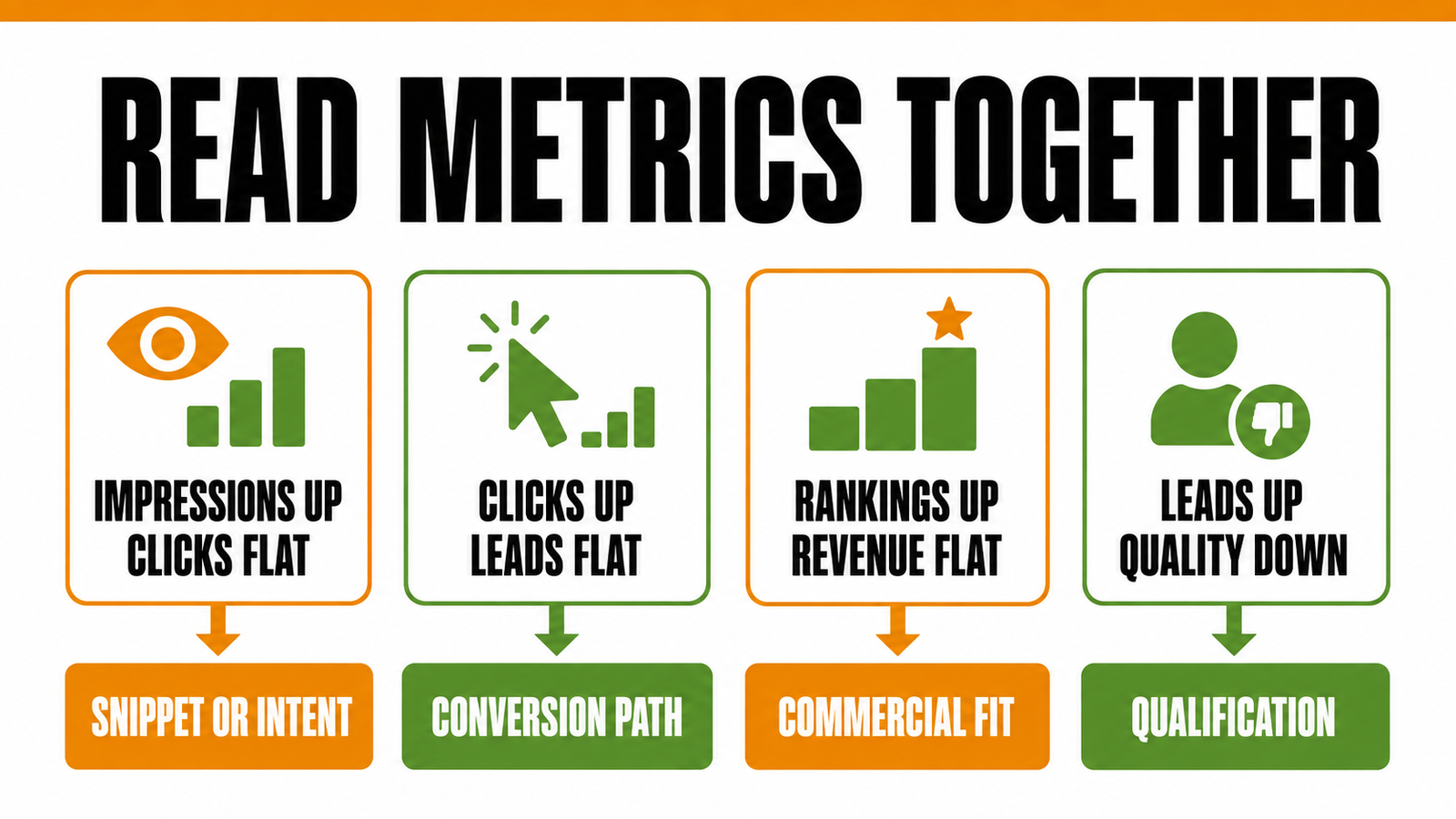
| Pattern | Possible explanation | What to investigate next |
|---|---|---|
| Impressions rise, clicks stay flat | Broader visibility, weak snippets or lower average relevance | Query groups, CTR, positions, search appearance and titles |
| Clicks rise, leads stay flat | More informational traffic or a conversion-path problem | Landing pages, key events, mobile friction and lead delivery |
| Rankings rise, revenue stays flat | Tracked terms may lack value or attribution may be incomplete | Commercial intent, lead quality, CRM source and sales handling |
| Leads rise, quality falls | Targeting, page promise or qualification may be too broad | Query intent, forms, service fit and sales feedback |
| Traffic drops, leads hold | Low-value traffic may have declined | Pages lost, query intent and qualified-lead rate |
Separate observation, interpretation and action
Every major finding should use three lines:
- Observation: what the data shows.
- Interpretation: the most plausible explanation and uncertainty.
- Action: what will be tested or changed, by whom and by when.
Example:
“Non-brand clicks to the commercial service cluster increased, while valid enquiries remained unchanged. Tracking tests passed, but mobile form completion fell on the two highest-traffic service pages. Review the form and mobile layout this week, then compare valid submissions over the next full reporting period.”
This format prevents opinions from being presented as facts.
Choose the reporting cadence that matches the decision
Not every metric needs daily review. A dashboard that updates continuously can encourage premature reactions to normal variation.
Weekly alerts
Use short checks for failures that require quick action:
- website downtime or server errors
- sudden loss of important indexed pages
- broken forms or tracking
- manual actions or security warnings
- severe traffic changes requiring investigation
Monthly decisions
Use the monthly report for:
- business outcomes and lead quality
- Search Console query and page changes
- landing-page behaviour and key events
- work completed and verified outcomes
- risks, tests and next actions
Quarterly strategy
Use a longer window to evaluate:
- topic and service-page clusters
- commercial visibility and pipeline contribution
- technical debt and development priorities
- content refresh, consolidation and expansion
- market and competitor changes
- budget and resource allocation
Annual baseline
Year-over-year comparison can help with seasonality, but only when tracking definitions and site structure remain comparable. Note redesigns, migrations, consent changes, product shifts and major campaigns that affect the baseline.
Build a monthly SEO report that answers five questions
1. What changed?
Give the executive answer first. State the material movement in business outcomes, search performance and technical health. Avoid opening with a task list.
2. Did it matter commercially?
Show valid leads, qualified opportunities, transactions or revenue where reliable. Explain attribution limits and sales-feedback gaps.
3. Why did it change?
Connect queries, pages, devices, locations, site changes and external context. Label hypotheses and avoid overclaiming.
4. What work was completed and verified?
List meaningful deliverables, affected pages and evidence of implementation. Distinguish completion from ranking or revenue outcomes.
5. What should happen next?
Finish with a small number of priorities. Each needs an owner, deadline, expected effect and measurement method.
Recommended monthly report structure
- Executive summary
- Business outcomes and lead quality
- Search demand and visibility
- Landing-page and content performance
- Technical health and implementation
- Local and AI visibility where relevant
- Work completed and evidence
- Risks and data limitations
- Decisions required
- Next-month action plan
Audit whether an SEO agency report is useful
A professional report should make accountability easier, not bury management in exported tables.
Use this checklist:
- [ ] The report states the business objective and agreed KPI definitions.
- [ ] Brand and non-brand performance are separated where relevant.
- [ ] Query and page changes are connected to search intent.
- [ ] Traffic is connected to key events, valid leads or sales outcomes.
- [ ] Lead quality and attribution limitations are disclosed.
- [ ] Average position is not presented as a fixed universal ranking.
- [ ] Technical issues are prioritised by affected pages and business risk.
- [ ] Completed tasks include implementation evidence.
- [ ] Explanations distinguish facts from hypotheses.
- [ ] The report names decisions, owners and deadlines.
- [ ] Month-to-month movement is supported by an appropriate longer baseline.
- [ ] No tool score is treated as guaranteed traffic or revenue.
Reporting red flags
Be cautious when a report:
- celebrates impressions without discussing clicks or relevance
- lists rankings without the landing page or location
- reports every form or button click as a qualified lead
- hides behind an overall “health score”
- claims exact revenue without a defensible attribution method
- repeats the same recommendations without ownership or deadlines
- shows completed work but no verification
- attributes every change to the agency without evidence
If the reporting system cannot explain the current constraint, start with an SEO audit of the website and measurement setup. For ongoing execution, review SEO services for Nairobi and Kenyan businesses with reporting responsibilities defined before work begins.
Actionable SEO reporting checklist
- [ ] Define the business outcome before choosing metrics.
- [ ] Confirm Search Console, GA4 and lead records cover the full journey.
- [ ] Test the actions marked as GA4 key events.
- [ ] Separate brand, non-brand, commercial and informational performance.
- [ ] Compare queries and the pages receiving visibility.
- [ ] Review landing pages according to their intended role.
- [ ] Reconcile contact actions with received and valid leads.
- [ ] Show underlying counts when presenting conversion ratios.
- [ ] Prioritise technical issues by business impact.
- [ ] Record local and AI visibility with clear methodology.
- [ ] Separate observation, interpretation and action.
- [ ] End each report with owners, deadlines and measurement plans.
Frequently asked questions
What should an SEO report include?
It should include an executive answer, business outcomes, search demand, page performance, technical health, work completed, data limitations and next decisions. The exact metrics depend on the business objective.
How often should a Kenyan business receive an SEO report?
Monthly reporting suits most management decisions. Critical technical and tracking alerts should be monitored more frequently, while strategy and investment decisions usually benefit from quarterly review.
Are rankings still important in SEO reporting?
Yes, as a diagnostic signal for selected query groups, pages and locations. Rankings should be interpreted with impressions, clicks, intent and business outcomes rather than presented alone.
Why do Search Console and GA4 show different traffic numbers?
They use different definitions and collection methods. Search Console measures eligible Google Search clicks. GA4 records tagged website activity subject to sessions, consent, browser behaviour and implementation. Directional comparison is more useful than forcing the totals to match.
What is the most important SEO KPI?
There is no universal KPI. The primary measure should reflect the business objective, such as qualified opportunities, direct bookings or ecommerce revenue. Search and technical metrics explain how the website is progressing toward that outcome.
Should branded searches count as SEO performance?
Report them, but separate them where possible. Branded demand can be influenced by advertising, referrals, offline activity, reputation and SEO. Combining it with non-brand discovery can hide what organic search is contributing.
How should AI search visibility be reported?
State the platform, prompt set, date, location, method and limitations. Track citations, referral traffic, branded demand and assisted outcomes where available. Do not treat one third-party visibility score as a stable ranking.
Can an SEO agency guarantee rankings or revenue in its report?
No responsible provider should guarantee a specific ranking or revenue result. An agency can commit to scope, execution quality, measurement, communication and evidence-based decisions.
How do we measure SEO when leads close offline?
Preserve the landing page and source in the lead record, then reconcile received leads, qualification and closed sales in a CRM or controlled log. Use call tracking or dedicated workflows where appropriate and legally compliant.
Summary: report decisions, not activity
SEO reporting should make the next business decision clearer.
Start with the outcome the business needs. Connect Search Console visibility to GA4 landing-page behaviour, verified contact actions, lead quality and revenue. Segment queries and pages by intent. Prioritise technical findings by risk. Treat rankings, AI observations and attribution with the limits they deserve.
The final report should say what changed, why it may have changed, whether it mattered and what happens next.
If your current report cannot answer those questions, run Tabala’s free SEO Visibility Audit to establish the missing baseline. If the business needs ongoing execution and accountable reporting, explore Tabala’s SEO services in Nairobi.
Accelerate Your Revenue
While Revenue Intelligence builds long-term authority, Google Ads delivers immediate, high-intent traffic. Combine both for maximum market dominance.

Strategist Profile
Abala Tom
Digital systems strategist specializing in high-performance SEO, Google Ads, and conversion optimization. Mission: to replace marketing 'guesswork' with predictable revenue systems.