SEO Audit Checklist for Kenyan Businesses: A Step-by-Step Guide
SEO Audit Checklist for Kenyan Businesses: A Step-by-Step Guide
If your website has stopped bringing enquiries, disappeared for important searches or never gained visibility in the first place, guessing is expensive. You need to know whether the problem sits in crawling, indexation, page quality, local relevance, user experience or measurement.
This SEO audit checklist for Kenyan businesses gives you a practical way to find that out. It is written for business owners and marketing teams, not only technical specialists. You can complete the first pass with free tools, record what you find and decide which problems deserve attention first.
An audit does not improve rankings by itself. Its value comes from separating symptoms from causes and turning a long list of observations into a short, sensible repair plan.
The short answer: how do you audit a Kenyan business website?
Start with evidence. Check whether Google can find and index the pages that matter, whether those pages match the searches your customers make, whether the mobile experience works under realistic conditions, and whether local business information is consistent. Then connect the findings to enquiries, calls, bookings or sales.
A useful audit should answer five questions:
- Can search engines access and understand the website?
- Are the right pages indexed and appearing for relevant searches?
- Does each important page satisfy the visitor's intent?
- Can a mobile visitor use the site without friction?
- Is the business measuring outcomes, not just visits?
Do not begin by installing every available crawler or exporting hundreds of warnings. Begin with the commercial pages that matter most: the homepage, main service or category pages, key location pages and the pages that receive enquiries or sales.
Before you begin: prepare the evidence
You can do a useful first audit with free access to Google Search Console, Google Analytics and PageSpeed Insights. You will also need access to the website's content management system if you intend to fix what you find.
Collect the following before you start:
- The website's preferred domain version, including whether it uses `www` and HTTPS
- The XML sitemap location
- Google Search Console access
- Google Analytics 4 access
- Google Business Profile access for every genuine location
- A list of the services, products and locations that generate revenue
- Recent website changes, migrations, redesigns or domain changes
- Known leads, calls, form submissions, bookings or ecommerce transactions
The revenue list matters. A page can attract traffic and still be commercially unimportant. The audit should prioritize the pages capable of creating qualified demand.
Phase 1: audit search performance before changing the website
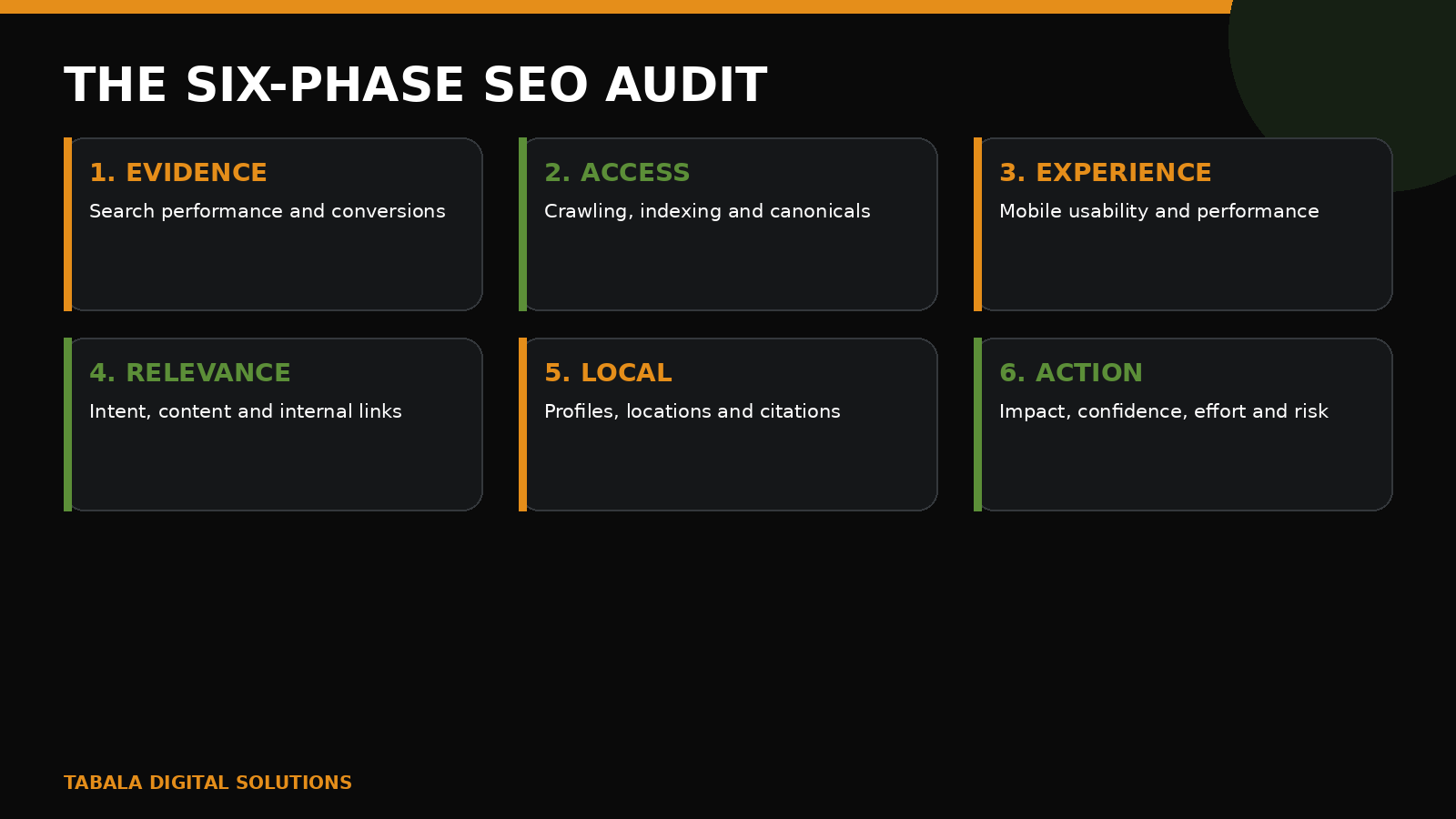
The fastest way to waste an audit is to start editing pages before understanding what has changed. Search Console shows how Google crawls, indexes and serves your site. Use it to establish the baseline.
1. Check clicks, impressions, click-through rate and average position
Open the Search results report and compare at least the last three months with the previous period. If the business is seasonal, compare the same period year on year as well.
Look for patterns, not one headline percentage:
- Did impressions fall across the entire site or only on a group of pages?
- Did rankings remain stable while clicks declined?
- Did branded searches grow while non-branded discovery fell?
- Is one service page carrying most of the organic traffic?
- Are visitors finding the business for relevant commercial searches or unrelated informational queries?
A fall in clicks does not always mean rankings collapsed. Search demand, result-page features, seasonality and changes in click-through rate can all affect traffic. Separate query loss from page loss before deciding what to fix.
2. Find the pages that gained or lost visibility
Compare pages, then open the queries attached to each one. This often reveals whether a page has lost relevance, been replaced by another URL, or is competing with a similar page on the same site.
Flag:
- Important pages with declining impressions
- Pages receiving impressions but few clicks
- Two or more pages appearing for the same intent
- Old URLs still receiving impressions after a redesign
- Blog posts attracting traffic but failing to lead readers toward a service or next action
The point is not to rewrite every declining page. It is to identify whether the loss comes from technical access, weak intent match, internal competition or a stronger result replacing yours.
3. Confirm that conversions are being measured
Traffic without outcome tracking leaves you unable to judge commercial performance. Test the actions that matter: contact forms, click-to-call buttons, WhatsApp clicks, booking confirmations, quote requests and completed purchases.
For ecommerce sites, confirm that a completed order records the transaction value and currency. For lead-generation sites, distinguish a genuine form submission from a visitor merely viewing the contact page.
Do not treat bounce rate as a ranking verdict. It can help you investigate page engagement, but the meaning changes by page type. A visitor who finds a phone number and calls immediately may have achieved the goal without browsing further.
Phase 2: crawling and indexation audit
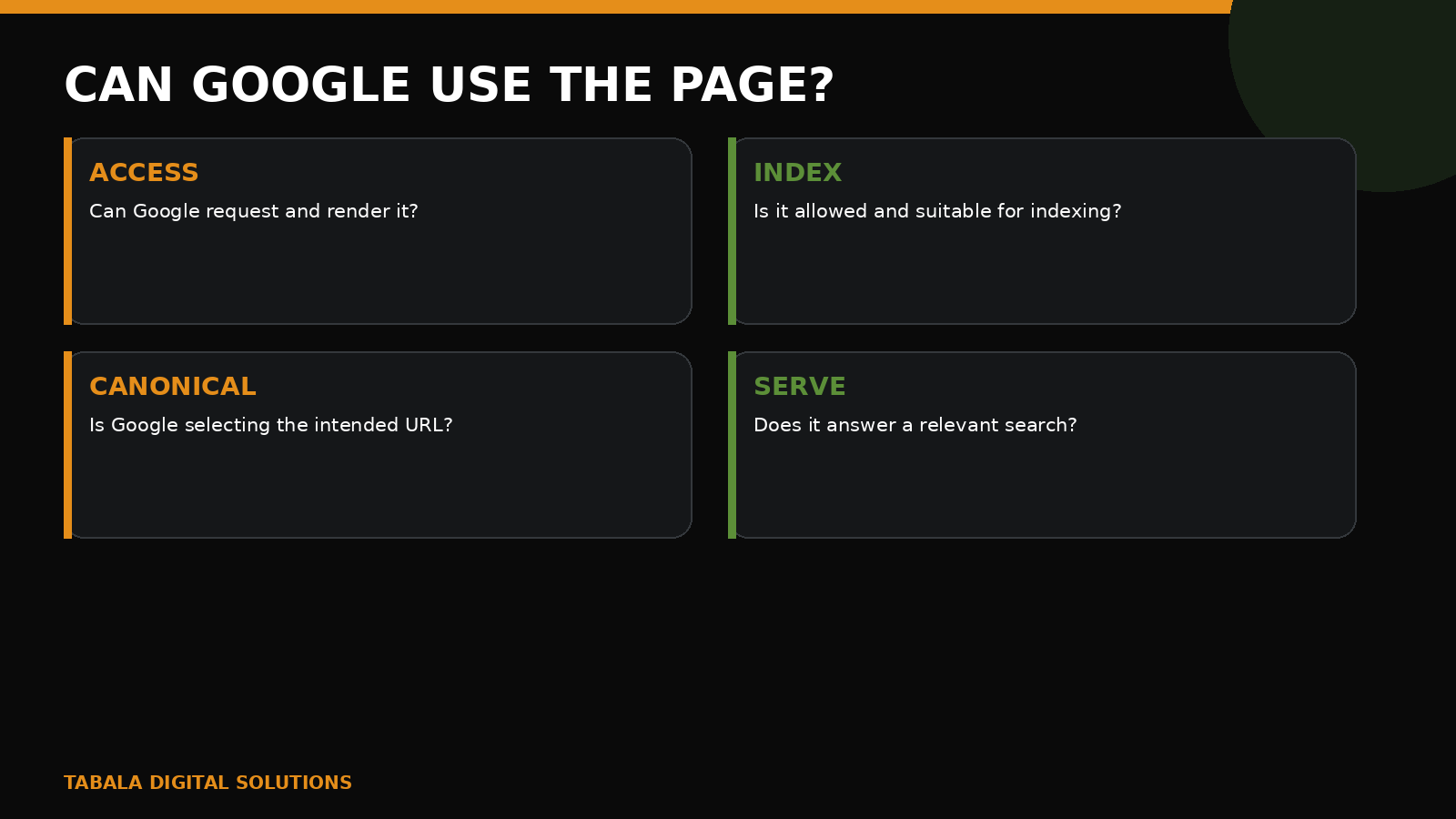
Google Search works through crawling, indexing and serving results. A page cannot compete properly if Google cannot access it, chooses a different canonical version or does not consider it suitable for the index.
4. Inspect the pages that generate revenue
Use Search Console's URL Inspection tool on the homepage and the most important service, product, category and location pages.
For each URL, confirm:
- Google can access the page
- The page is allowed to be indexed
- The user-declared canonical matches the intended URL
- Google has not selected an unexpected canonical
- The latest crawl is reasonably recent for the page's importance and update pattern
- The rendered page contains the main copy and links
One indexed homepage does not prove that the rest of the site is healthy. Inspect representative URLs from every important template.
5. Review the Page indexing report
Not every excluded URL is a problem. Filter the report by reason and investigate whether valuable pages are affected.
Pay close attention to:
- `noindex` applied to a live service or product page
- Pages blocked by `robots.txt`
- Duplicate pages without a clear canonical
- Soft 404s
- Server errors
- Redirect chains or loops
- Crawled or discovered pages that remain unindexed
Do not chase a goal of indexing every URL. Filter pages, account screens, internal search results and duplicate parameters may be better excluded. The right question is whether every page that should attract search demand is accessible, indexable and useful.
6. Check the XML sitemap
The sitemap should contain the canonical URLs you want search engines to discover. It should not become a warehouse for redirects, broken pages, duplicates or URLs marked `noindex`.
Check that:
- The sitemap loads successfully
- It has been submitted in Search Console
- Important new pages are present
- Redirecting and broken URLs are absent
- The URLs use the preferred HTTPS and hostname version
- Separate sitemaps are understandable if the site has products, posts or multiple languages
Submitting a sitemap is a discovery hint, not a guarantee of crawling, indexing or rankings.
7. Review `robots.txt` without confusing crawling and indexing
The `robots.txt` file controls which URLs crawlers can request. It is not the correct tool for removing a page from Google's index.
Check for broad rules that accidentally block CSS, JavaScript, product categories, blog sections or the whole website. Also confirm that the sitemap location is correct if it is declared in the file.
If a page must stay out of search results, use an appropriate `noindex` directive or protect the content behind authentication. Do not rely on `robots.txt` as a privacy mechanism.
8. Find broken internal links and redirect chains
Broken links interrupt visitors and waste the paths crawlers use to discover content. Redirect chains slow the journey and make migrations harder to maintain.
Crawl the website or check the key templates manually. Fix internal links so they point directly to the final live URL. Restore valuable missing pages where appropriate, or use a relevant permanent redirect when a page has genuinely moved.
Do not redirect every deleted URL to the homepage. A redirect should send the visitor to the closest meaningful replacement.
Phase 3: website technical audit for Kenyan mobile users
Kenya is a mobile-first market in practical terms. The Communications Authority reported 61.9 million mobile data subscriptions by the end of December 2025, with 83.2% on mobile broadband. That makes the mobile experience a commercial requirement, not a finishing touch.
9. Test the real mobile experience
Open the site on an actual phone. Test it on a normal mobile connection and use browser throttling to expose problems that a fast office connection can hide.
Check whether a visitor can:
- Understand the offer without zooming
- Read the text comfortably
- Open the menu and tap links without accidental clicks
- Complete a form without fighting the keyboard or layout
- Use click-to-call and WhatsApp buttons
- View prices, product information or location details
- Complete an M-Pesa or card checkout without losing entered information
M-Pesa integration is not an organic ranking factor. It belongs in the audit because checkout failure destroys the commercial value of the traffic you earn.
10. Review Core Web Vitals and page speed
Core Web Vitals measure real-world loading performance, responsiveness and visual stability. Use Search Console for field data across groups of pages and PageSpeed Insights for page-level diagnosis.
Review:
- Largest Contentful Paint for loading performance
- Interaction to Next Paint for responsiveness
- Cumulative Layout Shift for visual stability
- Oversized images and video
- Render-blocking resources
- Heavy third-party scripts
- Slow server response
- Fonts or banners that shift the layout
Do not reduce performance work to chasing a perfect score. Fix the delays that users actually experience, especially on templates that support enquiries or purchases.
11. Confirm HTTPS and one preferred site version
Every public page should load securely over HTTPS. HTTP versions should redirect directly to the preferred HTTPS URL, and alternate hostname versions should resolve consistently.
Check for mixed content, expired certificates and internal links that still point to HTTP. These issues can create browser warnings, duplicate URL variants and lost trust during checkout or form submission.
12. Audit structured data and visible content together
Schema markup can help search systems understand eligible content, but it must describe what the visitor can see. Validate relevant markup such as Organization, LocalBusiness, Product, Breadcrumb and Article data.
Look for missing required properties, incorrect business details, warnings caused by outdated templates and markup for content that is not visible on the page.
Do not add every schema type you can find. Choose the types that accurately represent the page.
Phase 4: on-page content and search intent
A technically accessible page can still fail if it does not answer the searcher's question or make the business credible.
13. Give every important page one clear job
Map each commercial query or intent to the best page. The homepage should not be expected to rank for every service, product and town.
For each important page, ask:
- What is the visitor trying to find, compare or buy?
- Does the title state that purpose clearly?
- Does the opening answer the main question quickly?
- Is the service or product explained with enough detail to make a decision?
- Are price factors, process, location, proof and common objections addressed where relevant?
- Is the next action obvious?
If two pages perform the same job, consolidate or differentiate them. Publishing near-duplicates for every keyword variation can create thin content and internal competition.
14. Review titles, headings and descriptions
Page titles should be unique, descriptive and aligned with the page. The H1 should confirm the subject when the visitor arrives. Headings should divide the answer into useful sections rather than carry awkward keyword variations.
Meta descriptions do not guarantee rankings, but a clear description can improve how the result communicates its value. Write for the person deciding whether to click.
Use related language naturally: organic search, local visibility, crawl errors, website performance, service pages, qualified traffic and conversion tracking. Semantic coverage comes from explaining the topic completely, not swapping words to manufacture keyword density.
15. Strengthen evidence, expertise and local relevance
Generic copy is easy to reproduce and hard to trust. Add the information that only a real business or experienced practitioner can provide:
- Clear service areas and genuine branch details
- Named authors or reviewers where expertise matters
- Original photos of the team, work, premises or products
- Practical examples and limitations
- Delivery process and ownership
- Relevant credentials, policies or guarantees that can be verified
- Sources for factual claims
Do not write “Kenya” or “Nairobi” in every paragraph. Local relevance should come from real operating details, not repeated place names.
16. Audit internal links and orphan pages
Important pages should be reachable through navigation or contextual links from related content. A useful internal link explains the relationship and helps the reader continue.
Check for:
- Service pages with few internal links
- Blog posts that never lead to a commercial next step
- Orphan pages absent from navigation and content links
- Repetitive anchors that feel forced
- Links pointing to redirects or outdated URLs
Build topic clusters around the questions buyers ask before choosing a service. A guide to SEO costs, for example, should connect naturally to choosing an organic search partner, running a website audit and understanding the delivery process.
Phase 5: local SEO checklist for Nairobi and other Kenyan locations
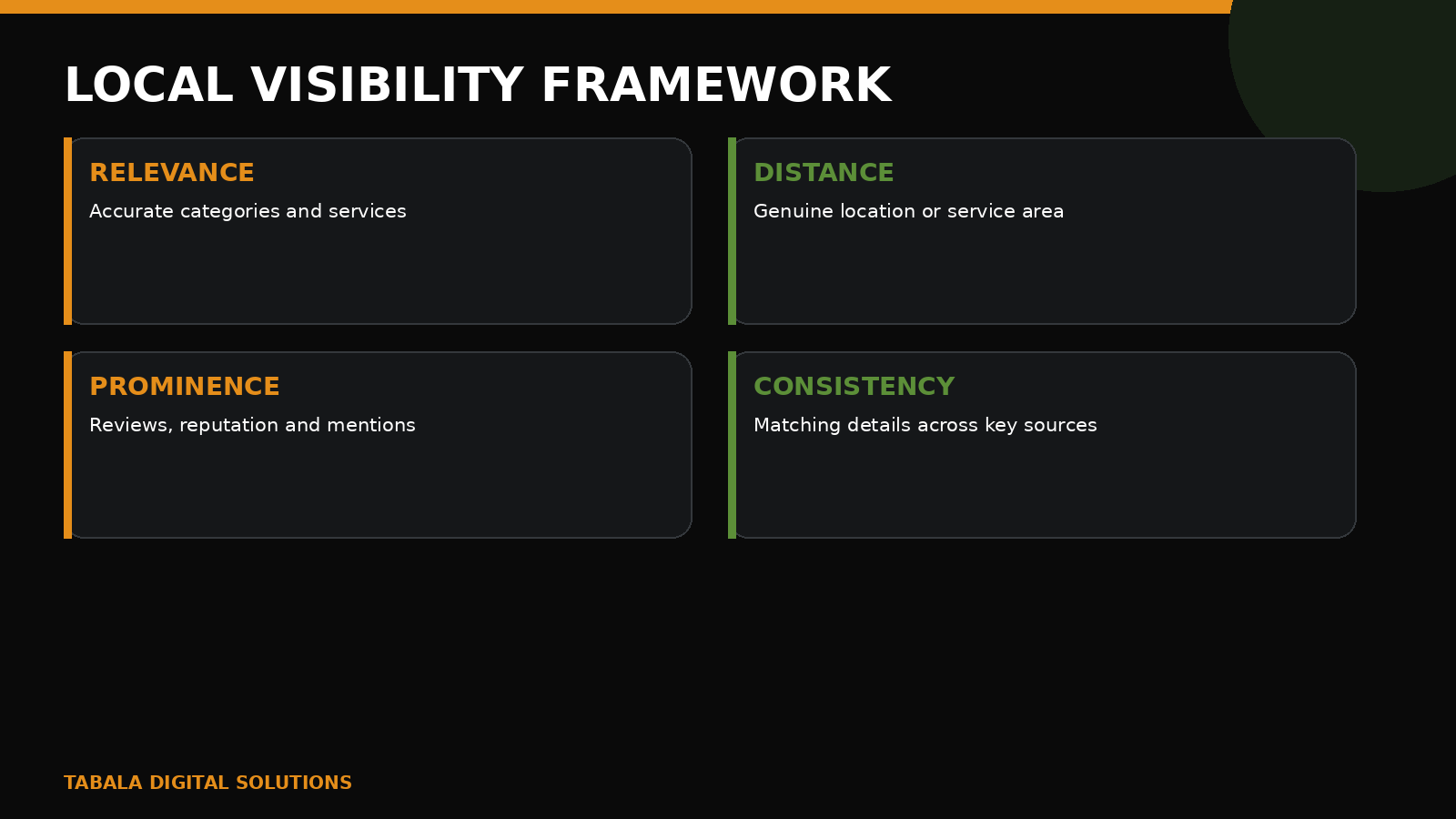
Local visibility depends on more than adding a city name to the page. Google describes local results in terms of relevance, distance and prominence. Your audit should therefore test the accuracy of the business entity, the quality of its location information and the strength of its reputation.
17. Audit each Google Business Profile
Confirm that every profile represents a genuine eligible business location or service-area business. Review:
- Business name without unnecessary keywords
- Primary and secondary categories
- Address or service area
- Phone number and website destination
- Opening hours and special hours
- Services, products and attributes
- Photos and business description
- Review responses
- Duplicate or former profiles
The profile, website and major citations should agree on the core business details. Correct contradictions before trying to manufacture more mentions.
18. Review location pages and citations
A location page should help someone decide whether the business can serve them. Include the address or service area, contact route, opening information, directions, relevant services and genuine local proof.
Do not clone one paragraph and replace “Nairobi” with Mombasa, Kisumu, Nakuru or Eldoret. If the business has no distinct information or capability for a location, a separate page may not deserve to exist.
Check major directory and social profiles for inconsistent names, phone numbers, URLs and addresses. Fix the sources that customers actually encounter rather than chasing hundreds of low-value directory listings.
19. Decide whether a `.co.ke` domain is necessary
No. A Kenyan business does not need a `.co.ke` domain to rank in Kenya. A country-code domain is a strong country-targeting signal, but a well-established `.com` can also perform locally when the website, business information, links and content clearly serve Kenyan users.
Do not change a healthy domain merely to acquire `.co.ke`. A domain migration introduces risk and must be planned carefully. If both versions are owned, choose one primary domain and redirect the other consistently.
Phase 6: prioritize the findings
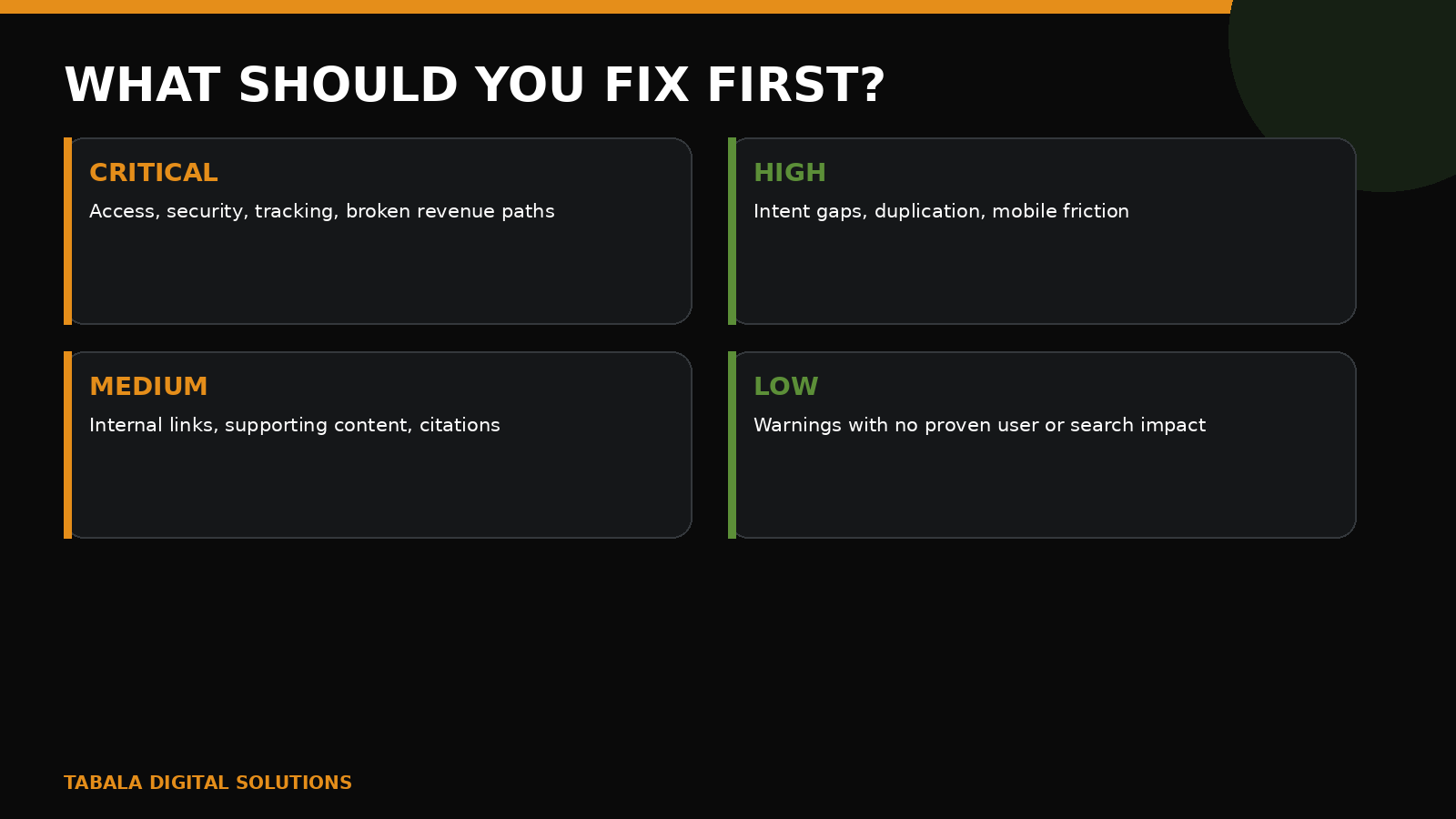
A 70-page audit is not useful if nobody knows what happens on Monday morning. Turn every confirmed issue into a prioritized action.
Use four factors:
- **Business impact:** Does it affect a page capable of producing revenue?
- **Search impact:** Does it prevent crawling, indexation, relevance or usability?
- **Confidence:** Do you have evidence, or only a tool warning?
- **Effort and risk:** Can the fix be made safely and verified?
Fix critical access and measurement failures first. Then improve pages that already show demand. Larger content expansion and authority building should follow once the foundation is dependable.
A practical order of work
**Immediate:** accidental `noindex`, broken revenue pages, server errors, tracking failure, security warnings and failed mobile forms or checkout.
**Next:** weak intent match, duplicate pages, poor internal linking, inconsistent local information, slow high-value templates and missing commercial detail.
**Later:** new topic coverage, deeper supporting resources, digital PR, citation cleanup beyond the main sources and design refinements that do not block conversion.
Assign an owner and a verification method to every action. “Improve page speed” is not a complete task. “Convert the hero image to WebP, keep it below the agreed size, deploy it on the service template and retest field performance” is much closer.
Essential free SEO tools for Kenyan businesses
You do not need an expensive platform for the first pass.
- **Google Search Console:** queries, pages, indexing, sitemaps, Core Web Vitals and URL inspection
- **Google Analytics 4:** landing-page engagement and measured conversions
- **PageSpeed Insights:** field and lab performance diagnostics
- **Google Rich Results Test:** validation for supported structured data
- **Google Business Profile:** local business accuracy, reviews and customer actions
- **Chrome DevTools:** mobile emulation, network throttling and technical inspection
- **Bing Webmaster Tools:** an additional view of crawling, indexing and search demand
Free tools can identify many issues. They cannot decide the commercial priority for you, understand every custom website implementation or replace expert judgment during migrations and complex technical repairs.
How long does a website SEO audit take?
A focused first pass for a small service website can take several hours. A complete audit may take days or weeks when the site has thousands of product URLs, several locations, multiple languages, a migration history or unreliable analytics.
Site size is only one factor. The time also depends on data access, the number of templates, the complexity of the business and whether the auditor is expected to investigate causes rather than export tool warnings.
Why is my Kenyan business website not ranking on Google?
There is rarely one universal reason. The website may be difficult to crawl, the important pages may not be indexed, the content may not match the search intent, competitors may provide stronger evidence, or the business may lack consistent local signals. An audit narrows those possibilities using data before you invest in fixes.
Frequently asked questions about SEO audits in Kenya
What is included in a website SEO audit?
A useful audit reviews search performance, crawling and indexation, site architecture, mobile experience, page quality, internal links, local visibility and conversion measurement. The final output should prioritize confirmed issues by impact, confidence, effort and risk.
Can I do an SEO audit myself?
Yes, a business owner or marketer can complete the first pass using Search Console, Analytics and free testing tools. Get specialist help when the website has suffered a major visibility loss, is preparing for a migration, contains thousands of URLs or requires code-level repairs.
Do I need a `.co.ke` domain for local SEO in Kenya?
No. A `.co.ke` domain is a clear Kenyan country signal, but it is not compulsory. A `.com` website can rank locally when its content, business details, reputation and links consistently show that it serves Kenyan customers.
How often should a business run an SEO audit?
Monitor Search Console and conversions continuously, then schedule a deeper review when evidence justifies it. Audit after a redesign, migration, unexplained traffic loss, major content expansion or a change in the services and locations the business targets.
Is an SEO audit the same as an SEO strategy?
No. The audit diagnoses the current condition and identifies constraints. The strategy decides what the business will prioritize, who owns each action, what resources are required and how progress will be measured.
Will fixing every audit warning improve rankings?
No. Crawlers often report items that have little commercial or search impact. Confirm the issue, connect it to an important page or user journey and prioritize it against other work before making changes.
Does M-Pesa integration improve SEO?
Not directly. M-Pesa is not a ranking factor, but a reliable mobile payment experience can improve conversion performance for ecommerce and booking journeys. It belongs in a commercial website audit because traffic has limited value if customers cannot complete payment.
What should I do after the audit?
Create a repair plan with an owner, deadline and verification method for every priority. Fix critical access, tracking and revenue-path failures first, then improve pages with proven demand before expanding into new content.
Final checklist
Before closing the audit, confirm that you have:
- Compared organic performance by query and page
- Tested every primary conversion action
- Inspected representative revenue pages in Search Console
- Reviewed indexing exclusions, canonicals, sitemaps and `robots.txt`
- Fixed broken internal links and unnecessary redirect chains
- Tested mobile navigation, forms, calls, WhatsApp and checkout
- Reviewed Core Web Vitals and visible performance problems
- Checked HTTPS, structured data and duplicate site versions
- Matched important search intents to clear pages
- Reviewed titles, headings, descriptions, evidence and internal links
- Verified Google Business Profile and location information
- Separated `.co.ke` country targeting from the wider local ranking picture
- Prioritized findings by impact, confidence, effort and risk
- Assigned ownership and a verification method
The purpose of an audit is not to produce the longest list of faults. It is to identify what prevents qualified customers from finding, trusting and using the website, then fix those constraints in the right order.
If you want an evidence-based review of your search visibility, technical foundation and local presence, start with Tabala Digital Solutions' website diagnostic audit or speak to us about a focused SEO review.
Accelerate Your Revenue
While Revenue Intelligence builds long-term authority, Google Ads delivers immediate, high-intent traffic. Combine both for maximum market dominance.

Strategist Profile
Abala Tom
Digital systems strategist specializing in high-performance SEO, Google Ads, and conversion optimization. Mission: to replace marketing 'guesswork' with predictable revenue systems.