SEO, AEO and GEO in Kenya: What Changes and What Stays the Same
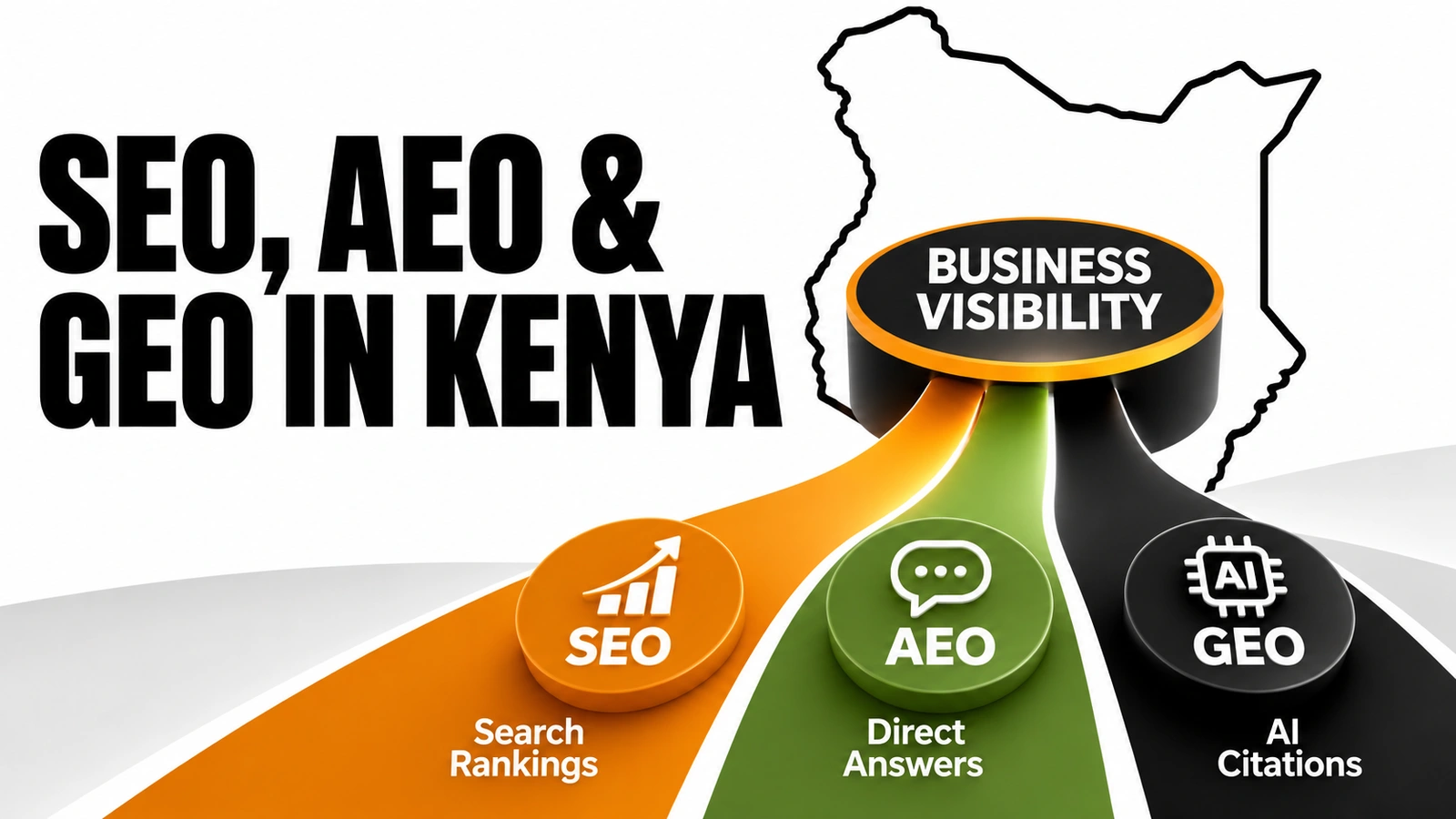
SEO, AEO and GEO are best treated as overlapping parts of one search visibility system. SEO makes pages accessible, relevant, useful and authoritative enough to compete in search. AEO improves how clearly content answers specific questions. GEO focuses on whether generative systems can understand, corroborate and cite a source when constructing an answer.
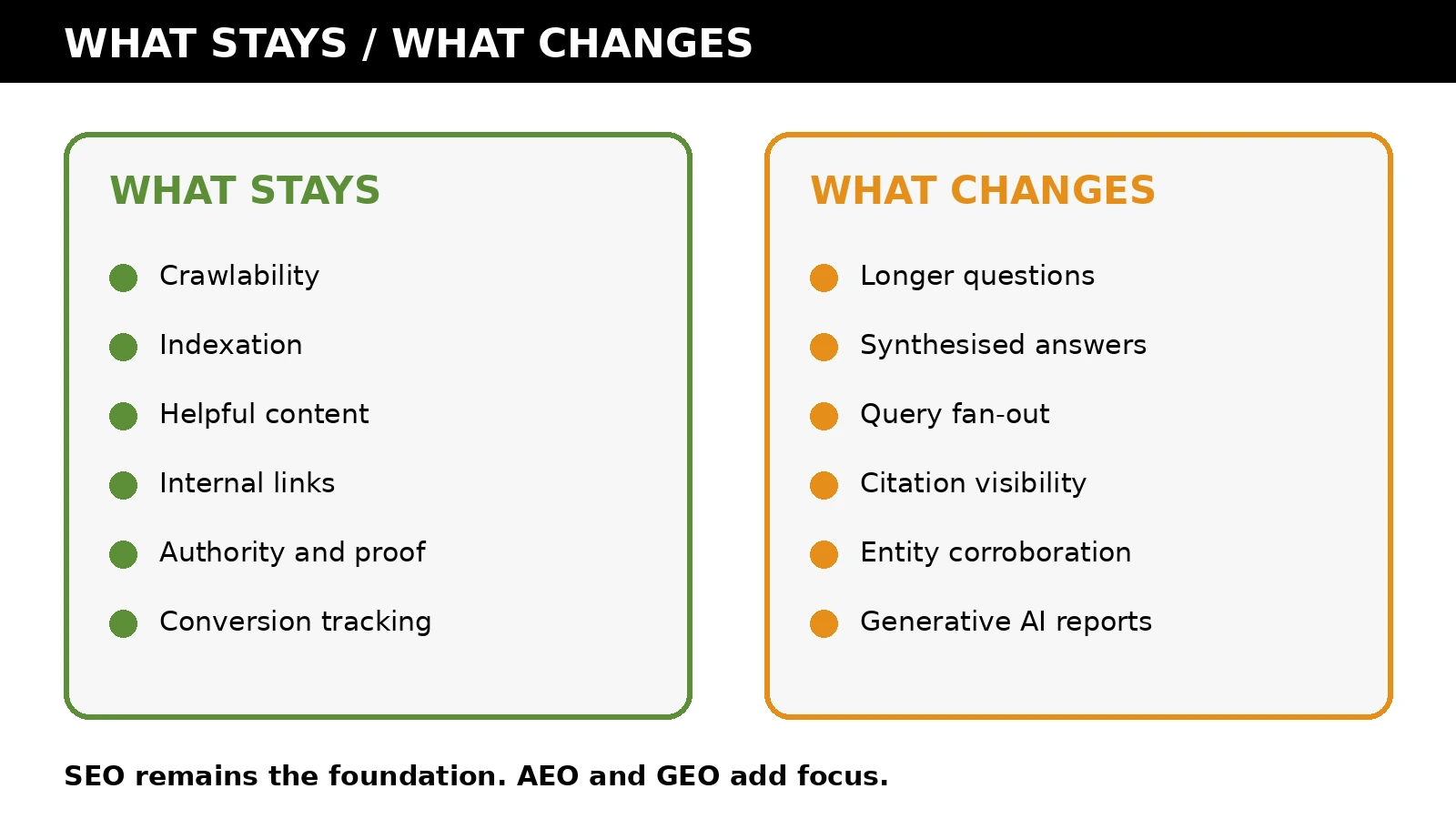
For Google Search, the foundation has not been replaced. Google states that established SEO practices remain relevant to AI Overviews and AI Mode, and that there are no additional technical requirements or special schema needed to appear in those features. What changes is the search experience: people ask longer questions, results may synthesize several sources, and measurement now includes dedicated generative-AI visibility reporting in Search Console. The practical response is to strengthen SEO, make answers more precise, document entities and evidence clearly, and measure outcomes across search, AI visibility and enquiries.
Key takeaways
- SEO remains the foundation. A page still needs to be accessible, indexable, useful, internally linked and eligible for a search snippet.
- AEO is a useful editorial lens for direct, complete answers. It is not a separate ranking system that replaces SEO.
- GEO is a useful visibility lens for generative answers and citations. It does not create a guaranteed route into ChatGPT, Gemini, Perplexity, AI Overviews or AI Mode.
- Google says no special AI text file or special schema is required for its generative search features.
- Structured data remains useful when it accurately describes visible content, but markup cannot manufacture authority or guarantee a result.
- Kenyan businesses should measure page visibility, generative-AI impressions, qualified enquiries and revenue. Prompt checks alone are too unstable to become the main KPI.
- The protected commercial destination is Tabala's AI Search Optimization service page. This article explains the operating model without duplicating that service intent.
Table of contents
- [Why the terminology matters](#why-the-terminology-matters)
- [SEO, AEO and GEO defined](#seo-aeo-and-geo-defined)
- [What stays the same](#what-stays-the-same)
- [What changes with AI-led search](#what-changes-with-ai-led-search)
- [How to build one visibility system](#how-to-build-one-visibility-system)
- [A practical Kenyan example](#a-practical-kenyan-example)
- [How to measure performance](#how-to-measure-performance)
- [Common mistakes to avoid](#common-mistakes-to-avoid)
- [Thirty-day implementation checklist](#thirty-day-implementation-checklist)
- [Frequently asked questions](#frequently-asked-questions)
Why the terminology matters
A Kenyan business can lose months of useful work by treating every new search acronym as a new channel. One agency proposes SEO. Another sells AEO. A third promises GEO citations. The website owner is left comparing labels while the service pages remain thin, important URLs are difficult to crawl, business details conflict across profiles, and nobody can connect visibility to qualified enquiries.
The commercial consequence is not academic. If the team spends its budget on a new layer of “AI optimization” while the site has weak technical foundations, the same defects limit both conventional search and AI-led discovery. If it ignores answer-led search completely, it may rank for short keywords but fail to provide the clear comparisons, evidence and explanations that modern buyers expect.
The right question is therefore not which acronym wins. It is which work helps a credible business become findable, understandable, corroborated and chosen.
Google's current guidance is unusually direct. Its documentation says the same SEO best practices remain relevant for AI Overviews and AI Mode. A page must be indexed and eligible to appear with a snippet, and there are no extra technical requirements for inclusion. Google's 2026 generative-search guide also warns against overfocusing on artificial “AEO/GEO hacks” such as unnecessary AI text files or manufactured mentions. See Google's official guidance on AI features and your website and optimizing for generative AI features.
That does not make AEO and GEO meaningless. It gives them a proper role: they are lenses for improving answer quality, evidence, entity clarity and measurement on top of sound SEO.
SEO, AEO and GEO defined
The three terms overlap, but each emphasizes a different part of the discovery journey.
| Term | Main question | Practical focus | Common output |
|---|---|---|---|
| SEO | Can the right page be discovered, indexed, understood and ranked for relevant searches? | Technical access, intent, content quality, internal links, authority, user experience and conversion | Search-visible pages that attract relevant visits and enquiries |
| AEO | Can a system extract a clear and accurate answer to the user's question? | Direct answers, question coverage, definitions, comparisons, steps, tables and consistent facts | Answer-ready passages, featured-result eligibility and clearer user journeys |
| GEO | Can a generative system understand, corroborate and cite the source when synthesizing an answer? | Entity clarity, original evidence, source quality, expert context, consistent facts and citation-worthy coverage | Greater potential to be referenced across generative experiences |
SEO: the discoverability and relevance foundation
Search engine optimization aligns a website with how people search and how search engines crawl, index and rank pages. It covers technical SEO, keyword and intent research, content, internal linking, authority, local relevance, page experience and measurement.
For a Nairobi law firm, this may mean one strong page for a specific legal service, technically accessible supporting guides, clear location evidence and a reliable conversion path. For a Mombasa hotel, it may mean crawlable room and destination pages, accurate business information, original travel guidance and structured booking information. The implementation differs, but the foundation is the same.
If that foundation is uncertain, start with the technical SEO checklist for Kenyan websites or run Tabala's free SEO audit.
AEO: the answer clarity layer
Answer engine optimization is the practice of making information easier to retrieve as a direct answer. A strong answer normally states the conclusion first, adds the condition or scope, and then supplies the evidence or next step.
For example, “How much should a Kenyan SME invest in SEO?” cannot be answered responsibly with one universal number. An answer-ready page should explain that the budget depends on the site's condition, competition, implementation responsibility and commercial value. It can then provide transparent ranges, inclusions and exclusions. The structure makes the answer easier to extract without pretending the market has one tariff.
AEO improves human readability too. Clear headings, short answer paragraphs, useful tables and complete definitions reduce the work a buyer must do before acting.
GEO: the generative visibility layer
Generative engine optimization became a formal research term through the 2023 paper GEO: Generative Engine Optimization, later presented at KDD 2024. The research explored ways to improve source visibility in generative-engine responses. Its benchmark findings should not be treated as a universal commercial promise, but the framework gave marketers useful language for a real shift: an answer can be synthesized from several sources instead of displayed as a conventional list of ranked links.
In practice, GEO asks whether a system can identify the business or author, understand the claim, confirm it against credible evidence and cite the page for the right context. Original data, explicit sourcing, consistent entity information, expert review, precise claims and well-connected topic coverage all help. None guarantees a citation.
What stays the same
Crawlability and indexation still come first
A source cannot earn sustainable search visibility if important pages cannot be accessed or indexed. Robots controls, status codes, canonicals, redirects, sitemaps, mobile rendering and internal links still determine whether search systems can reach the content intended for discovery.
Google says a page must be indexed and eligible to appear with a snippet before it can be shown as a supporting link in AI Overviews or AI Mode. This means a technically weak website cannot skip directly to GEO.
Helpful and distinctive content still matters
Commodity text is easy to reproduce and difficult to prefer. A useful page adds something a buyer could not obtain from a generic summary: local market context, a decision framework, implementation detail, original examples, professional judgment, transparent limitations or first-party evidence.
For Kenyan audiences, local relevance should be earned. Mention Nairobi, Mombasa, Kisumu, Nakuru or Eldoret when the location changes the answer. Do not insert town names into identical paragraphs. A multi-location clinic may need genuinely different service availability, directions, proof and FAQs for each location. A national ecommerce store may need delivery, payment and returns information that applies across Kenya rather than five copied city pages.
Authority still has to be demonstrated
Neither a keyword nor a schema property proves expertise. Readers and systems need evidence: named authors, current source links, first-party case information, clear service experience, accurate business profiles, reviews and reputable external references.
Authority also comes from coverage. One isolated article is less useful than a connected cluster that explains definitions, decisions, implementation and measurement. Internal links tell readers what to explore next and help crawlers understand those relationships. Tabala's SEO services in Nairobi show how technical, content, local and measurement work belong in one acquisition system.
Structured data must match visible content
Structured data remains useful for describing pages and making content eligible for supported search features. Google's structured data guidelines require markup to represent the visible page accurately. Marking up information that users cannot see, or adding a schema type merely because it sounds relevant, creates risk rather than authority.
Google explicitly says there is no special schema required for AI Overviews or AI Mode. Use BlogPosting, BreadcrumbList, Organization, LocalBusiness, Product, Service or other types when they truthfully describe the page. Treat schema as clarification, not a citation switch.
Conversion still determines commercial value
Visibility without a next step can become an expensive reporting exercise. A business should still connect landing pages to calls, WhatsApp enquiries, forms, bookings, purchases or qualified opportunities. The objective is not to appear in the most interfaces. It is to make the right buyer more likely to discover, trust and choose the business.
What changes with AI-led search
Queries become longer and more comparative
A conventional query might be “SEO agency Nairobi.” An AI-led query may ask: “Which Nairobi SEO agency is suitable for a multi-location healthcare business, what should the monthly scope include, and how should we measure qualified leads?” The second query combines category, location, use case, buying criteria and measurement.
This changes content planning. A single keyword map remains useful, but the page also needs to answer related decisions and conditions. It should explain who the service fits, where it does not fit, which evidence matters and what the buyer should do next.
One response may draw from many subqueries
Google explains that AI Overviews and AI Mode can use query fan-out, issuing several related searches across subtopics and data sources. A page may therefore be discovered for a supporting passage even when it is not the conventional number-one result for the original wording.
The practical opportunity is broader passage usefulness, not forced “content chunking.” Build sections that are complete enough to stand on their own while remaining part of a coherent article. Use descriptive headings, explicit subjects and supporting evidence. Do not reduce the article to disconnected blocks written for a machine.
Citation and corroboration become visible concerns
In a ranked results page, visibility is usually attached to a URL and position. In a generative answer, the system may summarize a claim and attach one or more supporting links. Brands therefore need facts that can be checked across their site, profiles and reputable third-party sources.
For a Kisumu logistics company, that may include consistent service areas, named transport capabilities, accurate contact information, documented delivery processes and customer evidence. For an Eldoret agribusiness supplier, it may include product specifications, counties served, expert agronomic guidance and current regulatory sources. Vague claims such as “best quality” offer little to corroborate.
Measurement gains a new layer
Google launched dedicated Search Generative AI performance reports in Search Console in June 2026 and completed the worldwide rollout on 31 August 2026. The report provides generative-AI impressions with page, country, device and date dimensions. It covers visibility in features such as AI Overviews and AI Mode while that activity also remains part of overall search performance reporting. See Google's launch announcement.
This matters because prompt screenshots are not a stable baseline. Answers can change by wording, context, location, model and time. Use controlled prompt panels for qualitative research, but give first-party Search Console data more weight for Google visibility.
More platforms require clearer measurement boundaries
Google Search Console measures Google. It does not provide a complete view of ChatGPT, Perplexity, Gemini outside Search, Microsoft Copilot or every assistant experience. Teams may need referral analytics, server logs, assisted-conversion analysis and a repeatable prompt panel to supplement first-party search data.
That does not justify inventing one universal “AI rank.” Record the platform, prompt set, market, date, source inclusion and outcome separately.
How to build one visibility system
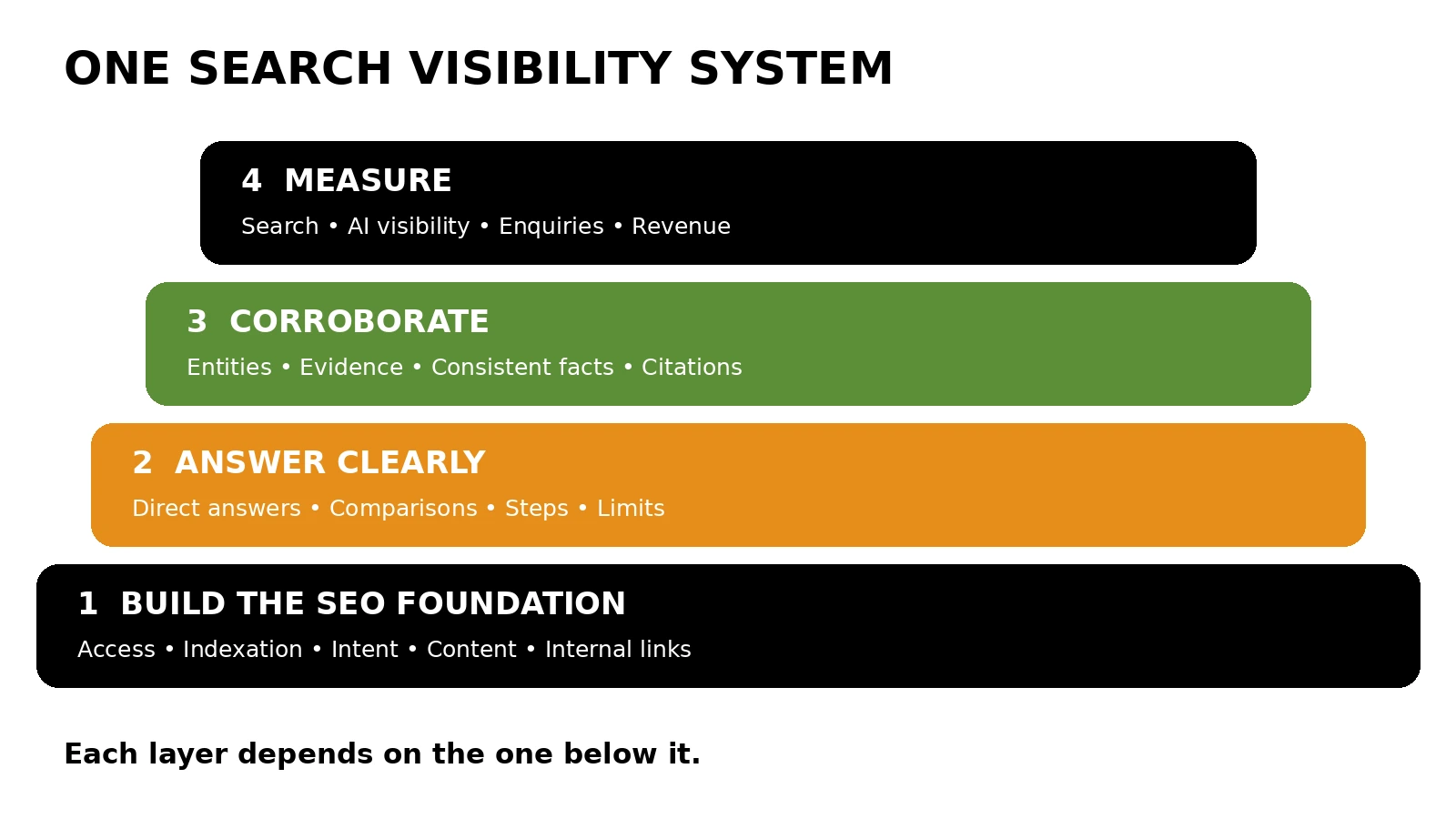
The most efficient approach is a layered operating model. Each layer depends on the one below it.
Layer 1: fix technical access
Confirm that priority pages return the correct status, allow crawling, use the intended canonical, appear in internal navigation, render essential content on mobile and are eligible for indexing. Check Search Console coverage and URL inspection before debating AI citations.
Layer 2: map commercial intent
Assign one primary job to each important page. The service page should convert service demand. A comparison article should help a buyer choose. A checklist should support implementation. A glossary should define concepts. This reduces cannibalization and gives internal links a clear purpose.
This article owns comparison and operating-model intent for “SEO, AEO and GEO in Kenya.” The protected AI Search Optimization service page remains the commercial page for businesses seeking implementation.
Layer 3: create complete answers
For each priority question:
- State the answer early.
- Define the scope and exceptions.
- Show the evidence or reasoning.
- Add a Kenyan example when location changes the decision.
- Link to the next useful page.
This pattern serves readers first and also makes passages easier to interpret accurately.
Layer 4: strengthen entities and proof
Make the business name, location, services, leadership, credentials and contact details consistent. Connect the website, Google Business Profile, reputable directories, professional profiles and authoritative references. Name authors and reviewers. Date material where freshness matters. Distinguish first-party evidence from external research.
An entity is not strengthened by repeating the company name in every paragraph. It is strengthened when multiple reliable signals agree about who the business is and what it does.
Layer 5: add accurate structured data
Implement markup that describes the visible page and validate it. Keep Organization and LocalBusiness information consistent. Use Article or BlogPosting for editorial content, BreadcrumbList for hierarchy, and relevant service or product types where supported by the page. Do not mark every heading as a question or create hidden FAQ content to chase an imagined AI advantage.
Layer 6: build a connected topic cluster
Connect the commercial page to supporting explanations, technical guides, audits, comparisons and measurement content. This creates useful reader journeys and helps establish topical relationships.
For this cluster, the AI marketing guide provides the broad business context. The technical SEO checklist explains access and indexation. This comparison explains the operating model. The AI Search service page covers implementation. The AI Visibility Audit gives a practical diagnostic next step.
Layer 7: measure and improve
Review visibility by page and query, generative-AI impressions, engagement, conversion paths and qualified outcomes. Refresh weak pages when evidence shows an intent gap, missing proof, technical constraint or poor conversion path. Avoid rewriting pages simply because a tool introduced a new score.
A practical Kenyan example
Consider a professional training company serving Nairobi, Mombasa and Kisumu. It wants to be visible when HR leaders search for leadership training and when they ask AI assistants to compare suitable Kenyan providers.
SEO work would include a technically accessible leadership-training service page, location evidence, course details, internal links, expert-led supporting articles, title and heading alignment, and conversion tracking for brochure downloads and consultation requests.
AEO work would improve direct answers: who the programme is for, delivery formats, typical duration, how outcomes are assessed, whether programmes can be customized and what a procurement team should compare.
GEO work would strengthen corroboration: named facilitators and credentials, original programme methodology, client evidence with permission, consistent company details, references to relevant standards, clear dates and pages that other sources can cite responsibly.
The company should not create three near-identical city pages. If delivery differs by city, each page should include genuine venue, schedule, facilitator, travel or client context. If the offer is national and delivery is consistent, one strong Kenya-wide service page may be better.
The result is one coherent system. SEO makes the content reachable and relevant. AEO makes the answers usable. GEO makes claims easier to understand and verify. Conversion design turns that visibility into a business conversation.
How to measure performance
Use a measurement stack rather than one score.
| Layer | Primary evidence | What to monitor | Limitation |
|---|---|---|---|
| Google Search | Search Console Performance | Queries, pages, clicks, impressions, CTR, average position, country and device | Aggregated data; position is contextual |
| Google generative AI | Search Console Generative AI performance report | Generative-AI impressions, visible pages, countries, devices and dates | Availability may depend on sufficient data; does not cover every AI platform |
| Other AI platforms | Analytics referrals, server logs and controlled prompt panel | Referral sessions, cited pages, brand mentions, source inclusion and changes over time | Prompt outputs vary; referral attribution can be incomplete |
| On-site behaviour | Analytics and event tracking | Engaged visits, CTA clicks, form starts, calls, WhatsApp clicks and bookings | Requires clean implementation and consent handling |
| Commercial outcome | CRM and sales records | Qualified leads, opportunities, revenue, sales cycle and assisted conversions | Depends on disciplined lead-source capture |
Build the baseline before changing content
Export at least the latest 90 days and the prior comparable period. Capture page-query pairs, not only site totals. Separate branded and non-branded demand where it helps decision-making. Record the pages currently appearing in the generative-AI report. Add CRM outcome data where available.
Current Tabala planning remains provisional because the latest usable GSC and SEMrush exports were not available in the connected sources. The exact missing inputs are listed in the package's evidence note. No impression, ranking, CTR or difficulty metric in this package has been invented.
Use prompt testing as qualitative research
Create a fixed panel of realistic prompts for Kenya, Nairobi and relevant service locations. Record the wording, platform, date, sources cited and whether the business appears. Repeat on a defined schedule. Use the results to discover coverage gaps and citation patterns, not to claim a stable universal ranking.
Connect visibility to enquiries
Add campaign and landing-page context to lead records. Ask which pages assisted the journey. Review qualified enquiries rather than treating every form completion as equal. A page can lose clicks while improving lead quality, or gain visibility without contributing commercial value.
Common mistakes to avoid
Declaring SEO dead
Generative interfaces still need accessible, trustworthy sources. Google's own guidance says SEO remains foundational. Abandoning technical quality, intent mapping or internal linking weakens the material AI systems may retrieve.
Creating a second page for every acronym
Separate pages for “SEO services,” “AEO services,” “GEO services” and “AI SEO services” can compete for the same commercial intent. Keep a clear canonical service destination, then use supporting articles for distinct informational jobs.
Treating llms.txt or special schema as mandatory
Google says no new AI text file or special markup is required to appear in its AI features. Experimental files or protocols may have other uses, but they should not displace crawlability, content quality or measurement.
Publishing generic question blocks
Adding dozens of shallow FAQs does not create answer authority. Questions should reflect real buyer decisions and receive complete, accurate answers. Google stopped showing FAQ rich results broadly in 2026, so FAQ content should earn its place through reader value, not an expected search decoration.
Manufacturing mentions and citations
Inauthentic mentions, paid placements without editorial value and copied “expert” quotes can create reputational and search risk. Build references through useful research, strong services, legitimate partnerships, original tools and credible commentary.
Trusting a proprietary score without evidence
A third-party platform can help organize work, but it does not have access to Google's internal ranking or AI systems. Google explicitly advises teams to evaluate third-party claims against official guidance. Ask what the score measures, which data it uses, how often it updates and whether improvements correlate with qualified business outcomes.
Thirty-day implementation checklist
Week 1: establish the baseline
- Export GSC Queries, Pages, Countries and Devices for the latest and prior 90-day periods.
- Export the GSC Generative AI report by page, country, device and date.
- Record SEMrush Organic Research positions and pages plus Kenya Position Tracking if available.
- Identify the service pages that generate or should generate qualified enquiries.
- Run the AI Visibility Audit and record the diagnostic, not only the score.
Week 2: fix access and page roles
- Resolve indexation, canonical, status-code and internal-link problems on priority pages.
- Give each service, comparison, checklist and glossary page one primary intent.
- Consolidate or redirect genuine duplicates.
- Keep the existing AI Search Optimization service URL, canonical and navigation role unchanged.
Week 3: improve answers and evidence
- Rewrite weak openings so they state the business problem and practical answer early.
- Add useful comparisons, definitions, steps and limitations.
- Add named expertise, current authoritative sources, original examples and proof.
- Align business details across the website, Google Business Profile and trusted profiles.
Week 4: connect and measure
- Add contextual links between the service page, technical guide, comparison article, audit and AI marketing pillar.
- Validate structured data against visible content.
- Test calls, forms, WhatsApp and booking events.
- Review generative-AI visibility and traditional search performance by page.
- Create the next content brief from measured gaps rather than a new acronym.
Frequently asked questions
Is SEO still relevant when people use AI search?
Yes. Google says established SEO practices remain relevant to AI Overviews and AI Mode. Technical access, indexation, helpful content, internal links and authority still support discovery. AI-led search adds new answer and measurement considerations; it does not remove the foundation.
What is the difference between AEO and GEO?
AEO focuses on making content suitable for direct answers. GEO focuses on visibility and citation potential in generative responses that synthesize several sources. The implementation overlaps: clear answers, strong evidence, consistent entities and accessible pages support both.
Does a Kenyan business need separate SEO, AEO and GEO agencies?
Usually not. The business needs one accountable strategy with clear owners for technical SEO, content, authority, entity consistency, structured data, analytics and conversion. Separate specialists can help, but the work should share one page map and measurement system.
Is there special schema for AI Overviews or AI Mode?
No. Google says no special schema is required for its AI features. Use structured data that truthfully describes visible content and follows Google's policies. Markup can improve clarity and eligibility for supported search features, but it does not guarantee inclusion.
Will adding FAQs make a page appear in AI answers?
Not by itself. FAQs can improve clarity when they answer real buyer questions accurately. Thin or repetitive questions add little value. A page still needs technical accessibility, useful content, evidence and authority.
How can I see whether my site appears in Google's generative AI features?
Use the Generative AI performance report in Google Search Console. It includes generative-AI impressions and dimensions for pages, countries, devices and dates. Combine it with the main Performance report, analytics and conversion data.
How do I measure ChatGPT or Perplexity visibility?
Use referral analytics and server logs where available, then maintain a controlled prompt panel for qualitative monitoring. Record platform, prompt, location, date and cited sources. Do not present one prompt result as a stable ranking.
Should I create location pages for Nairobi, Mombasa, Kisumu, Nakuru and Eldoret?
Only when each page serves a real local need and contains distinct value. Useful differences may include service availability, staff, proof, delivery, venue, regulations or customer questions. Replacing town names in duplicate text creates weak pages and cannibalization risk.
How long does GEO take to work?
There is no universal timeline or guaranteed outcome. Progress depends on technical access, current authority, competition, content quality, corroborating sources and how often platforms refresh their systems. Set implementation milestones and measure visibility and qualified demand over time.
What should a business do first?
Establish the baseline, fix technical access, clarify the role of each priority page, strengthen direct answers and evidence, then connect the cluster with contextual internal links. If the current gap is unclear, run Tabala's AI Visibility Audit before buying isolated tactics.
Build one accountable visibility system
SEO, AEO and GEO describe different parts of the same commercial problem. A buyer needs to find the business, understand the answer, trust the evidence and know what to do next. A search or AI system needs accessible pages, clear context and corroborated information before it can surface those answers responsibly.
Keep SEO as the foundation. Use AEO to improve answer clarity. Use GEO to strengthen evidence, entity consistency and generative visibility. Measure all three against qualified enquiries and revenue.
Run Tabala's AI Visibility Audit to identify the current gaps in SEO foundation, answer-led content, entity consistency, structured data, authority and measurement. If the opportunity is clear and you need implementation, review AI Search Optimization services in Nairobi.
Accelerate Your Revenue
While Revenue Intelligence builds long-term authority, Google Ads delivers immediate, high-intent traffic. Combine both for maximum market dominance.

Strategist Profile
Abala Tom
Digital systems strategist specializing in high-performance SEO, Google Ads, and conversion optimization. Mission: to replace marketing 'guesswork' with predictable revenue systems.