How Long Does SEO Take in Kenya? A Realistic Timeline
Quick answer
There is no fixed number of days or months in which every Kenyan website should rank. Google says some changes may be reflected within hours, while others can take several months, and recommends waiting at least a few weeks before assessing many improvements. A business can often see early technical, indexing or impression signals within weeks. Meaningful growth in competitive visibility, qualified enquiries and revenue commonly needs sustained work over several months. The responsible answer is a staged timeline tied to the site's condition, market, implementation speed and commercial goal, not a guaranteed “page one in 90 days” promise.
Key takeaways
- SEO has several clocks: implementation, crawling, indexing, ranking, traffic and commercial conversion.
- Early movement does not always mean the programme is succeeding, and quiet weeks do not automatically mean it has failed.
- An established site fixing a clear technical problem may respond faster than a new domain entering a competitive market.
- Local visibility for a specific service can move differently from national product or category searches.
- A credible provider reports completed work, indexation, relevant impressions, landing-page performance and qualified leads.
- A fixed ranking guarantee ignores competition, search systems and factors outside an agency's control.
- The correct review question is not only “How many months?” It is “What evidence should exist by this stage?”
Why there is no single SEO timeline
A business can spend three months waiting for “SEO to kick in” when the real problem is much simpler: the priority page was never indexed, the developer did not implement the recommendations or the agency targeted a search that brings readers but no buyers.
That is why a timeline without a diagnosis is close to meaningless.
When someone asks how long SEO takes in Kenya, they may be asking several different questions:
- When will Google discover a changed page?
- When will the page enter the index?
- When will impressions begin?
- When will rankings improve for a useful query?
- When will more people visit the site?
- When will that traffic produce qualified enquiries or sales?
- When will the programme recover its cost?
Those events do not happen at the same time. A new service page may be crawled within days, start earning a few relevant impressions weeks later and still need more work before it produces a customer. Another page may already rank but fail commercially because it answers the wrong intent or has a weak next step.
Google's SEO Starter Guide says every change takes time to be reflected. Some changes may take effect within hours, while others can take several months. Google advises waiting at least a few weeks before assessing whether many changes had a beneficial effect.
That is the most honest foundation for planning. There are ranges and milestones, not one universal deadline.
Do Kenyan websites have a separate Google timeline?
No. Google does not publish a special waiting period for Kenya, Nairobi or East Africa. The same crawling, indexing and ranking systems apply. What changes locally is the competitive environment, the available search demand, the strength of competing pages, the locations served and the business's ability to implement the work.
A Nairobi law firm competing for a broad commercial phrase faces a different task from a specialised supplier in Nakuru targeting a narrow product category. A Mombasa hotel entering a crowded travel market will not share the same path as an Eldoret consultant building visibility around a highly specific service.
The six clocks behind SEO results
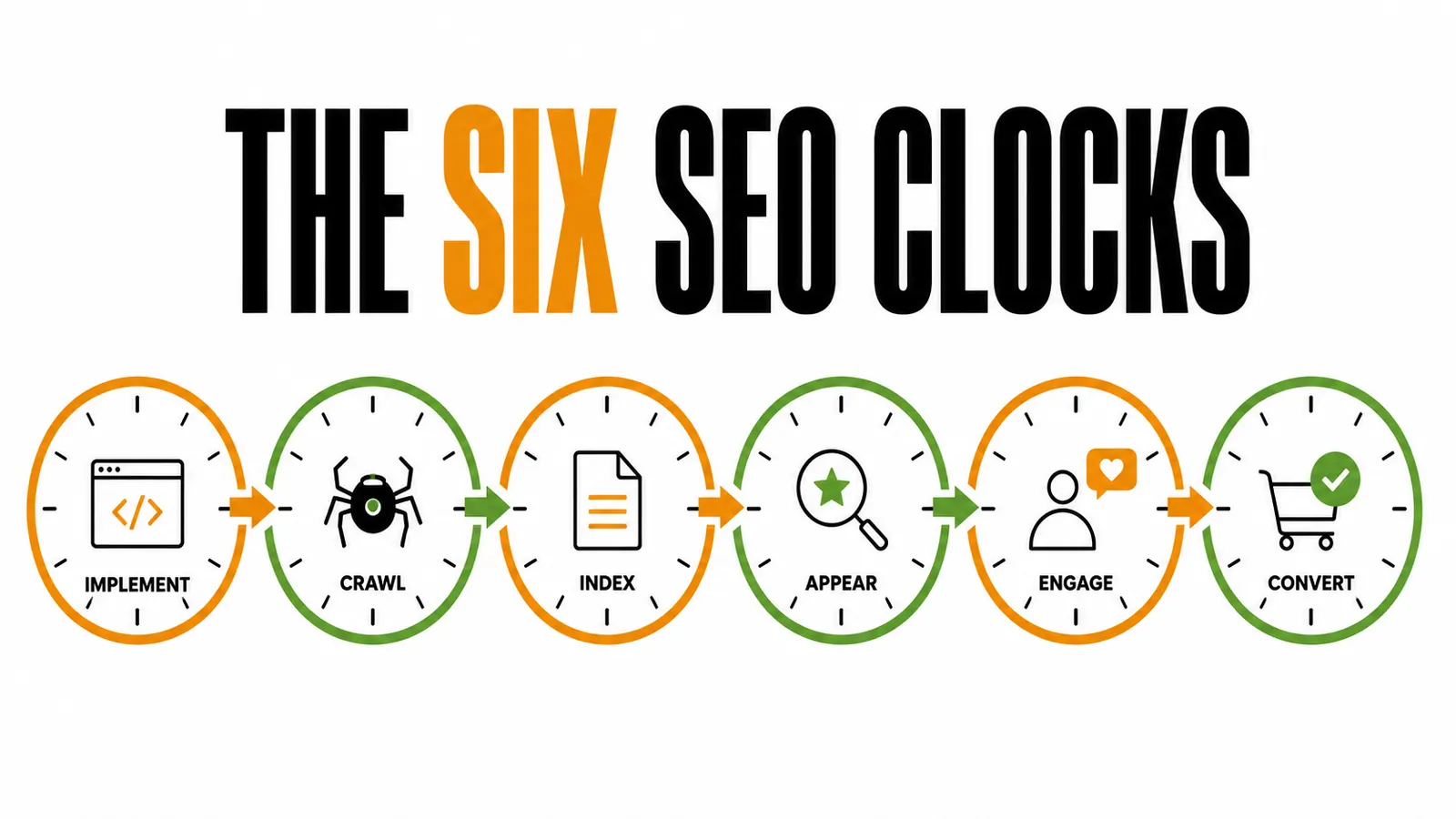
It is useful to think of organic growth as six connected clocks. If one clock has not started, the later ones cannot be judged fairly.
| Clock | What is happening | Evidence to look for |
|---|---|---|
| Implementation | Recommendations become real website changes | Published pages, fixed templates, working redirects and completed technical tickets |
| Discovery and crawling | Googlebot finds new or changed URLs | URL Inspection, crawl evidence and sitemap processing |
| Indexing | Google decides whether to store the page | Indexing status and canonical selection in Search Console |
| Search visibility | The page earns impressions and ranking positions | Relevant queries, pages and impression trends |
| Engagement | Searchers choose and use the result | Organic clicks, landing-page behaviour and useful actions |
| Commercial impact | Visits become qualified opportunities or sales | Calls, forms, bookings, qualified leads, pipeline and revenue |
The implementation clock is often ignored
An agency can finish research in week two, but the clock does not advance if title changes, service pages, internal links or technical fixes remain in a document for six weeks. Reporting “three months of SEO” is misleading when only a few days of recommendations have reached the live site.
Record the date each material change was implemented. Judge its effect from that point, not from the date the invoice was paid.
Crawling is not indexing, and indexing is not ranking
Google explains that Search works through crawling, indexing and serving results. A crawl request can take from a few days to a few weeks, and requesting a recrawl does not guarantee instant inclusion. See Google's guidance on requesting a recrawl.
An indexed page has cleared one stage. It has not earned a particular position. Relevance, quality, competition, context and other systems still affect whether it appears for a query.
Rankings are not the same as business results
A page can improve from position 60 to position 20 without producing a noticeable volume of clicks. It is still evidence that Google is testing or reassessing the page, but it is not yet a commercial win.
Likewise, ranking first for an irrelevant or very narrow phrase may produce no useful enquiries. Progress must remain tied to the demand the business can serve.
What a realistic first six months can look like
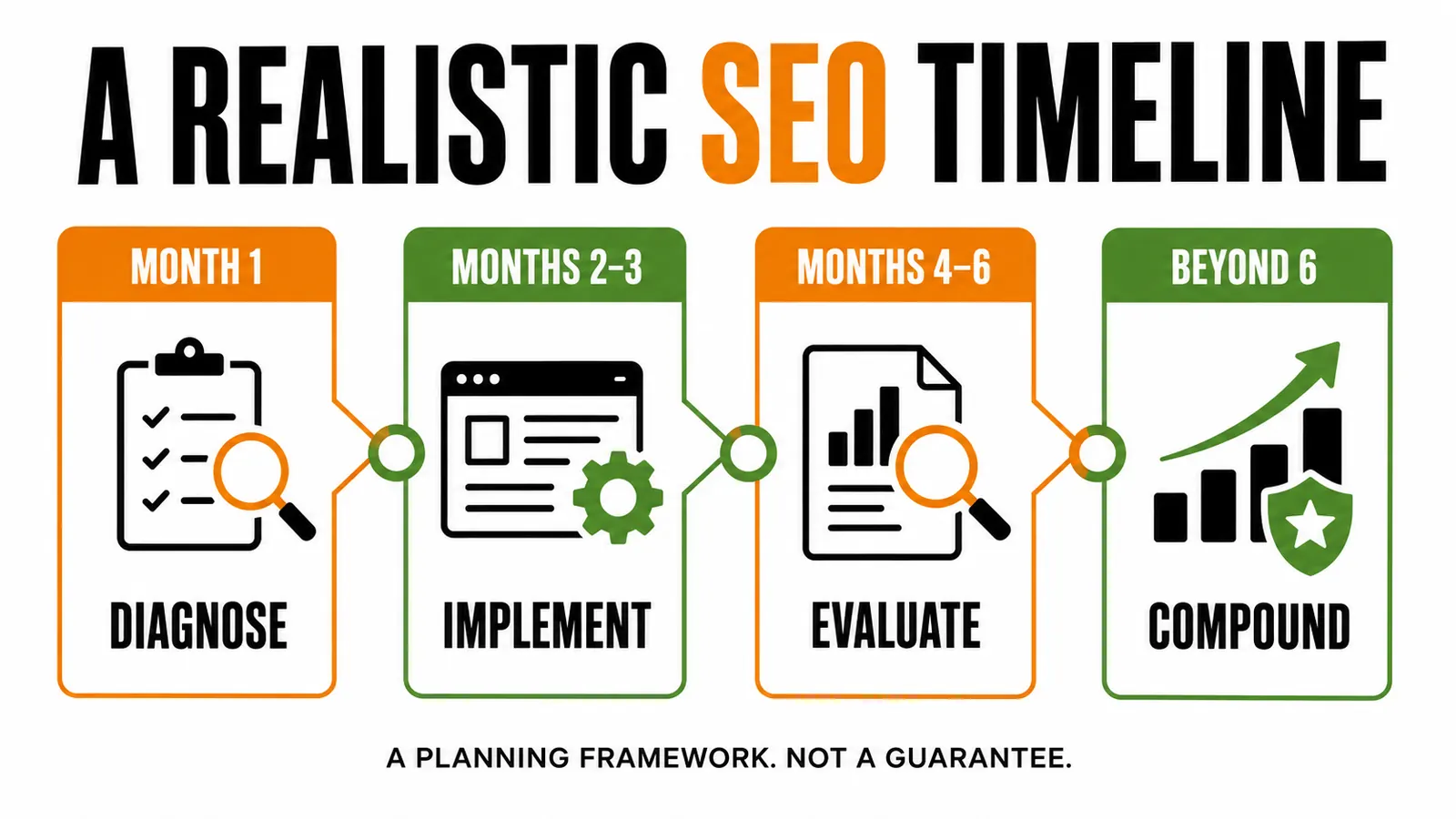
The following timeline is a planning framework, not a promise. A focused local project may move faster. A new site in a competitive sector may take much longer. The work, evidence and constraints matter more than the calendar label.
Month 1: diagnosis and foundations
The first month should create clarity.
Typical work includes:
- establishing access to Search Console, analytics and the website;
- checking crawling, indexing, canonicals, redirects and site architecture;
- defining priority services, locations and commercial outcomes;
- mapping important search intents to existing or planned pages;
- documenting the baseline for relevant visibility and conversions;
- repairing urgent issues that prevent access or lead generation.
The strongest month-one result may be an accurate diagnosis, not a ranking jump. If important pages were blocked or broken, visible movement can happen sooner. If the foundation was already healthy, the month may be spent producing the assets needed for later growth.
Months 2 and 3: implementation and early evidence
This is where the plan should become visible on the site.
Typical work includes:
- improving priority commercial pages;
- publishing missing service, category or location content;
- strengthening headings, titles, internal links and calls to action;
- aligning Google Business Profile information where local search matters;
- resolving technical recommendations;
- beginning relevant authority and relationship work;
- testing forms, calls, bookings or purchases.
Possible early signals include successful indexation, more impressions for relevant queries, a wider set of ranking terms, better branded visibility or movement from very low positions. These signals should be interpreted carefully. A short spike can disappear, while a quiet but steady expansion across useful queries may be more valuable.
Months 4 to 6: evaluation and compounding
By this stage, a consistently implemented programme should provide better evidence about what is working.
The team can evaluate:
- which commercial pages are gaining relevant visibility;
- whether clicks are coming from the intended locations and queries;
- which articles assist service-page discovery;
- whether local profile actions and organic enquiries are improving;
- which pages remain stuck and why;
- whether leads are qualified and commercially valuable;
- what deserves expansion, consolidation or repair.
Some businesses may see meaningful gains within this period. Others may still be building credibility in a competitive category. The correct response is not to declare success at month six automatically. It is to compare the work completed, evidence observed and constraints remaining.
Beyond six months: scale or change the thesis
Longer programmes should not repeat the same tasks indefinitely. They should deepen what has evidence behind it, improve weak pages, earn stronger authority and expand into adjacent demand.
If the strategy has been implemented consistently and there is still no relevant visibility, no improvement in page coverage and no defensible explanation, the team should reconsider the diagnosis. Waiting is not a strategy.
What can move quickly and what usually takes longer
Not all search work needs the same patience.
| Change | What may happen relatively quickly | What may still take longer |
|---|---|---|
Remove an accidental noindex | Google may recrawl and restore eligibility | Previous visibility may not return immediately |
| Repair a broken redirect or canonical | Signals can become clearer after recrawling | Consolidation and ranking reassessment can take time |
| Update a title and page copy | The snippet or relevance may change after processing | Competitive position depends on the whole result set |
| Improve an existing strong page | Impressions can respond within weeks | Qualified traffic and conversion need enough demand |
| Publish a new service page | Discovery and indexing can happen fairly soon | Trust and page-one competitiveness may take months |
| Improve a Google Business Profile | Details may update promptly | Local visibility depends on relevance, distance and prominence |
| Earn relevant mentions and links | Referral value may be immediate | Search-system interpretation and competitive effect are not scheduled |
| Repair site-wide quality problems | Individual pages may improve at different speeds | Google's site-level reassessment may take several months |
Google's guidance on core updates says improvements may show in a few days, but it can take several months for systems to learn and confirm that a site is producing helpful, reliable content over the long term. In some cases, a site may need to wait for a later core update to see the full effect.
This is why “we changed the page yesterday” is not enough evidence to judge the final result. It is also why an agency cannot use patience as a blanket excuse for unfinished work.
What determines the timeline in Kenya
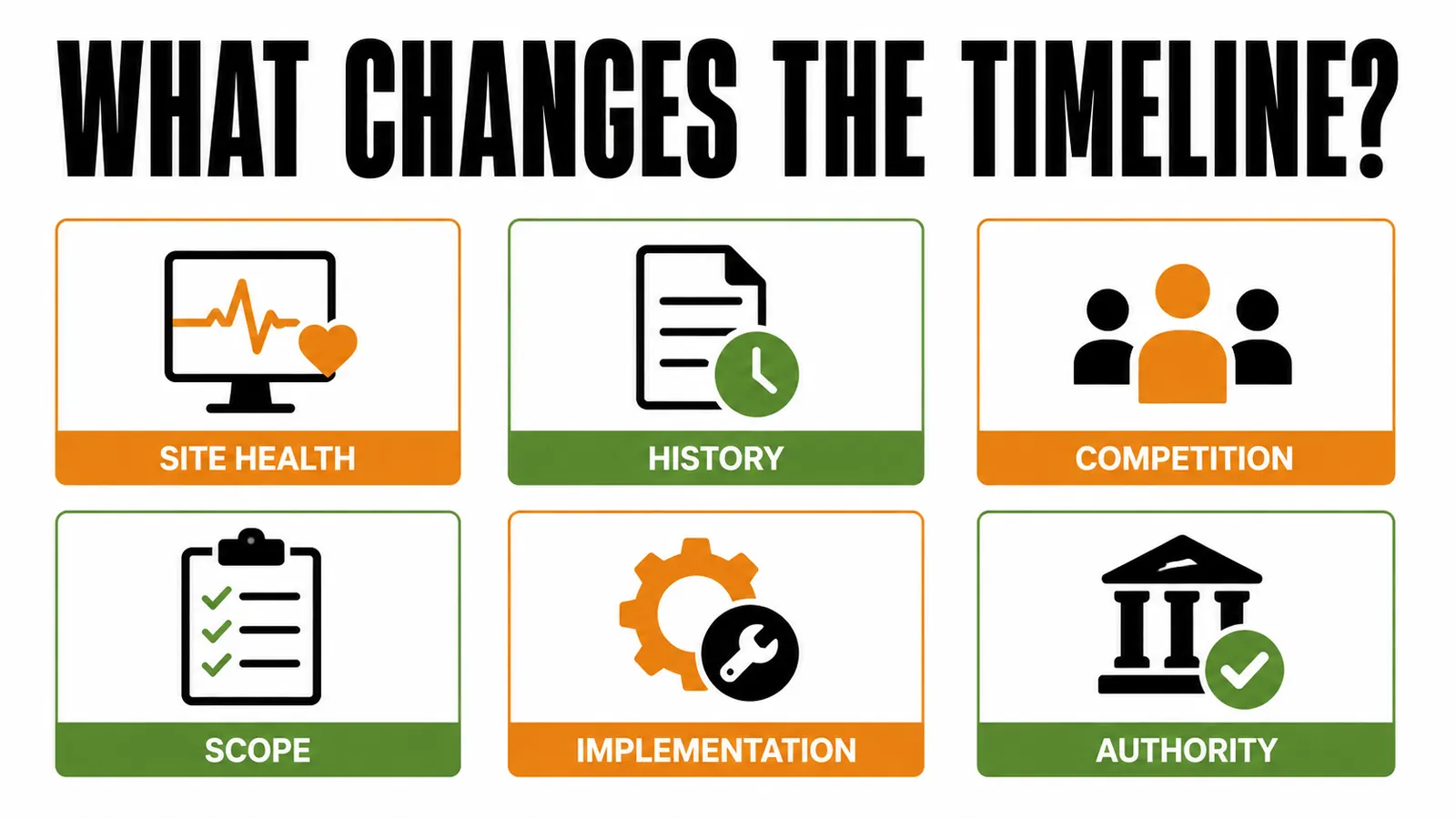
The condition of the website
An established site with sound architecture and a few clear gaps can respond differently from a site with duplicate URLs, weak service pages, inconsistent redirects and no reliable measurement.
Start with a free SEO Visibility Audit to identify whether the main constraint is access, content, authority or conversion. A timeline should follow that diagnosis.
Website and domain history
Age alone does not guarantee strong rankings. History matters because an existing site may have useful pages, links, branded demand and past performance data. It may also carry years of duplication, migrations, low-value content or poor link decisions.
A new domain starts without that history. It can still earn visibility, especially for specific and underserved searches, but it should not be sold the same schedule as an established brand with relevant authority.
Competition and search intent
“Accountant in Nairobi” and a detailed question about one tax process are not equally competitive or commercially equivalent. Broad money terms often attract established firms, directories, publishers and strong service pages.
The more valuable and crowded the query, the stronger the page, brand evidence, authority and experience normally need to be. Choosing attainable subtopics can create earlier learning without abandoning the larger commercial goal.
Scope and number of markets
A business serving one area has a narrower architecture than an organisation targeting Nairobi, Mombasa, Kisumu, Nakuru and Eldoret with distinct branches or service realities. Multi-location visibility requires accurate profiles, useful location information, governance and local proof.
Creating five city names on otherwise identical pages does not create five strong local assets. The local SEO guide for Kenyan businesses explains how local relevance should connect profiles, website pages and trust.
Implementation capacity
The timeline stretches when every recommendation waits for a developer, legal review, new photography or management approval. That may be a valid business constraint, but it should appear in reporting.
The provider should separate:
- work completed by the search team;
- changes awaiting the client;
- changes awaiting development;
- changes live and waiting for processing;
- tests that have enough data to assess.
Content and evidence quality
Publishing more words is not the same as improving the site. A page becomes stronger when it answers the decision, shows credible experience, uses accurate sources and connects to a real offer.
Thin pages can be produced quickly and still create months of cleanup. Human expertise, original examples, customer questions and clear commercial judgment take more effort but create a better foundation for both traditional and AI-assisted discovery.
Authority and reputation
Competitive visibility is difficult when nobody outside the site confirms the business exists or deserves attention. Relevant mentions, professional associations, supplier relationships, reviews and independent coverage develop through real activity.
This cannot be compressed into a safe package of 100 links delivered next Friday. Sustainable authority takes time because trust is earned, not uploaded.
Measurement maturity
A site may already be generating leads from organic search without recording the source correctly. Another may report form fills but count spam and job applications as conversions.
Until tracking and qualification are fixed, nobody knows whether the timeline is commercially working. The Digital Growth Diagnostic can help distinguish a visibility problem from a website, measurement or sales-process problem.
How timelines differ by business and website
An established Nairobi service company
Suppose the business has operated for years, owns a credible domain and ranks on pages two or three for relevant services. Its strongest opportunity may be improving intent alignment, service-page depth, internal links and conversion paths.
Early movement may appear sooner because Google already knows the site. However, moving from the lower results to the most competitive positions can be harder than moving from nowhere to initial visibility.
A new professional-services website
A new firm may have excellent expertise but no search history, few mentions and only a homepage. The first job is to build a complete commercial structure and credible entity signals.
It may earn visibility for specific questions or narrow services before broad category terms. The programme should judge whether the site is becoming eligible across the right topic, not demand an immediate top position for the biggest phrase.
A local business in Kisumu or Nakuru
A strong local offer, accurate Google Business Profile, relevant category, useful service information and genuine reviews can create earlier discovery for specific local needs. Distance and competition still affect results, so two searchers in the same city may see different businesses.
Local progress should include profile actions, calls, directions, website visits and qualified enquiries, not a single screenshot from one location.
An ecommerce business serving Kenya
Online shops often have more URLs, technical dependencies and inventory changes. Category architecture, product availability, merchant data, duplication, filters, structured data and mobile purchase experience can all affect the programme.
An ecommerce timeline should separate technical coverage from category growth and actual sales. More indexed products are not useful if the wrong pages appear or the checkout loses customers.
A site recovering after a redesign or traffic loss
Recovery work follows a different clock. The priority may be restoring changed URLs, redirects, internal links, canonicals and lost content rather than publishing new articles.
Do not assume every decline is an algorithm penalty. Compare the timing of migrations, deleted pages, tracking changes, manual actions and announced Google updates. Recovery may be fast when one technical mistake is isolated, or prolonged when the site lost important content and authority.
What should happen in the first 30, 60 and 90 days
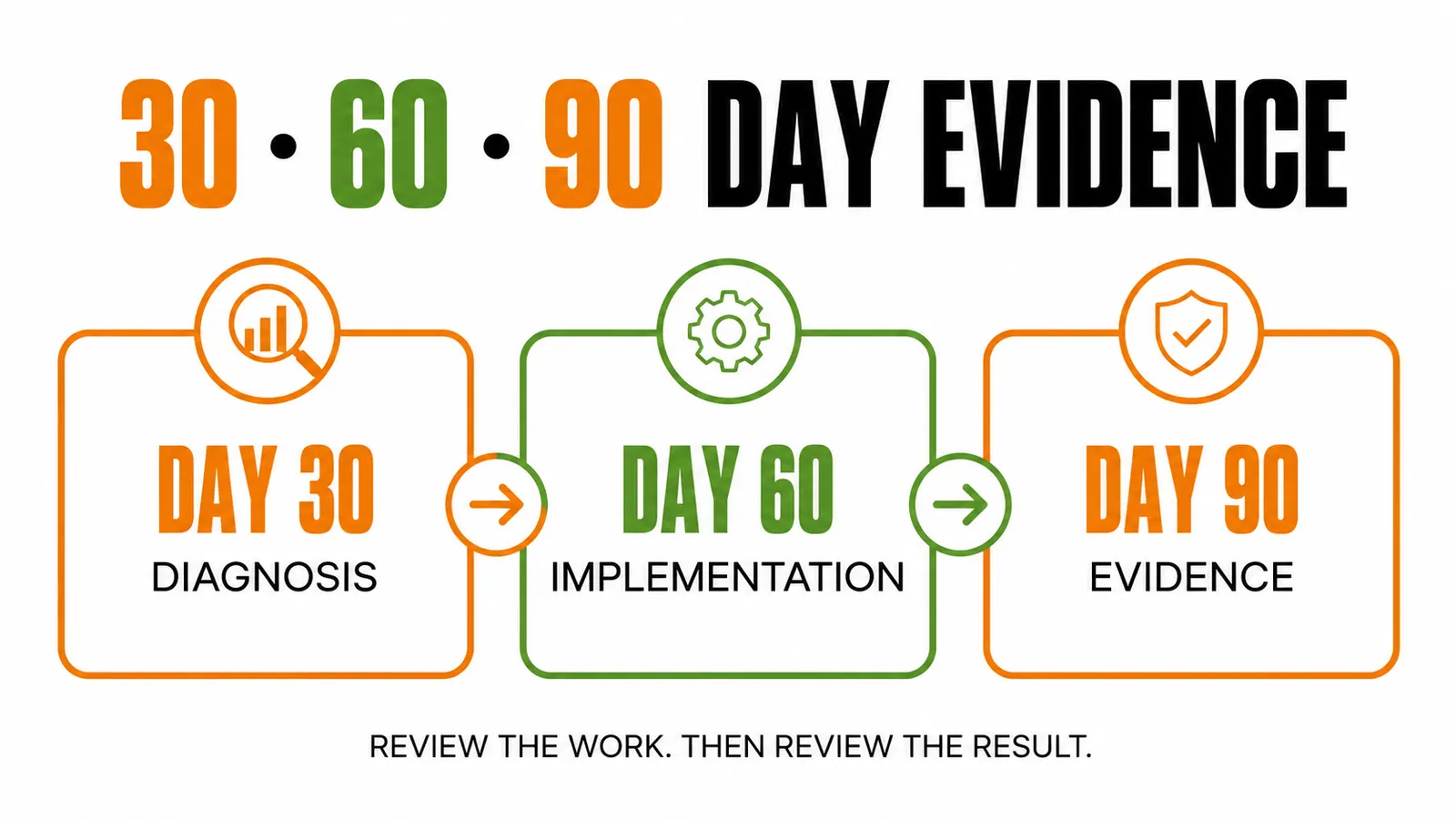
These milestones assess execution and evidence. They do not guarantee a ranking by each date.
By day 30
- Goals, priority services, locations and commercial conversions are defined.
- Search Console, analytics and website access are confirmed.
- Technical, content, authority and conversion baselines are documented.
- The keyword-to-page and topic map is agreed.
- Critical access, indexing or measurement defects are prioritised.
- Owners and implementation deadlines are named.
By day 60
- Priority technical fixes should be live or have a documented blocker.
- Core service or category pages should be improved or in production.
- Internal links should connect relevant commercial and supporting content.
- Local profiles should be aligned where location affects the decision.
- Conversion actions should be tested.
- Search Console should be monitored for discovery, indexation and relevant-query signals.
By day 90
- The business should be able to see what work went live and when.
- Priority pages should have clear indexing status.
- Relevant impressions and ranking coverage should be compared with the baseline.
- Early clicks and enquiries should be checked for quality.
- Pages with no movement should have a specific diagnosis, not a vague “wait longer.”
- The next quarter should be based on evidence from the first, not the original proposal copied forward.
The detailed SEO cost guide for Kenya can help buyers evaluate whether the engagement funds enough strategy, implementation and measurement to meet these milestones.
How to measure progress before revenue arrives
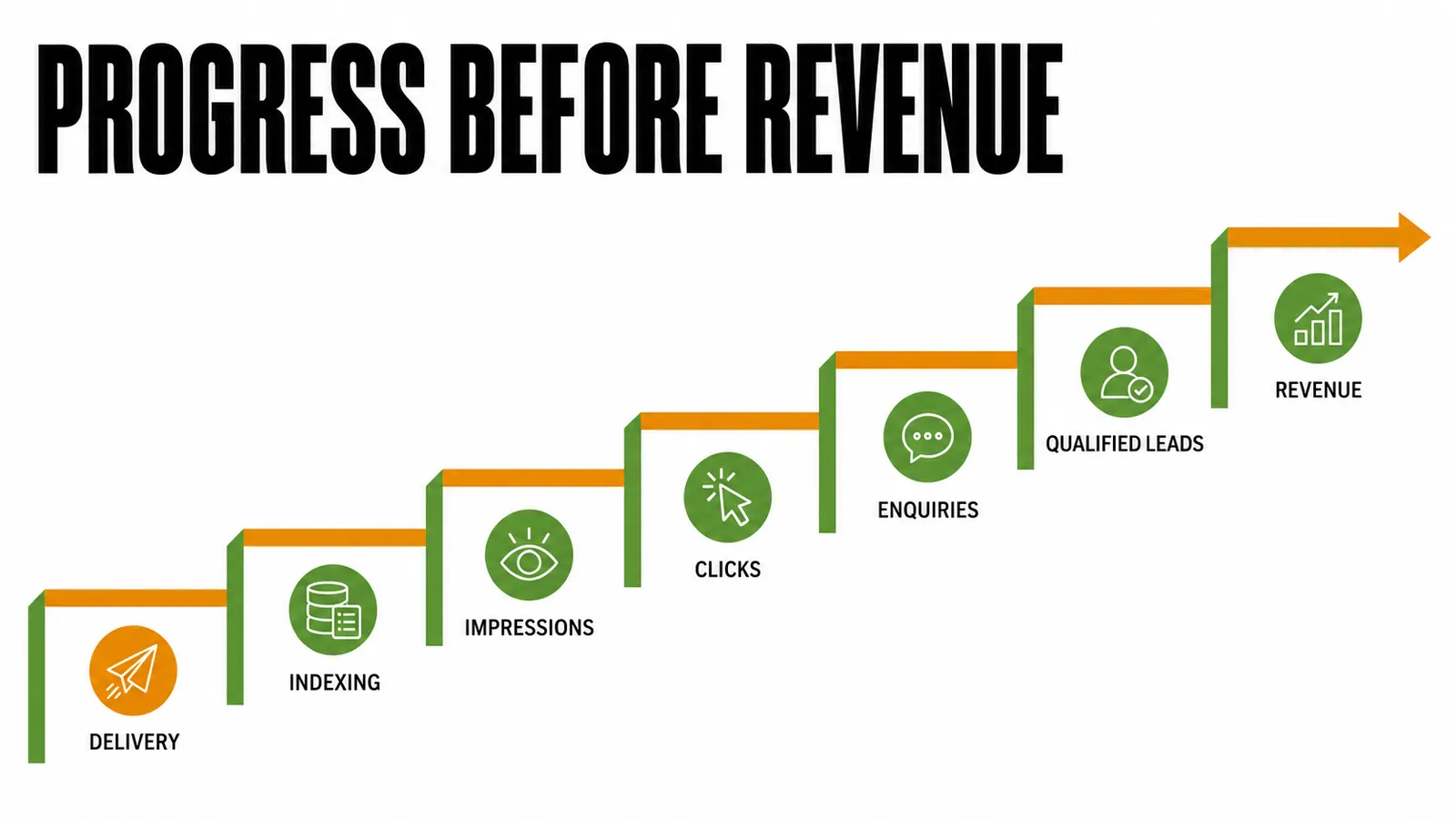
Revenue is the strongest business outcome, but it may be a lagging measure. Use a sequence of evidence without mistaking the early signals for the final goal.
| Stage | Measures | What a useful review asks |
|---|---|---|
| Delivery | implemented fixes, pages and internal links | Did the planned work reach the live site? |
| Technical eligibility | crawlability, indexation and canonical status | Can Google access and use the right pages? |
| Relevance | impressions for priority topics and locations | Are we appearing for searches the business can serve? |
| Attraction | clicks, click-through and landing pages | Are searchers choosing the result? |
| Conversion | calls, forms, bookings and purchases | Are visits taking meaningful actions? |
| Quality | accepted leads, opportunities and customers | Are the actions commercially useful? |
| Return | pipeline, revenue and gross profit | Is the programme creating economic value? |
Google's Search Console guidance recommends using the tool to understand performance and monitor significant changes, not checking it every day. Monthly review is normally sufficient for a small site, with additional checks after important changes or problems.
Do not report averages without the pages and queries behind them
An average position can improve because branded searches increased while a priority service page declined. Total traffic can grow because one informational article attracted people outside the market.
Review the actual queries, landing pages, locations where available and conversion quality. A smaller increase in commercially relevant visibility can be more valuable than a large increase in general readership.
Measure AI visibility carefully
Google says the same foundational practices apply to AI Overviews and AI Mode, and no special AI markup is required. The company's AI features guidance recommends indexable pages, good page experience, crawlable links, accessible text and structured data that matches visible content.
AI citation checks can provide directional intelligence, but results can vary by prompt, time and user context. Do not turn a handful of manual prompts into a guaranteed visibility score. If AI discovery is strategically important, connect the work to the protected AI Search Optimization service and measure it as part of the wider search system.
When slow progress is reasonable
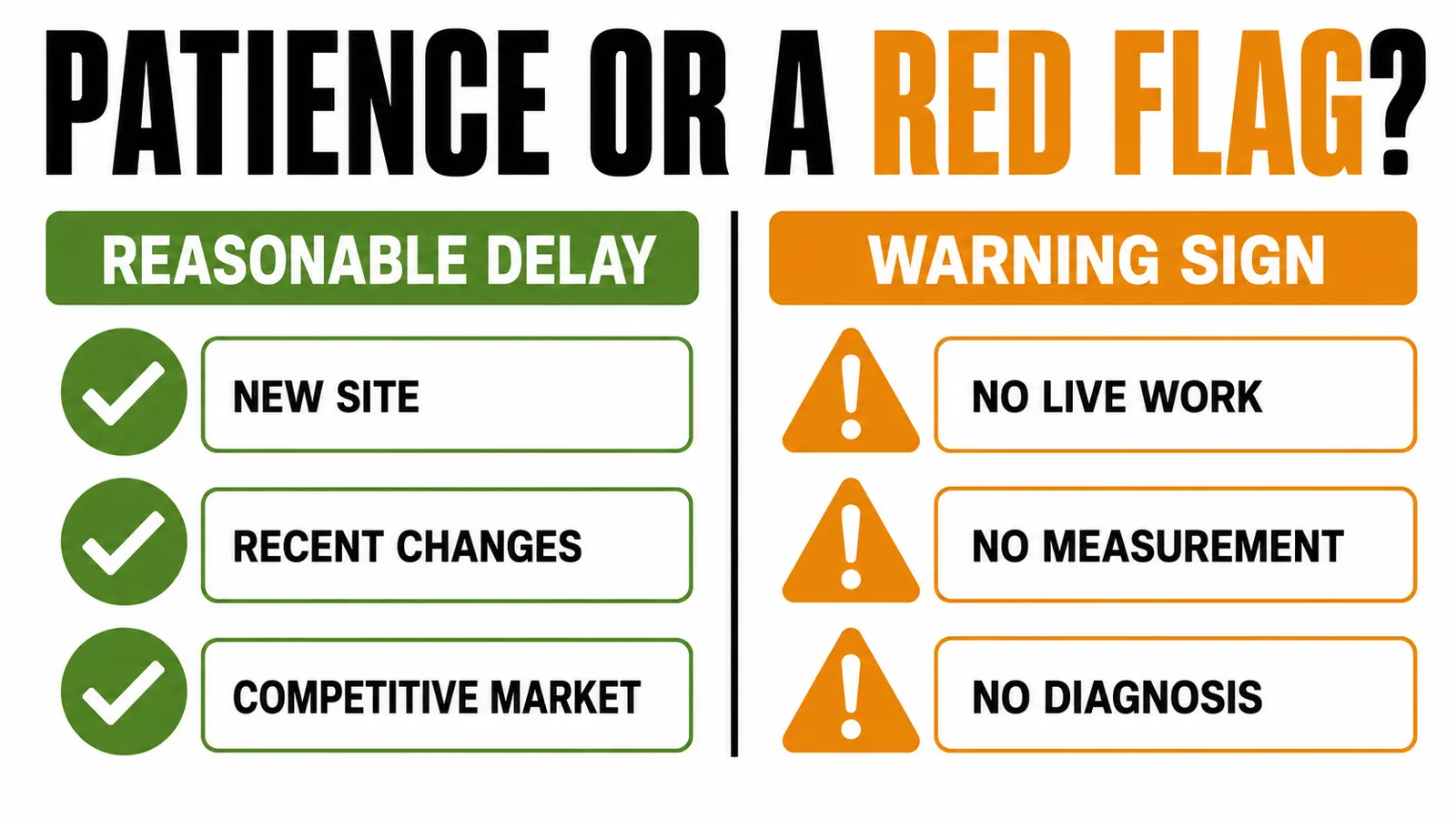
Patience can be justified when:
- a new domain is entering an established category;
- material recommendations were implemented recently;
- Google has not yet recrawled important URLs;
- the project requires substantial new service or category content;
- a migration or consolidation needs signals to settle;
- authority and reputation are being built through genuine relationships;
- the business is waiting on development or internal approval;
- site-wide quality improvements need broader reassessment;
- the search demand is seasonal and the review window misses the buying period.
The provider should still explain what has happened, what evidence exists and what remains uncertain.
When slow progress is a warning sign
“SEO takes time” becomes an excuse when it hides inactivity or poor thinking.
Investigate when:
- the agency cannot show which changes went live;
- months pass without access to Search Console or conversion data;
- reports show only total traffic and generic keyword counts;
- the same tasks appear every month without an outcome;
- content is published without a page map or internal-link role;
- rankings are promised for phrases unrelated to profitable services;
- backlinks arrive from unrelated or obviously manufactured sites;
- priority pages are still not indexed and nobody owns the fix;
- leads are never qualified or connected to revenue;
- the strategy does not change after evidence contradicts it;
- a redesign, deletion or redirect problem is ignored while new blogs continue.
A mobile SEO and conversion review may also be necessary when visibility improves but mobile users cannot complete the next step.
How to evaluate an agency's timeline
Do not ask only, “How many months until page one?” A responsible search partner cannot control competitors, Google updates or the exact timing of ranking reassessment.
Ask these questions instead:
- What is the current constraint on our priority pages?
- Which changes should be live in the first 30, 60 and 90 days?
- Who implements each recommendation?
- How will crawling and indexation be verified?
- Which queries, pages and locations define relevant progress?
- How will calls, forms, bookings or sales be measured?
- How will lead quality be reported?
- What would cause the strategy to change?
- Which risks could extend the timeline?
- What happens if implementation is delayed?
A credible answer connects the timeline to the audit, resources and market. It does not offer certainty before reviewing the site.
If you are comparing providers, SEO services in Nairobi should include diagnosis, implementation priorities, meaningful reporting and a clear commercial path. The engagement should explain what the business owns and what the provider owns.
Avoid ranking guarantees
Google does not accept payment to crawl more often or rank a page higher, and even pages that follow Search Essentials are not guaranteed to be crawled, indexed or served. A provider can guarantee deliverables, communication standards and honest reporting. It cannot guarantee a specific organic position by a specific date.
Ethical, sustainable methods are discussed further in Tabala's guide to white-hat search optimisation.
SEO timeline checklist
Before work starts
- Priority services, locations and commercial goals are documented.
- The current site condition has been audited.
- Search Console and analytics access are confirmed.
- Meaningful conversion actions are defined and tested.
- The engagement separates strategy from implementation.
- Dependencies and approval owners are named.
During the first quarter
- Every material recommendation has an owner and status.
- Live dates are recorded for major changes.
- Priority pages have verified indexing status.
- Reports show pages and relevant queries, not totals alone.
- Internal links connect service and supporting content.
- Lead quality is discussed with sales or the owner.
- Delays are attributed to a specific constraint.
At each review
- Completed work is compared with the plan.
- Relevant impressions, clicks and conversions are reviewed together.
- Branded and non-branded demand are separated where useful.
- Short spikes are not presented as durable growth.
- The next action responds to evidence.
- No ranking or AI citation is presented as guaranteed.
Frequently asked questions
How long does SEO take to work in Kenya?
There is no universal deadline. Some technical or indexing changes can appear within days or weeks, while competitive visibility and meaningful commercial growth may require several months of consistent implementation. Judge the work through staged evidence, not a fixed promise.
Can SEO show results in one month?
Yes, but the result may be an implemented fix, restored indexation, new relevant impressions or better branded visibility rather than a major increase in sales. A clear technical problem on an established site can respond faster than a new website competing for broad commercial terms.
Is three to six months a guaranteed SEO timeline?
No. Three to six months is often used as a planning range, but it is not a guarantee. Competition, website history, technical condition, content, authority, implementation speed and the definition of “results” can shorten or extend the path.
How long does a new website take to rank on Google?
A new website can be discovered and indexed relatively quickly, but ranking for competitive searches can take much longer. Specific, useful pages may earn initial visibility before broad service or category terms. There is no official waiting period that applies to every new domain.
Does local SEO work faster than national SEO?
It can, particularly for a specific service in a less competitive area, but it is not automatically fast. Local visibility depends on relevance, distance and prominence, while the profile, website and reputation must accurately represent the business.
How often should SEO performance be reviewed?
Track implementation continuously, check important technical changes after launch and conduct a meaningful performance review monthly. Daily ranking checks often create noise. Quarterly reviews are useful for deciding whether to scale, repair or change the strategy.
Why are rankings moving but leads are not increasing?
The site may be gaining visibility for low-intent queries, appearing below the positions that earn meaningful clicks or sending visitors to weak landing pages. It may also have broken tracking. Review queries, pages, conversion paths and lead quality together.
When should I stop an SEO campaign?
Do not stop only because one month was quiet. Reconsider the programme when agreed work is not being implemented, relevant visibility is not expanding, measurement remains unreliable or the strategy cannot explain persistent failure after a reasonable evidence window.
Can an SEO agency guarantee first-page rankings?
No responsible agency can control Google's results or competitors closely enough to guarantee a position by a date. It can commit to research, implementation, technical standards, content quality, reporting and transparent decisions.
Set milestones, not fantasies
The answer to “How long does SEO take?” should never be a number pulled from a proposal template.
Start with the site. Define the commercial pages that matter. Identify what prevents them from being accessed, understood, trusted or chosen. Record when the fixes go live. Then watch the sequence from indexation to relevant visibility, engagement, qualified leads and revenue.
Some progress can appear within weeks. Stronger market visibility may take several months. Competitive authority can take longer. The timeline is credible only when every stage has evidence and an owner.
If your current programme is asking for more patience without showing what is blocking progress, run Tabala Digital's free SEO Visibility Audit. It will help identify whether the delay starts with technical access, content structure, authority or the conversion path. If you need an implementation strategy tied to commercial outcomes, review our SEO services in Nairobi.
Accelerate Your Revenue
While Revenue Intelligence builds long-term authority, Google Ads delivers immediate, high-intent traffic. Combine both for maximum market dominance.

Strategist Profile
Abala Tom
Digital systems strategist specializing in high-performance SEO, Google Ads, and conversion optimization. Mission: to replace marketing 'guesswork' with predictable revenue systems.