CRO for Small Businesses in Kenya: A Practical Guide
Practical conversion rate optimization for Kenyan businesses. Fix leaky funnels, improve mobile journeys and turn traffic into paying clients.
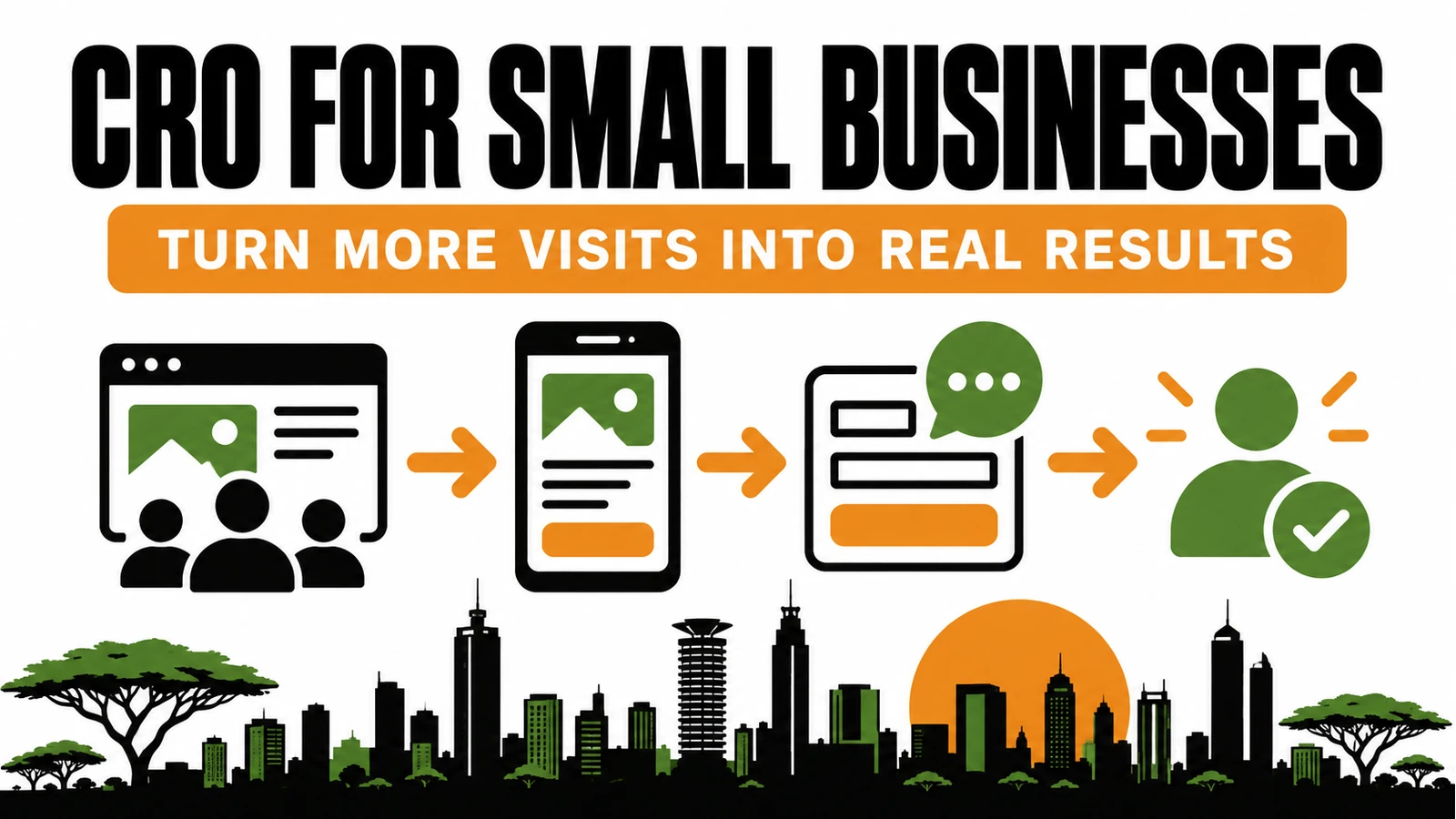
A small business can pay for search visibility, social campaigns and website traffic, then lose the commercial opportunity after the visitor arrives.
The problem is not always a lack of demand. A Nairobi consultancy may attract the right decision-maker but hide its process behind a vague “Contact us” button. A Mombasa retailer may display the product but leave delivery costs and returns unanswered. A Kisumu clinic may ask for too much sensitive information before explaining what happens after an appointment request. Each point of friction gives a qualified visitor another reason to delay, leave or choose a competitor.
Conversion rate optimisation, usually shortened to CRO, is the disciplined work of finding those obstacles and improving the path from interest to a completed business outcome. It is not a collection of button-colour tricks. For a Kenyan small business, CRO should connect the offer, the website, the enquiry channel and the sales follow-up to a measurable result.
This guide explains how to build that system with the traffic and resources you already have.
Quick answer
Conversion rate optimisation helps a business increase the proportion of relevant visitors who complete a valuable action, such as submitting a qualified enquiry, booking an appointment or completing a purchase.
Start by defining one primary outcome for each page. Confirm that it is measured when the action completes, not merely when someone clicks a button. Then review the journey for five common constraints: weak message match, unclear value, unresolved risk, difficult interaction and failed follow-up. Fix the largest constraint first and compare the completed outcomes before and after the change.
Small businesses with limited traffic do not need to wait for a sophisticated testing platform. They can combine analytics, form records, WhatsApp conversations, call logs, sales outcomes and direct customer feedback to make evidence-led improvements. The standard remains the same: document the hypothesis, change one meaningful element, watch for unintended effects and judge the result using qualified leads or sales.
Key takeaways
- CRO begins with a business outcome, not a website element.
- Measure completed enquiries, bookings and purchases rather than button clicks alone.
- Improve the path from traffic source to page, action, delivery and sales follow-up.
- Match each page to one audience, one decision and one primary next step.
- Resolve buyer risk beside the action instead of hiding proof and policies elsewhere.
- Treat mobile usability, form delivery and page reliability as conversion requirements.
- Use Kenyan buying realities naturally, including WhatsApp, M-Pesa, delivery coverage and KES pricing.
- Low-traffic businesses can use structured before-and-after tests without pretending the evidence is statistically conclusive.
- Protect personal data and request only what the business needs at that stage.
- Prioritise changes by expected commercial impact, confidence and effort.
1. What CRO means for a small business
Conversion rate optimisation is a structured process for improving how often suitable visitors complete a valuable action.
The action depends on the business:
- a law firm may want a qualified consultation request;
- a contractor may want a site-visit booking;
- a clinic may want a confirmed appointment;
- a retailer may want a paid order;
- a training provider may want an application from an eligible learner;
- a B2B supplier may want a request containing product, quantity and delivery information.
The word “suitable” matters. Increasing low-quality form submissions is not an improvement if the sales team spends more time rejecting them. A better CRO programme improves both completion and commercial usefulness.
CRO is not only design
The constraint may sit outside the visible page. The form may fail to send an email. A WhatsApp conversation may have no assigned owner. A quotation may take four days. The price shown in an advert may not match the page. A customer may complete checkout but receive no confirmation.
For that reason, CRO should examine five connected layers:
- Acquisition: the source, audience and promise that brought the visitor.
- Page: the message, offer, evidence and interaction.
- Action: the form, call, WhatsApp, booking or checkout.
- Delivery: whether the completed action reaches the business and the customer receives confirmation.
- Commercial outcome: whether the enquiry becomes qualified, quoted, sold or retained.
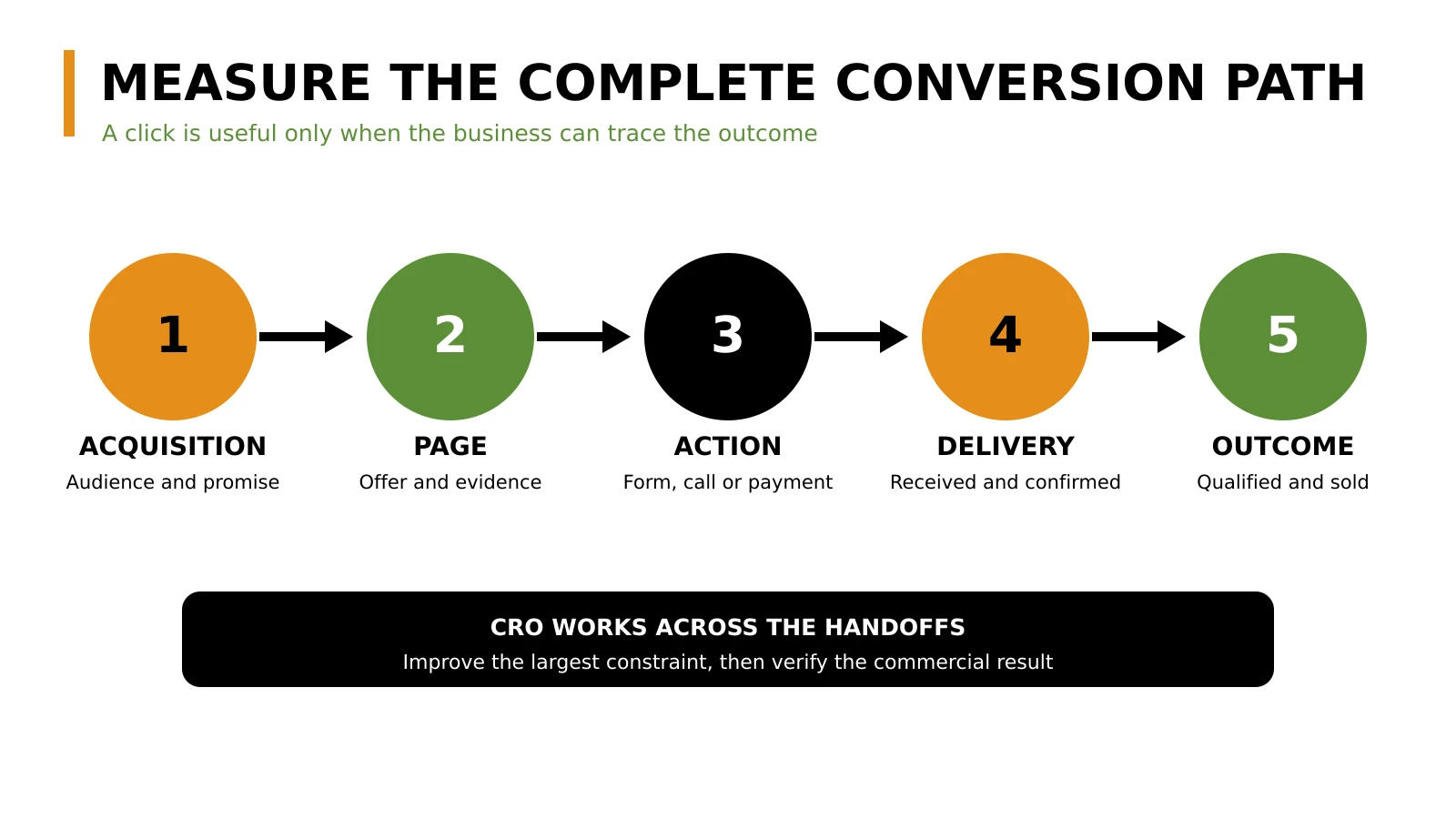
Improving only the visible page can move a problem rather than solve it.
2. Define the conversion before improving the rate
The conversion rate is normally calculated as:
completed conversions ÷ relevant visits × 100
The definition of both terms must be consistent. A business should not compare users in one report with sessions in another, or count button clicks as completed enquiries in one month and confirmation-page views in the next.
Choose a primary conversion for each page
Every important page should have one primary commercial purpose.
| Page | Primary conversion | Useful secondary evidence |
|---|---|---|
| Service page | qualified consultation request | phone or WhatsApp conversation that reaches qualification |
| Product page | completed purchase or add-to-cart for longer journeys | product enquiry, stock notification |
| Booking page | confirmed booking | started booking, date selected |
| Campaign landing page | completed lead form | call connected, WhatsApp conversation started |
| Pricing page | proposal or consultation request | plan comparison, pricing FAQ use |
| Diagnostic tool | completed diagnostic and verified contact | tool start, result unlock |
A secondary action can explain behaviour, but it should not automatically become the headline business result.
Use a conversion ladder
For a service business, the ladder might be:
Page visit → form start → completed enquiry → delivered lead → qualified lead → quotation → sale
For ecommerce:
Product view → add to cart → begin checkout → payment attempt → purchase → fulfilled order
Each stage answers a different question. A drop between form start and completion suggests interaction friction. A drop between completed enquiry and delivered lead suggests a technical or operational failure. A high enquiry count with few qualified leads may indicate poor targeting, weak qualification or an offer that attracts the wrong person.
3. Map the complete customer journey
A conversion path begins before the visitor reaches the website.
Write down the journey as the customer experiences it:
- What problem triggers the search or referral?
- What promise does the advert, search result or social post make?
- Which page receives the visitor?
- What must the visitor understand before acting?
- What doubts could stop the decision?
- Which action is requested?
- What happens immediately after the action?
- Who follows up, through which channel and within what realistic period?
- How does the business decide whether the enquiry is qualified?
- Where is the final sale or loss recorded?
This exercise often exposes a broken handoff. The marketing team may celebrate submitted forms while the business owner sees only unread messages. The website may promise “instant quotations” while every request needs a manual inspection. The page may invite a WhatsApp message without telling the visitor what information to send.
Use Tabala's Google Ads conversion-tracking checklist when paid traffic is part of the journey and the business must separate clicks from received leads.
4. Establish a trustworthy measurement baseline
Do not change several important elements before confirming that measurement works.
Google Analytics uses events to measure interactions. An important event can be marked as a key event, while a relevant Analytics key event can also be used to create a Google Ads conversion. See Google's official guidance on setting up Analytics events and marking events as key events.
Minimum baseline record
For each primary conversion, record:
- page or journey;
- traffic source where available;
- device type;
- completed action;
- delivery status;
- lead or order quality;
- quotation or sale status;
- date and relevant change notes.
Do not invent a baseline when the historical records are unreliable. Start a clean measurement period and state when it began.
Test the evidence chain
Complete the action as a real visitor would.
- Submit the form on mobile and desktop.
- Confirm the browser shows a useful success state.
- Verify the business receives the enquiry.
- Check that Analytics records the intended completed event once.
- Confirm the lead source or campaign information survives where required.
- Verify that the sales record can later capture qualification and revenue.
The 360 Digital Growth Diagnostic can help a business separate traffic, conversion and follow-up constraints before it chooses a fix.
5. Find the real conversion constraint
Start with evidence, then inspect the page.
Useful inputs include:
- analytics by page, source and device;
- Search Console landing-page and query data;
- form and booking records;
- WhatsApp and call logs;
- customer questions and objections;
- sales acceptance and rejection reasons;
- session recordings or heatmaps, where consent and configuration are appropriate;
- page-speed and technical reports;
- direct usability observation.
Diagnose by pattern
| Observed pattern | Possible constraint | What to check next |
|---|---|---|
| Traffic reaches the page but few people start the action | weak relevance, unclear offer or hidden CTA | source promise, first screen, scope and CTA visibility |
| Many people start but do not complete a form | form length, confusing labels, privacy concern or error | required fields, mobile keyboard, validation and privacy explanation |
| Mobile performs materially worse than desktop | layout, speed, tap targets or intrusive overlays | real-device journey and field behaviour |
| Enquiries arrive but most are unsuitable | targeting, page promise, qualification or price ambiguity | source terms, audience, offer boundaries and form questions |
| Completed forms are absent from the inbox or CRM | delivery failure | mail logs, integrations, spam filtering and confirmation records |
| Qualified leads receive proposals but do not buy | commercial fit, evidence, response time or proposal stage | objections, pricing, decision process and follow-up |
Treat each explanation as a hypothesis until the evidence supports it.
6. Match the page to the visitor's intent
A visitor should immediately understand that the page continues the promise that earned the click.
If a search result offers “office cleaning in Nairobi,” the page should confirm the service, coverage, ideal customer, quotation route and what affects price. Sending the visitor to a general homepage adds interpretation work.
Check four forms of message match:
- Problem match: does the page address the problem the visitor is trying to solve?
- Offer match: does it provide the service, product or information promised by the source?
- Location match: does it state genuine coverage, delivery or attendance information?
- Action match: does the requested next step fit the visitor's stage?
Tabala's Google Ads landing-page guide explains how to preserve message match when the traffic comes from paid search.
The Google Ads Quality Score guide for Kenya adds the advertising-side context for expected click-through rate, ad relevance and landing-page experience, while CRO measurement confirms whether the resulting visits create useful business outcomes.
Do not force every visitor into the same action
A high-intent visitor may be ready to book. Another may need pricing logic, process or proof first. The page can support both without displaying several competing primary buttons.
Use one primary CTA and provide supporting information in the order needed to make that CTA reasonable.
7. Make the offer clear and commercially believable
Clarity usually converts better than inflated language because it reduces the work of interpreting the offer.
Explain:
- who the offer is for;
- the problem it solves;
- what is included;
- what is excluded;
- how delivery works;
- what the next step requires;
- the price, starting price or factors that determine a quotation where practical;
- the realistic response or delivery period.
Use KES and local operating details naturally
A Kenyan buyer should not have to guess whether a price is in KES, whether M-Pesa is accepted, whether delivery reaches Mombasa or Kisumu, or whether a Nairobi consultation is online or in person.
Local detail is valuable when it changes the decision. It becomes distracting when city names are added only for search visibility.
Strengthen the CTA
A useful CTA explains the next step.
Weak: Submit
Stronger: Request a website review
Supporting line: Tell us your main conversion problem. We will review the journey and confirm the next practical step.
Do not promise a response time that the business cannot meet.
8. Build a fast and usable mobile journey
Mobile conversion work is not limited to making a page fit a smaller screen.
Test whether a visitor can:
- understand the offer without zooming;
- read text with sufficient contrast;
- tap the intended control without hitting another element;
- complete fields using the appropriate mobile keyboard;
- recover from an error without losing entered information;
- open WhatsApp, maps or phone actions correctly;
- see the total price and material conditions;
- complete payment or booking without a layout shift.
Core Web Vitals describe loading performance, interactivity and visual stability through Largest Contentful Paint, Interaction to Next Paint and Cumulative Layout Shift. The official Web Vitals guidance provides the definitions and recommended thresholds. Use them as diagnostic experience measures, not as proof that a page will convert.
Use Tabala's mobile SEO and conversion guide for the mobile journey and the technical SEO checklist for Kenyan websites for broader reliability checks.
9. Improve forms, WhatsApp, calls and bookings
The best enquiry channel is the one the customer can complete and the business can manage reliably.
Forms
Ask only for information required at that stage. W3C guidance notes that users generally prefer short, simple forms and that unnecessary information can increase abandonment. It also requires controls to have labels or instructions that explain the expected input. See the official WAI forms tutorial.
For a first consultation, name, working contact, service need and a concise challenge may be enough. A high-risk or regulated service may require more information, but the page should explain why.
Use:
- visible labels, not placeholder text alone;
- clear required and optional states;
- field-specific error messages;
- sensible input types for phone, email and numbers;
- a confirmation that explains what happens next;
- spam protection that does not make legitimate submission unreasonably difficult.
WhatsApp can reduce interaction friction, but an open chat is not a qualified lead by itself.
Pre-fill a useful opening message, such as:
Hello, I need a website review. My business is [type], and the main issue is [problem].
Assign ownership, label the conversation source where possible and record the eventual outcome.
Phone calls and bookings
Check that call buttons use the correct number and work on mobile. For bookings, show the duration, format, location, fee or payment requirement, cancellation terms and confirmation process before the final step.
10. Reduce risk with verifiable trust signals
Trust evidence should answer the doubt that appears at the decision point.
Useful evidence may include:
- accurate business identity and contact information;
- named people with relevant roles or credentials;
- genuine customer reviews used with permission;
- relevant work examples and case studies;
- clear process and response expectations;
- delivery, cancellation, return and refund information;
- privacy information near forms;
- secure transmission and approved payment integrations.
Do not use an invented testimonial, false office, expired certification or unauthorised partner logo.
When a form collects personal data, the business should define a lawful, specific purpose and explain relevant processing. Kenya's Data Protection Act provides the national legal framework. Sector, data type and processing model can create additional obligations, so sensitive or high-risk cases need appropriate professional advice.
11. Improve ecommerce and payment journeys
An ecommerce conversion path should answer the questions that affect the transaction before payment.
Show:
- accurate product name, image and specification;
- current stock or availability state;
- price in KES and relevant taxes or fees;
- delivery area, method, timing and cost;
- payment identity and accepted methods;
- return, refund, cancellation and support conditions;
- order confirmation and fulfilment status.
Google Analytics recommends ecommerce events that describe shopping behaviour, including product views, cart activity, checkout and purchases. See Google's official ecommerce measurement guidance.
Check Kenyan payment realities
If M-Pesa is offered, confirm that the customer can identify the merchant or paybill, the amount is correct, the callback is processed and the order does not remain uncertain after payment. Do not request a customer's PIN or unnecessary identity document.
If cash on delivery is limited by location or order value, disclose that condition before the final confirmation.
12. Prioritise CRO work with limited resources
A long issue list is not a strategy. Prioritise by impact, confidence and effort.
| Factor | Question | Simple score |
|---|---|---|
| Impact | If fixed, how close is this issue to a qualified lead, booking or sale? | 1 to 5 |
| Confidence | How strong is the evidence that this is a constraint? | 1 to 5 |
| Effort | How much time, cost and risk does the fix require? | 1 to 5, lower is easier |
A practical priority score can be calculated as:
impact × confidence ÷ effort
This is a decision aid, not an objective truth. A broken form receives immediate priority even if there is not enough historical traffic to score it neatly.
Fix functional failures first
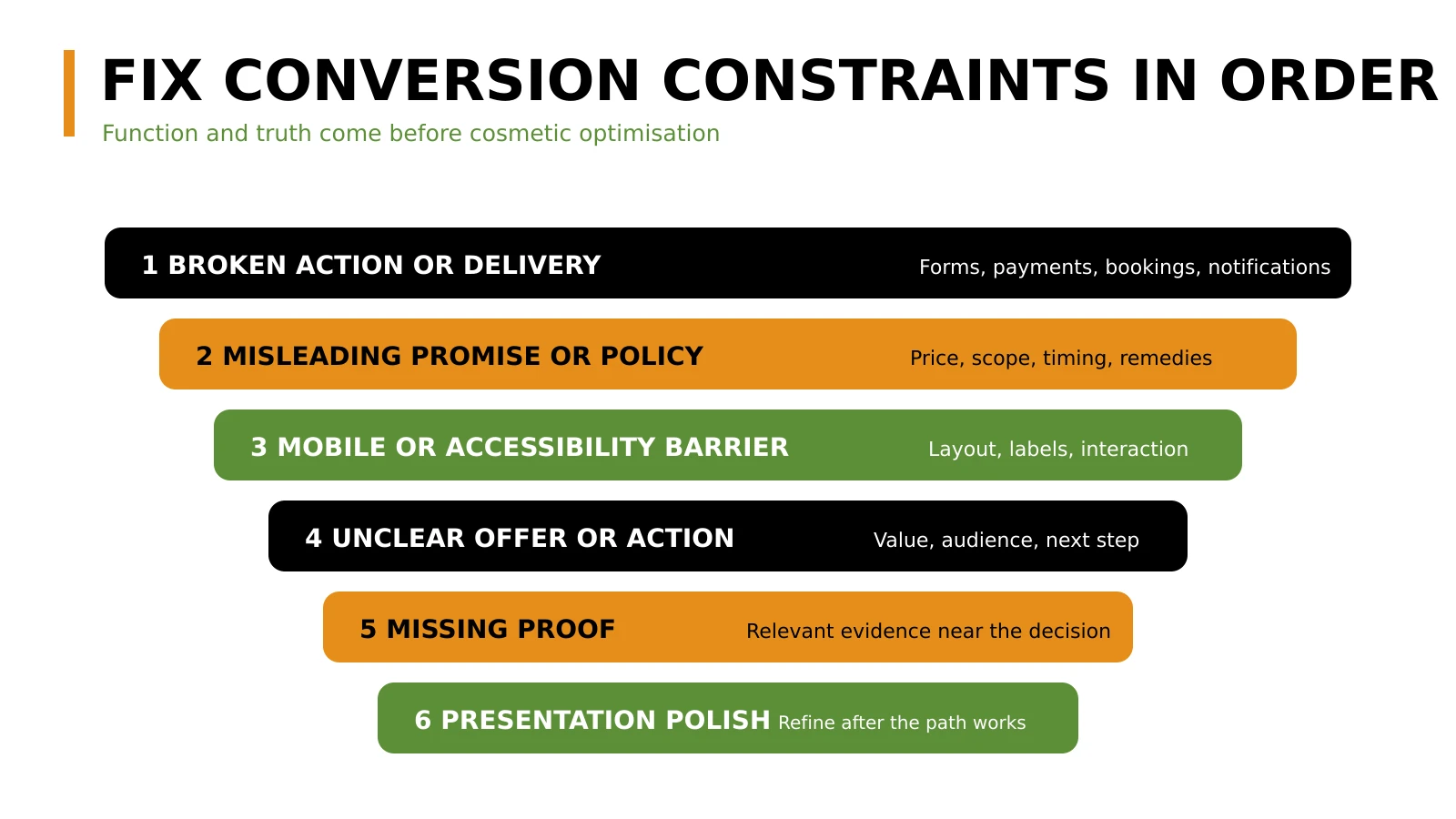
Use this order:
- broken submission, payment, booking or delivery;
- misleading promise, price or policy;
- mobile or accessibility barrier;
- unclear offer or action;
- missing evidence at a high-risk decision;
- lower-impact presentation refinements.
13. Test changes responsibly with low traffic
Small businesses often lack enough traffic for a conventional A/B test to reach a reliable conclusion quickly. That does not justify random redesigns.
Use a structured change record:
- state the observed problem;
- identify the affected audience and journey;
- define the expected business outcome;
- record the current measurement period;
- make one meaningful change or one coherent group of dependent fixes;
- monitor completed outcomes and guardrail measures;
- retain, revise or reverse the change based on the evidence.
Use guardrail measures
A change that increases form submissions but reduces qualified leads may be harmful. Monitor:
- completion rate;
- delivery success;
- qualified-lead rate;
- quotation or purchase rate;
- refund, cancellation or complaint rate;
- operational workload;
- device-specific failures.
Be honest about uncertainty
If a page receives a small number of relevant visits, describe the result as an early directional signal. Do not present a few additional enquiries as a universal conversion lift.
14. Apply CRO to Kenyan business types
Nairobi professional service
Problem: the homepage lists many services and routes every visitor to the same generic form.
Priority change: create a clear service path with audience, scope, process, relevant proof and a consultation request that asks what the prospect needs.
Mombasa ecommerce retailer
Problem: mobile users can add products to cart but discover delivery costs and return conditions late.
Priority change: show delivery coverage, timing, KES cost logic and return terms on the product or cart journey before payment.
Kisumu clinic
Problem: the appointment form requests sensitive details before explaining the appointment process or privacy treatment.
Priority change: minimise the first-step data, identify the practitioner or service, explain confirmation and provide privacy information beside the form.
Nakuru contractor
Problem: the site promises instant quotes for work that requires an inspection.
Priority change: replace the misleading promise with a site-visit request, state genuine coverage and explain what information helps prepare the inspection.
Eldoret training provider
Problem: the page promotes a certificate but does not identify the issuer, schedule, fee or assessment.
Priority change: publish the complete course decision information and request an application only after eligibility and commitment are clear.
15. Follow a practical 30-day CRO plan
Days 1 to 5: define and verify
- Choose the primary conversion for each priority page.
- Map the acquisition-to-sale journey.
- Test every form, call, WhatsApp, booking and payment route.
- Confirm analytics and operational records agree.
- Record the current evidence limitation.
Days 6 to 10: investigate
- Review page and device performance.
- Read recent enquiries, objections and sales rejection reasons.
- Inspect the source-to-page promise.
- Observe several people completing the journey where appropriate.
- List functional failures and unresolved buyer risks.
Days 11 to 18: fix the largest constraint
- Repair broken delivery first.
- Clarify the offer and primary CTA.
- Shorten or explain the form.
- Move essential proof and conditions beside the action.
- Test mobile and confirmation states.
Days 19 to 25: measure the change
- Verify event collection again.
- Track completed and delivered actions.
- Record quality and sales outcomes.
- Watch for device or channel regressions.
- Collect customer and sales feedback.
Days 26 to 30: decide and plan
- Compare like-for-like periods cautiously.
- Retain, refine or reverse the change.
- Document what was learned.
- Select the next highest-priority constraint.
- Avoid rebuilding the whole website unless the evidence supports structural change.
16. Small-business CRO checklist
Outcome and measurement
Message and offer
Action and usability
Risk and trust
Testing and operations
17. Frequently asked questions
What is conversion rate optimisation?
Conversion rate optimisation is the structured process of improving how often suitable visitors complete a valuable action. It combines measurement, customer understanding, usability, messaging, technical reliability and commercial follow-up.
What is a good website conversion rate in Kenya?
There is no universal rate that is good for every Kenyan business. The result depends on the offer, traffic source, intent, device, price, sales cycle and conversion definition. Compare consistent periods and focus on qualified commercial outcomes rather than copying an unrelated benchmark.
How do I calculate a conversion rate?
Divide completed conversions by the relevant visits, then multiply by 100. Keep the denominator and conversion definition consistent. For long sales journeys, also measure the rates from enquiry to qualification, quotation and sale.
Can a small business do CRO without A/B testing software?
Yes. Verify measurement, review customer and sales evidence, document a hypothesis, make one meaningful change and compare completed outcomes before and after. With low traffic, describe the evidence as directional rather than statistically conclusive.
Should WhatsApp clicks count as conversions?
A click can be a useful interaction event, but it does not prove that a conversation started or became a qualified lead. Where possible, connect click data with received conversations, qualification and sales outcomes.
Which page should a small business optimise first?
Start with the page closest to revenue that has a verified constraint. A broken booking page or high-intent service page usually deserves attention before a low-traffic informational page.
Does page speed improve conversions?
Speed and responsiveness remove interaction barriers, but a fast page can still have a weak offer or confusing action. Treat performance as one part of the complete conversion journey and measure the business result after improvement.
How often should CRO changes be reviewed?
Review functional health continuously and assess meaningful changes after a suitable evidence period for the business. High-traffic ecommerce may learn quickly. A low-volume B2B service may need a longer period and sales-stage evidence.
18. Summary and next step
CRO helps a small business earn more value from relevant demand by removing the constraints between interest and a completed commercial outcome.
The best starting point is not a redesign. It is a verified journey. Define the primary conversion, test whether it completes and reaches the business, trace it through qualification or fulfilment, and identify the largest point of friction. Then make a focused change and judge it using completed, commercially useful outcomes.
Run Tabala's 360 Digital Growth Diagnostic to identify whether the current constraint is traffic quality, website conversion, measurement or follow-up. If the evidence shows that the platform itself needs structural work, review Tabala's conversion-focused website development services in Nairobi.
Accelerate Your Revenue
While Revenue Intelligence builds long-term authority, Google Ads delivers immediate, high-intent traffic. Combine both for maximum market dominance.

Strategist Profile
Abala Tom
Digital systems strategist specializing in high-performance SEO, Google Ads, and conversion optimization. Mission: to replace marketing 'guesswork' with predictable revenue systems.