Common SEO Mistakes Kenyan Businesses Must Fix

Common SEO mistakes quietly waste visibility, leads and budget
A Kenyan business can publish every week, pay for backlinks, rewrite page titles and still fail to generate qualified enquiries from Google. The problem is often not a lack of activity. It is that the activity is aimed at the wrong constraint.
The most expensive SEO mistakes rarely look dramatic. The website remains live. Reports show impressions. A few keywords move. Yet core service pages target vague phrases, several URLs compete for the same search, important pages are hard to crawl, and no one can connect organic visits to valid leads. More content then amplifies the disorder.
The right response is not to change everything at once. Diagnose the search system in order: commercial intent, page ownership, crawlability, content usefulness, internal relationships, authority, local evidence, mobile experience and measurement.
Quick answer
The most common SEO mistakes in Kenya are targeting broad traffic instead of buyer intent, forcing many services onto one page, creating duplicate location or topic pages, publishing generic content, neglecting technical access and mobile usability, using weak titles, leaving important pages orphaned, buying risky backlinks, treating Google Business Profile as separate from the website, ignoring conversions, reacting to rankings without context and expecting immediate results.
Fix measurement and priority-page ownership first. Then repair technical access, search-intent alignment and internal linking. Improve or consolidate weak content before publishing more. Build genuine authority only after the website provides a clear, useful destination for the demand you want to capture.
<p>Run Tabala's free SEO Visibility Audit to identify whether your main constraint is technical, content-related, authority-related or conversion-related.</p>
Key takeaways
- More organic traffic is not automatically better traffic.
- One strong page should own each important search intent.
- A technically accessible page can still fail because it is generic, untrusted or difficult to act on.
- Internal links are part of site architecture, not decorative additions.
- Google Business Profile and the website should reinforce the same local entity.
- Backlinks cannot rescue a weak offer, unclear page or broken measurement system.
- Search Console evidence should guide decisions, but rankings and clicks must be connected to qualified outcomes.
- SEO timelines depend on the starting condition, competition, implementation speed and evidence, not a universal promise.
Why SEO mistakes are difficult to spot
The easiest failures to notice are a website outage, a page returning an error or a sudden traffic collapse. The costlier failures can remain hidden because the site continues to attract some activity.
A page may rank for research queries while failing to appear for the service that generates revenue. A blog may earn impressions while the service page receives no internal support. A form may record submissions without showing whether they were valid prospects. An agency may report twenty keyword improvements while the sales team receives the same volume of weak enquiries.
SEO also has delayed feedback. Google must discover, process and reassess changes. Competitors keep publishing, improving and earning authority during the same period. That makes it easy to blame the latest edit for a change that came from a different cause.
Use three questions to expose the real failure:
| Diagnostic question | Evidence to inspect | Commercial meaning |
|---|---|---|
| Can the right page be discovered and indexed? | Search Console, crawl responses, canonicals, internal links | A blocked or ambiguous page cannot reliably compete |
| Does the page satisfy the right search intent? | Query-to-page mapping, content, titles, competitor results | Visibility may attract the wrong audience |
| Does qualified traffic produce a measurable action? | Analytics, forms, calls, WhatsApp, CRM or order data | Rankings may not create business value |
Google's Search Essentials separates technical requirements, spam policies and key best practices. That is a useful reminder: SEO performance comes from a system, not one trick.
Fix SEO mistakes in dependency order
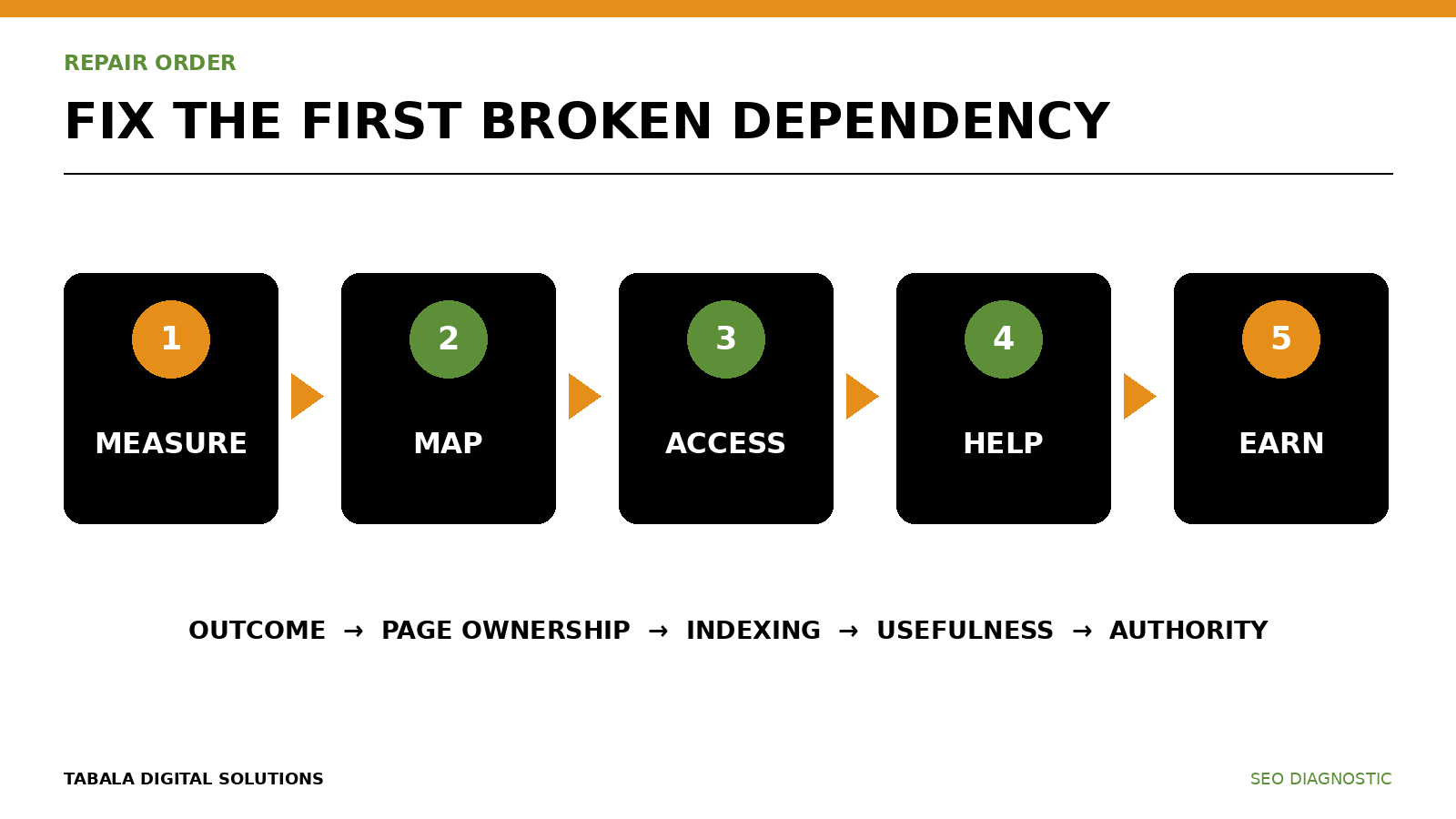
Do not begin with the task that is easiest to sell. Begin with the first broken dependency.
- Define the business outcome and priority services.
- Assign one preferred page to each important intent.
- Confirm that Google can access, render and index those pages.
- Improve the page's usefulness, evidence and conversion path.
- Connect supporting content through contextual internal links.
- Strengthen local and external authority.
- measure query, page, lead-quality and revenue changes.
This sequence prevents a common waste pattern: buying links to a page that targets the wrong intent, or publishing more articles while the site already has three weak pages competing for the same query.
Mistake 1: Targeting traffic instead of commercial intent

Search volume is not the same as buying intent. A broad phrase can attract many visitors who are learning, studying or looking for jobs. A narrower phrase may attract fewer searches but a much higher share of potential customers.
For example, a Nairobi accounting firm might target “accounting” because it appears large. The phrase does not reveal whether the searcher wants a definition, a course, software, jobs or professional help. “Tax consultant for small business in Nairobi” expresses a clearer commercial need.
The mistake becomes more expensive when the content team celebrates total traffic without checking which landing pages and queries created it.
How to fix it
- List the services, products or bookings that create real value.
- Group queries by informational, commercial-investigation, transactional and navigational intent.
- Map each high-value intent to one page.
- Use supporting articles to answer earlier questions and guide readers toward the relevant commercial page.
- Review Search Console queries by landing page, not only as a site-wide list.
- Compare organic contact actions with valid and qualified leads.
Tabala's conversion-tracking checklist for Kenyan businesses explains how to separate a recorded action from a valid lead or sale.
Mistake 2: Making one page rank for every service
Many Kenyan business websites place every service on the homepage. The page lists web design, SEO, Google Ads, social media and branding, then expects Google to understand which service deserves visibility for which query.
The homepage can introduce the business. It usually cannot provide the depth, evidence, objections, process, pricing context and local relevance required for every commercial intent.
The opposite mistake is creating a page for every tiny keyword variation. That produces thin pages with no distinct purpose.
How to fix it
Create one substantial page for each genuine service or category that a customer would evaluate separately. Each page should have:
- a clear promise aligned with the target search;
- the audience and problem it solves;
- scope, process and expected next step;
- proof, limitations and frequently asked questions;
- useful internal links to related services and supporting guides;
- a visible contact, quote, booking or purchase action.
The on-page SEO checklist for Kenyan businesses provides the page-level framework for titles, headings, content, links and conversion actions.
Mistake 3: Creating competing pages and location duplicates
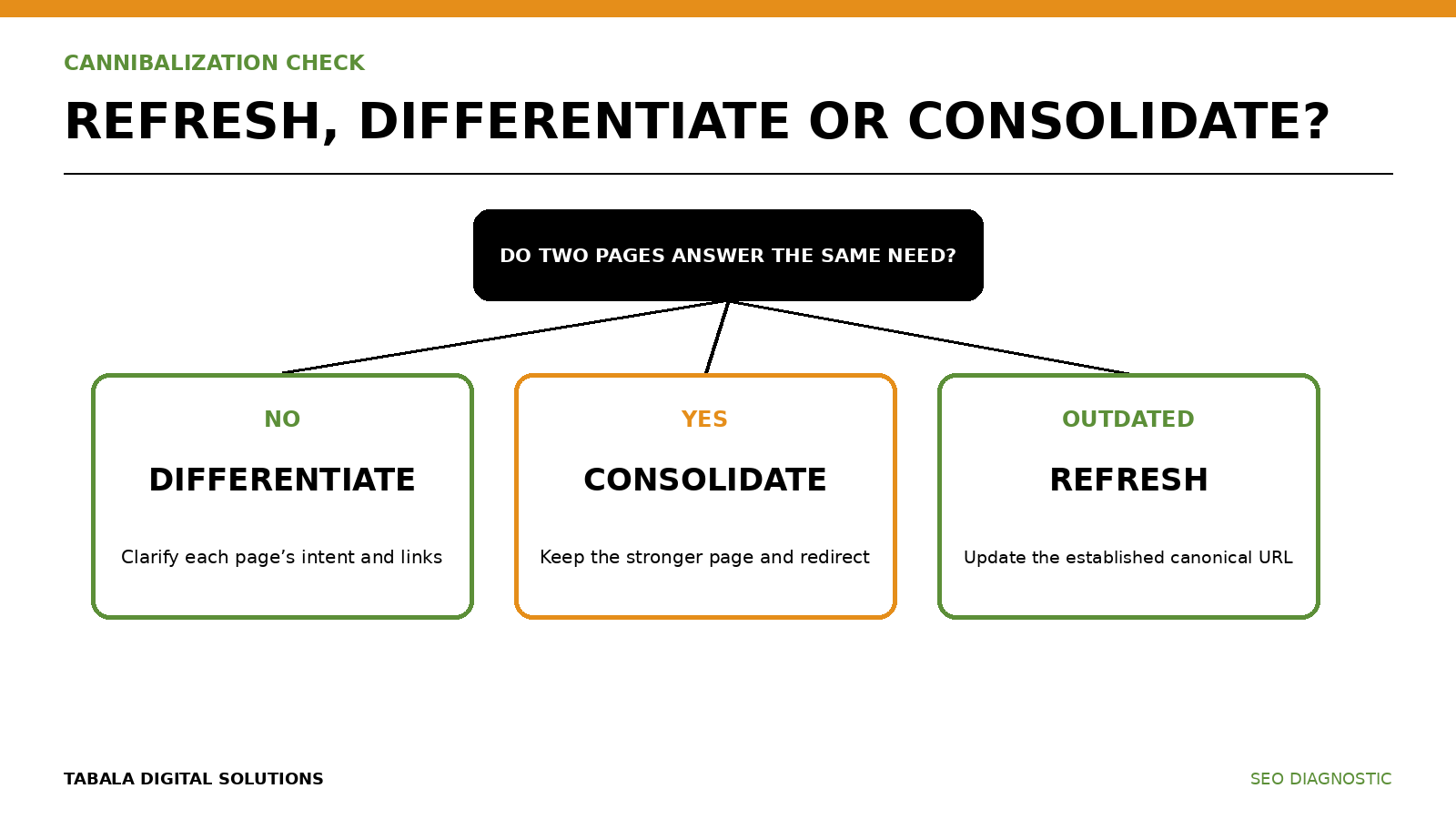
Cannibalization occurs when multiple pages pursue substantially the same intent without a clear reason for each to exist. Google may alternate between them, select the weaker version or distribute signals across several URLs.
Common causes include:
- publishing a new guide without checking the existing archive;
- changing a slug and leaving the old URL live;
- creating separate pages for close keyword variants with identical content;
- duplicating one service page across Nairobi, Mombasa, Kisumu, Nakuru and Eldoret with only the city name changed;
- retaining old campaign or category URLs after a redesign.
Duplicate content is not automatically a spam violation, but Google's SEO Starter Guide notes that duplication can create a poor experience and waste crawling resources. Google's canonical guidance recommends consistent signals to the preferred URL.
How to fix it
Choose one action for each overlap:
| Situation | Best action |
|---|---|
| Two weak pages answer the same need | Consolidate into one stronger canonical and redirect the weaker URL |
| One current page and one outdated version | Refresh the established page and preserve its useful history |
| Similar keyword, genuinely different intent | Differentiate the purpose, content, title and internal-link role |
| Location pages with no local value | Keep only defensible pages or add real local evidence and service detail |
| Tracking or parameter duplicates | Link internally to the clean canonical URL and align technical signals |
Never create a location page merely to insert a city name. A useful local page needs a genuine service relationship, specific coverage, relevant proof and a distinct next step.
Mistake 4: Publishing generic content at scale
Publishing frequency cannot compensate for low value. Generic articles that repeat widely available advice add little reason for a reader, journalist, customer or AI system to choose the page.
Google's people-first content guidance asks whether content provides original information, substantial value, clear expertise and a satisfying experience. Content designed mainly to attract search visits is a weak foundation.
This risk increases with unreviewed AI-generated copy. The problem is not the tool. The problem is publishing inaccurate, repetitive or unsupported material at a speed that exceeds editorial control.
How to fix it
Every article should contribute something useful:
- a Kenyan example that changes the decision;
- a transparent framework, process or checklist;
- original experience from delivery or audits;
- clear boundaries and conditions;
- primary-source references for technical claims;
- an internal role within a topic cluster;
- a next step that matches the reader's stage.
Before drafting, audit the live inventory. Refresh or consolidate when an existing URL already owns the intent. After publishing, link the new article with older related posts in both directions where the relationship helps the reader.
For AI-assisted discovery, Google's current guidance for generative AI features still centres on foundational SEO and unique, reliable, people-first content. Unsupported “GEO hacks” do not replace clarity or authority.
Mistake 5: Ignoring crawling, indexing and canonicals
A polished page cannot earn search visibility if Google cannot access or index it. Common technical failures include accidental noindex directives, production pages blocked by staging rules, broken redirects, server errors, conflicting canonicals and important content rendered only after fragile scripts run.
The mistake is often discovered late because staff can open the page in a browser and assume Google sees the same thing.
How to fix it
For every priority page, confirm:
- the final URL returns a successful response;
- it is not blocked by authentication, firewall or robots rules;
- it does not carry an accidental
noindex; - the canonical identifies the intended preferred URL;
- internal links point directly to that final URL;
- the sitemap includes only canonical, indexable URLs;
- the rendered mobile version contains the main content and links;
- Search Console reports no unresolved exclusion or canonical conflict.
Use the technical SEO checklist for Kenyan websites to audit access, crawling, rendering, indexing, structured data and security in the correct order.
Mistake 6: Writing weak or keyword-stuffed titles
The title should help a searcher understand the page before clicking. Weak titles are vague, duplicated across pages, dominated by the brand name or stuffed with the same phrase in several forms.
Google's title-link guidance recommends concise, descriptive titles and warns against keyword stuffing and boilerplate repetition.
Compare these approaches:
| Weak title | Better direction |
|---|---|
| Services | Corporate Tax Services in Nairobi |
| Best Affordable Cheap SEO Company Kenya Nairobi | SEO Services in Nairobi |
| Home | Brand plus primary business category where useful |
| Blog Post 12 | Technical SEO Checklist for Kenyan Websites |
Write for clarity first. Place the main topic naturally, show the useful distinction, and add the brand only when it improves recognition. Then review the actual query, page and CTR evidence rather than assuming a rewritten title will automatically improve performance.
Mistake 7: Leaving important pages orphaned
An orphan page has no meaningful internal path from the rest of the website. It may appear in a sitemap, but users and crawlers have little context for its importance or relationship to other content.
Google's link best practices state that internal links help people and Google understand pages, and that every page you care about should receive a link from another page.
How to fix it
- Link every supporting article to its relevant pillar or service page.
- Add two to four useful sideways links to related articles.
- Use descriptive anchors that state what the destination explains.
- Link older articles forward to newer, stronger resources after publication.
- Update links after a redirect or consolidation.
- Avoid forcing the same exact-match anchor repeatedly.
Internal links should appear where the concept becomes relevant. A technical SEO article should link to the on-page guide when it discusses visible content. A reporting article should link to conversion tracking when it discusses lead measurement. A new article should not simply dump a “related posts” list at the end and call the cluster complete.
Mistake 8: Buying links before earning relevance
Backlinks can support discovery and authority, but volume alone does not make them valuable. Links from irrelevant directories, paid networks, copied articles or hacked pages may create risk without contributing qualified visibility.
Google's spam policies identify link spam and other manipulative practices that can lead to lower visibility or removal from Search.
Before outreach, confirm that the destination page is technically sound, useful and aligned with a real audience. Then pursue defensible reasons for reputable sites to reference it:
- original Kenyan market research;
- expert commentary;
- useful calculators, templates or datasets;
- partnerships, associations and genuine community work;
- supplier, customer or professional relationships where editorially appropriate;
- resources that solve a problem better than existing alternatives.
Tabala's practical backlink guide for Kenyan businesses explains how to evaluate relevance, editorial control, traffic quality and risk before treating a link as an asset.
Mistake 9: Treating local SEO as a profile-only task
A Google Business Profile is important, but local visibility also depends on the relevance and consistency of the business entity across the web. The website should explain what the company does, where it genuinely operates and how customers can verify or contact it.
Google states that local results are mainly based on relevance, distance and prominence. There is no setting that allows a business to pay for a better local ranking.
How to fix it
- Keep the business name, category, address or service-area information and contact details accurate.
- Link the profile to the most relevant canonical website page.
- Build strong service pages and genuine location information.
- Earn reviews through a compliant, consistent process without incentives or review gating.
- Publish accurate hours, photos and updates when useful.
- Avoid virtual offices, fake locations and city pages for areas the business cannot serve properly.
The local SEO guide for Kenyan businesses shows how website relevance, profile quality and local authority work together.
Mistake 10: Neglecting mobile speed and conversion paths
Google uses the mobile version of a site's content for indexing and ranking. Its mobile-first indexing guidance recommends equivalent essential content and metadata across mobile and desktop.
For a Kenyan business, mobile failure has an immediate commercial cost. A customer may arrive on a mid-range phone over an inconsistent connection. Oversized images, overlapping buttons, intrusive pop-ups or a form that rejects a valid 07 or +254 number can end the journey.
Test priority pages on real devices. Check:
- hero image and font weight under realistic mobile conditions;
- visible service promise and primary action without excessive scrolling;
- tap targets, menus, accordions and sticky elements;
- forms, calls, WhatsApp links, checkout and booking actions;
- layout stability and unexpected movement;
- parity between mobile and desktop content.
Core Web Vitals measure real-world loading, responsiveness and visual stability, but Google's page-experience guidance also warns that good tool scores do not guarantee top rankings. Performance supports the journey. It does not replace relevance, usefulness or authority.
Mistake 11: Reporting rankings without leads
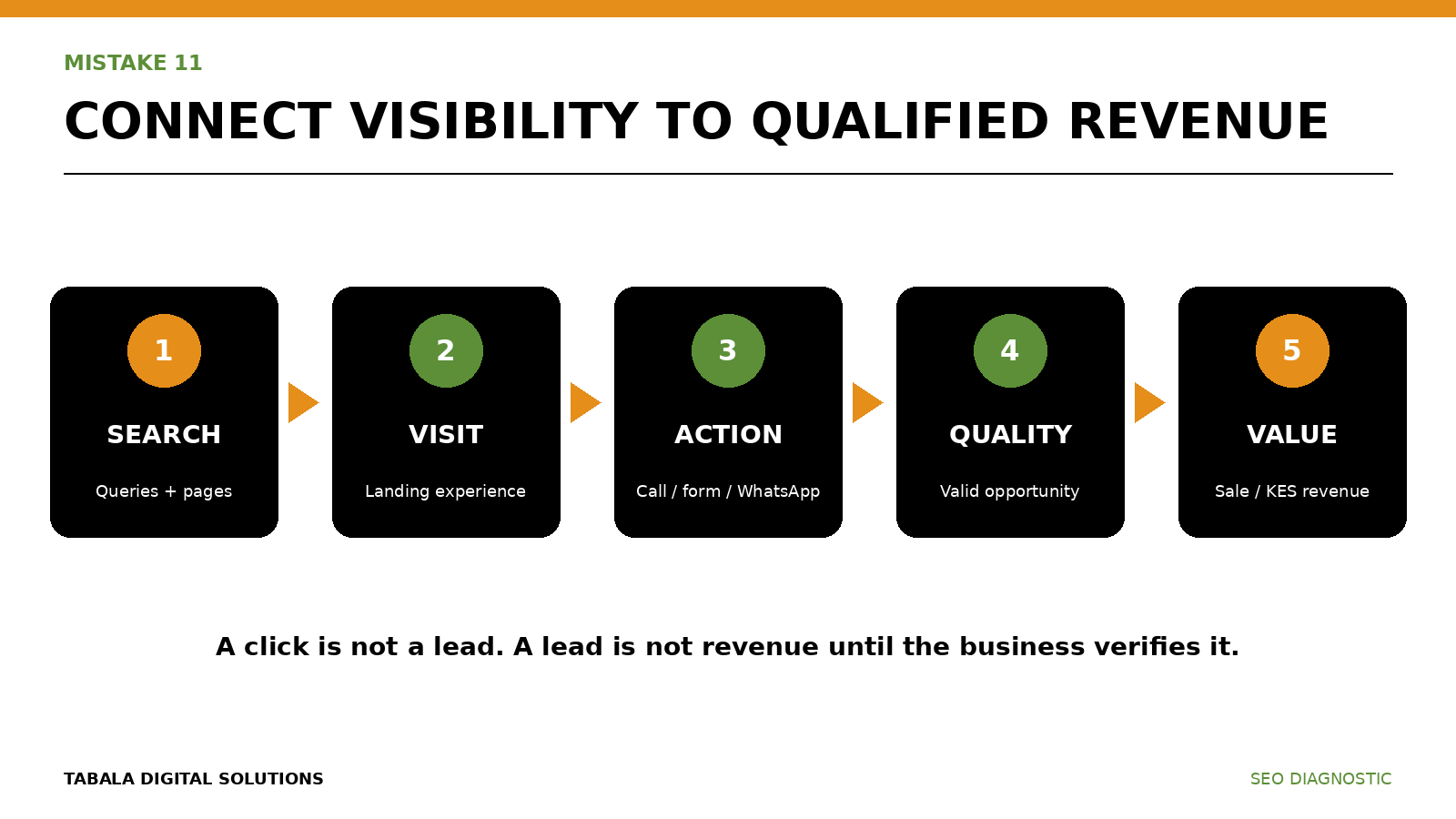
A ranking report can look impressive while hiding the wrong queries, irrelevant locations or pages that never convert. Average position can also vary by query, device, country and result type.
Google's Search Console guidance recommends using performance breakdowns by queries, pages and countries to monitor clicks, impressions and trends.
Connect four evidence layers:
| Layer | Core question |
|---|---|
| Search demand | Which relevant queries and pages gained or lost visibility? |
| Website behaviour | What did organic visitors do after landing? |
| Lead quality | How many contact actions became valid prospects? |
| Commercial outcome | Which opportunities became sales, bookings or revenue? |
A WhatsApp click is not automatically a lead. A form submission is not automatically qualified. Traffic is not automatically revenue.
When evaluating an external provider, Tabala's guide to choosing an SEO agency in Kenya explains what a useful report should contain and which promises should trigger scrutiny.
Mistake 12: Expecting instant results and changing direction too early
SEO does not move on one universal schedule. A title change, technical repair, new page, site migration and authority campaign each have different dependencies. Competitive conditions and implementation speed also matter.
Changing direction every week prevents clean learning. Constantly rewriting titles, moving URLs or replacing pages can introduce new ambiguity before the previous change has accumulated enough evidence.
How to fix it
- Record what changed, where, when and why.
- Verify implementation before waiting for performance.
- Watch early signals such as crawling, indexing, impressions and query fit.
- Judge later signals such as qualified leads and revenue over an appropriate period.
- Use 30, 60 and 90-day milestones for accountability, not ranking guarantees.
- Escalate when work is not implemented or reports cannot explain progress.
Use the SEO cost guide for Kenya to connect timelines with realistic scope, implementation capacity and budget rather than buying a fixed ranking promise.
A practical SEO repair checklist
Use this sequence before increasing content or link-building spend:
- Define the services, products and locations that create commercial value.
- Export current Search Console pages and queries for the relevant comparison periods.
- Map each priority intent to one canonical page.
- Identify overlaps, outdated pages and location duplicates.
- Confirm access, status, indexability, canonical and sitemap alignment.
- Review mobile rendering, forms, calls, WhatsApp and checkout paths.
- Rewrite weak titles and introductions around the actual reader problem.
- Improve pages with specific evidence, useful answers and visible next steps.
- Add contextual links to the parent service and related articles.
- Add relevant reverse links from older cluster pages.
- Validate analytics and distinguish actions, valid leads and qualified opportunities.
- Build authority only to pages worth recommending.
- Record changes and review evidence on an agreed cadence.
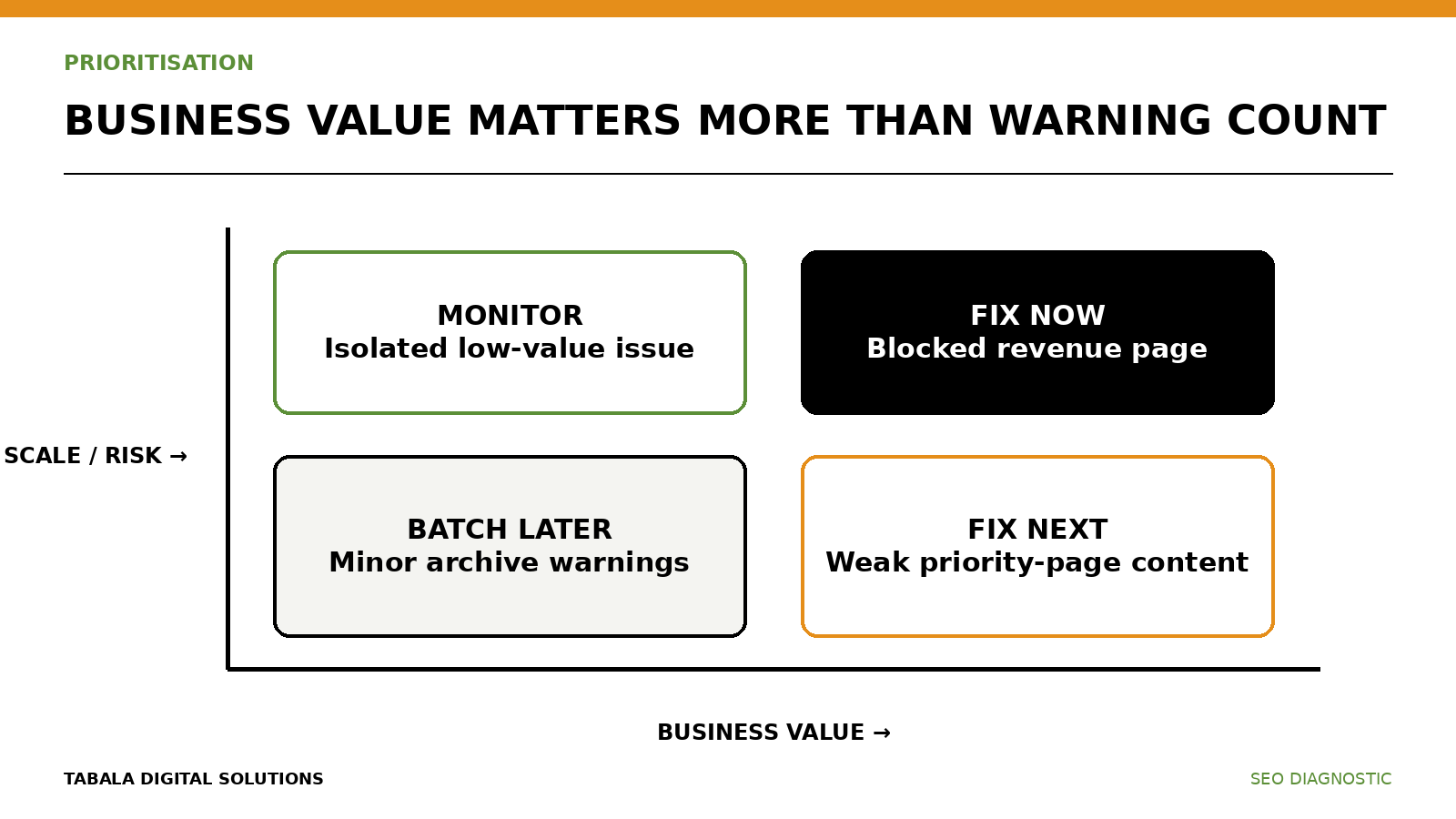
If several failures appear at once, prioritise by affected page, business value, scale and risk. A blocked revenue page matters more than dozens of minor warnings on low-value archive URLs.
Frequently asked questions
What is the biggest SEO mistake a Kenyan business can make?
The biggest mistake is pursuing visibility without defining which search intent, page and business outcome matter. That leads to more content, links and reporting around traffic that may never become customers.
Should a business target “Kenya” and “Nairobi” on the same page?
Only when one page genuinely serves both intents. Review the search results, customer need and operating coverage. Create separate pages only when each has a distinct purpose and enough local value to avoid duplication.
Does repeating a keyword improve rankings?
No. Repetition does not substitute for relevance, usefulness or authority. Use the main topic naturally in the title, headings and copy, then answer the searcher's problem thoroughly.
Is duplicate content a Google penalty?
Not automatically. Google may group duplicate or near-duplicate URLs and choose a canonical. The practical risk is diluted signals, wasted crawling and a poor user experience. Manipulative or mass-produced content can create separate quality or spam concerns.
How many internal links should an article contain?
There is no universal number. Link to the service, audit tool and related articles when each destination improves the reader's next step. For a substantial Tabala guide, five to ten contextual destinations is a practical editorial range, not a ranking formula.
Are backlinks still important for SEO?
Relevant editorial links can support discovery and authority. Bought, automated or irrelevant links can create risk. Strengthen the page and its internal role before investing in outreach.
Can Google Business Profile replace a website?
No. A profile can capture local discovery, calls and directions, while the website provides deeper service information, proof, conversion paths and content ownership. The two should reinforce one another.
Why is a page indexed but not ranking?
Indexing only means the page is eligible to appear. It may still have weak intent alignment, insufficient depth, poor internal support, limited authority, strong competition or low usefulness compared with alternatives.
How quickly should SEO mistakes be fixed?
Critical access, indexing, security and revenue-page failures should be addressed first. Content, architecture and authority work should follow a prioritised plan. The time until performance changes depends on crawling, competition and the size of the improvement.
Should a business publish more content after traffic drops?
Not automatically. Diagnose which pages and queries changed, confirm tracking, inspect technical problems and review search intent first. Publishing more can deepen cannibalization or distract from a fixable issue.
Final recommendation
The worst SEO system is not the one with the fewest articles or backlinks. It is the one that cannot explain which page should rank, why a customer should choose it and whether the resulting traffic becomes qualified demand.
Start with the pages that generate revenue. Give each important intent one clear owner. Repair access and mobile usability. Consolidate overlap. Build contextual internal links. Publish evidence-led content that deserves attention. Then measure the complete journey from query to qualified lead or sale.
If your rankings have stalled, traffic has dropped or organic visits are not producing enquiries, run Tabala Digital Solutions' free SEO Visibility Audit. For implementation support, review our SEO services for Nairobi and Kenyan businesses.
Accelerate Your Revenue
While Revenue Intelligence builds long-term authority, Google Ads delivers immediate, high-intent traffic. Combine both for maximum market dominance.

Strategist Profile
Abala Tom
Digital systems strategist specializing in high-performance SEO, Google Ads, and conversion optimization. Mission: to replace marketing 'guesswork' with predictable revenue systems.