AI Marketing Tools for Kenyan SMEs
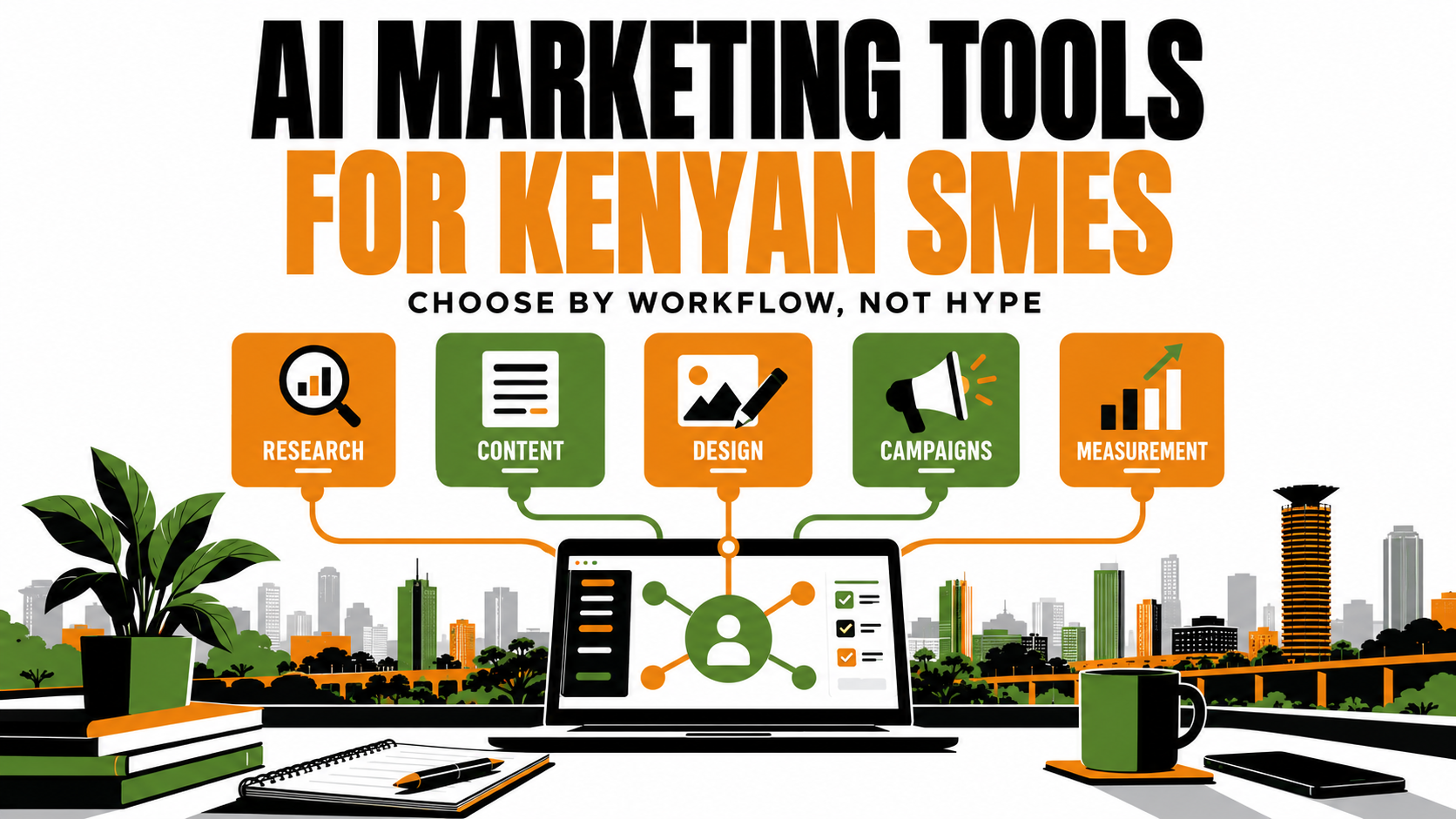
An AI subscription can feel productive long before it produces revenue. A team generates thirty captions, five designs and a polished report in an afternoon, yet the offer is still unclear, the leads are still weak and nobody can explain which activity influenced a sale. The business has moved faster, but not necessarily forward.
That is the main risk for Kenyan small and medium-sized businesses adopting AI marketing tools. The problem is rarely a shortage of software. It is choosing tools before defining the workflow, feeding customer information into systems without checking the terms, and automating output without assigning a human owner for accuracy and results.
The right tool can reduce repetitive work, improve first drafts, organise research and help a small team test ideas faster. It cannot choose your commercial priorities, understand every local nuance or take responsibility for a misleading claim. This guide shows how to build a small, useful AI marketing stack around business problems rather than hype.
## Quick answer
Kenyan SMEs should start with one general AI assistant for research and drafting, one brand-controlled design tool, the AI features already available in their advertising or email platform, and a reliable measurement setup. Choose each tool for a defined workflow, owner and measurable outcome. Never upload confidential customer, employee, payment, health or legal information until the business has reviewed data handling, access controls, retention and its obligations under Kenya’s Data Protection Act.
## Key takeaways
- Start with a marketing bottleneck, not a list of fashionable tools.
- Use AI for research support, first drafts, variations, summaries and repetitive production.
- Keep people responsible for strategy, facts, offers, approvals, sensitive data and final publication.
- Prefer tools that fit the systems your team already uses and make review easy.
- A low monthly price is not a saving if the tool creates rework, duplicated subscriptions or poor campaigns.
- Measure time saved and commercial outcomes separately.
- Review privacy, permissions and retention before entering customer or company data.
What counts as an AI marketing tool?
An AI marketing tool uses machine learning or generative AI to assist with a marketing task. That task may involve finding patterns, predicting an outcome, generating a draft, adapting creative, selecting an audience, automating a response or summarising performance.
The category is wider than standalone chat assistants. Google Ads uses AI for bidding, query matching and creative combinations. Email platforms can suggest subject lines or draft campaign sections. Design platforms can generate layouts and resize assets. Analytics products can summarise trends. Customer-service systems can classify enquiries or propose replies.
This matters because an SME may already pay for useful AI features inside its current software. Buying another separate tool can add cost and complexity without removing a real bottleneck.
For the broader strategic context, read Tabala’s guide to AI marketing in Kenya. This article has a narrower job: helping a small team choose and govern the tools it will actually use.
Start with the workflow, not the software
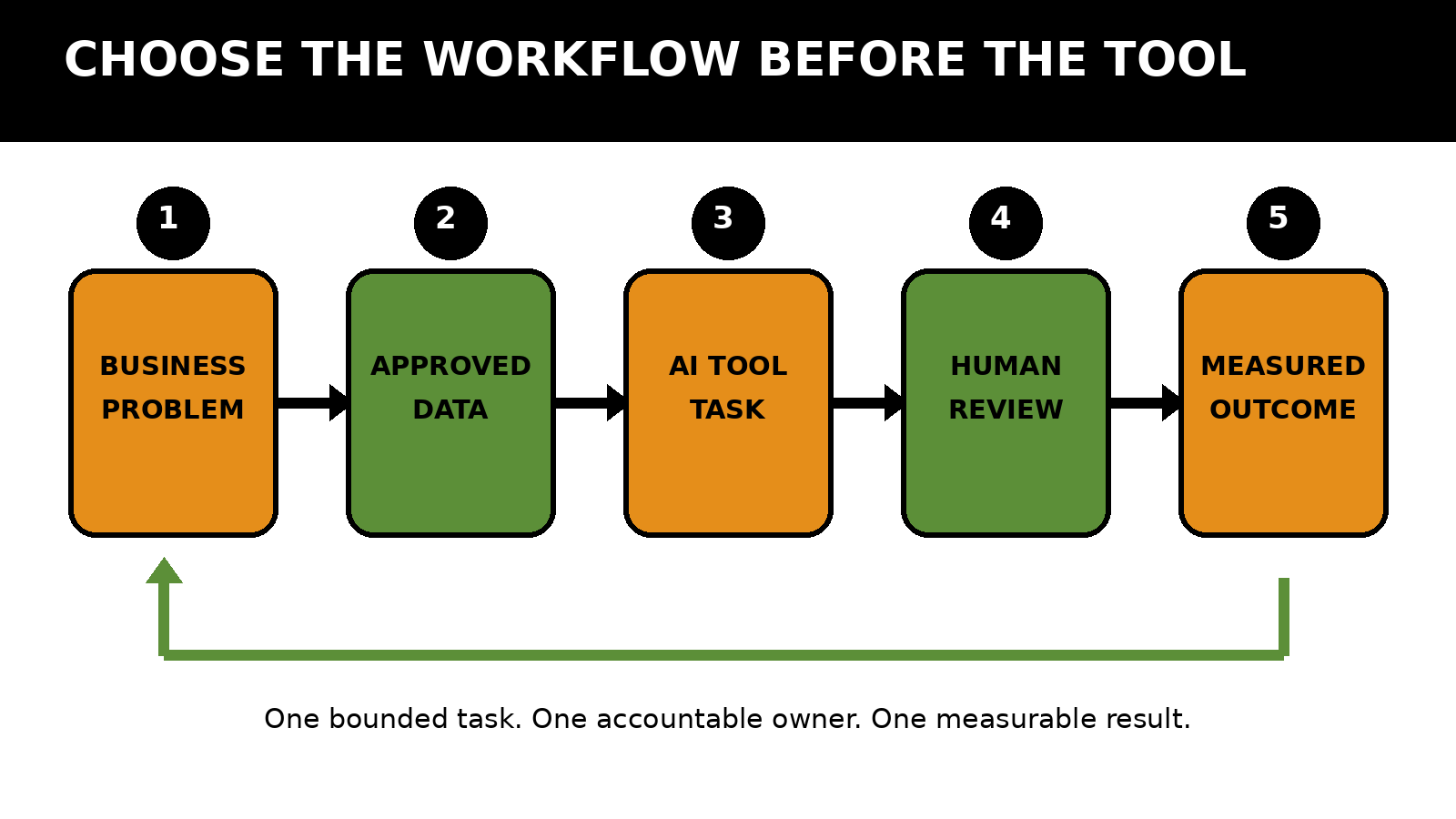
Before comparing products, write down the work that is slow, inconsistent or impossible with the current team. A useful workflow statement has four parts:
> We need to complete this task, using these approved inputs, so that this measurable outcome improves, with this person approving the result.
Examples include:
- turn approved product information into first-draft social posts, reviewed by the marketing manager;
- summarise weekly campaign changes, checked against the advertising platforms by the account owner;
- turn one approved article into email and social variants without changing factual claims;
- classify incoming enquiries by service and urgency without making the final qualification decision; and
- identify recurring questions in customer feedback after removing personal details.
Avoid vague objectives such as “use AI for content” or “automate marketing.” They do not define what enters the system, what comes out, who checks it or how the business will judge success.
The workflow-first approach also prevents tool sprawl. If two products solve the same task, test them against one defined job. Keep the one that integrates better, needs less correction and produces the stronger business outcome.
The practical AI marketing tool categories
1. Research and planning assistants
General assistants such as ChatGPT and Gemini can help a marketer organise interview notes, build question lists, compare positioning options, summarise supplied documents and turn an approved brief into a working plan.
They are strongest when the prompt includes reliable source material, audience context, constraints and a clear output format. They are weakest when asked to invent market facts, customer evidence or legal conclusions.
Use them to accelerate thinking, not replace evidence. Verify competitor claims on the competitor’s site, platform behaviour in official documentation, regulations in official sources and performance in your own analytics.
OpenAI states that business-product data is not used to train its models by default. Personal plans have different controls, so teams must understand which account type they are using and what their settings mean. Google also offers business-oriented Gemini capabilities within Workspace. Product terms and features change, so review current documentation before procurement.
2. Content drafting and repurposing tools
AI can turn a documented idea into several first drafts: a blog outline, email, product description, FAQ set, sales-enablement note or social caption. That is useful when the original source is accurate and the reviewer knows the subject.
Do not publish the first output automatically. Check:
- whether the opening addresses a real customer problem;
- whether the offer, price and availability are current;
- whether Kenyan place names and examples are correct;
- whether the text makes unsupported guarantees;
- whether sources are real and directly support the claim;
- whether the voice sounds like the business; and
- whether several channels now contain near-identical copy.
For unfamiliar terminology, use Tabala’s digital marketing terms guide before approving content that uses specialist language loosely.
3. Design and creative-production tools
Canva’s Magic Studio includes AI-assisted design and editing features, while many other creative platforms now offer background removal, resizing, image generation and copy assistance. These tools can shorten production time for a team without a full-time designer.
The safe use case is controlled variation: start from the approved brand kit, real product information and an agreed campaign concept. Generate options, then have a person check logo use, colours, typography, cropping, readability, representation and product accuracy.
Never let convenience justify a fake product, impossible result, invented testimonial or misleading before-and-after image. If the audience cannot distinguish illustration from evidence, the creative needs clearer treatment.
4. Advertising-platform AI
Google and Meta increasingly embed AI into campaign delivery and creative. Google Ads can use machine learning for bidding and matching, and eligible Performance Max workflows can generate or suggest assets from a website and advertiser instructions. Google explicitly requires advertisers to review generated assets for accuracy, policy compliance and applicable law.
The platform is optimising towards the signals it receives. If a WhatsApp tap is counted as valuable even when the conversation never becomes a qualified lead, automation may find more taps rather than more customers.
Before increasing automation, follow the Google Ads conversion-tracking checklist. The advertising tool cannot repair a bad commercial definition of success.
5. Email and customer-journey tools
Email platforms may offer AI writing, layout suggestions, segmentation or automation. Mailchimp, for example, documents AI-assisted email content features, but availability can depend on plan, geography or rollout status.
Use AI to draft a welcome email, suggest variants or summarise campaign patterns. Keep consent, contact eligibility, frequency, suppression, final wording and send approval under human control.
An automated message must still be useful. Sending more irrelevant email faster is not improved marketing.
6. Analytics and reporting assistants
AI can explain a supplied table, group feedback themes, draft commentary or flag changes for investigation. Google’s October 2026 small-business announcement and Workspace materials also describe AI assistance within documents, spreadsheets and everyday work applications.
Treat the summary as a starting point. Reconcile figures with the original source, confirm date ranges and distinguish a correlation from a cause. A generated report should not invent reasons for a performance change.
The strongest reporting workflow links the narrative back to verified measures: qualified leads, sales, revenue, conversion rate, cost per acquisition and retention. Use Tabala’s free Growth Diagnostic when the bigger problem is not reporting speed but uncertainty about where the marketing system is leaking revenue.
7. AI search and visibility tools
Some products track whether a brand appears in AI answers, audit entity consistency or help structure answer-led content. These tasks are different from content generation. The goal is to make the business easier to find, understand and verify across search and AI-assisted discovery.
Start with the AI Visibility Audit if the concern is whether AI systems can identify and trust the business. The commercial AI Search Optimization service is for implementation across technical SEO, structured data, entity clarity and answer-led content. This article does not replace that service or target the same search intent.
How to compare AI marketing tools
Use the same scorecard for every trial. A tool with impressive output but weak data controls or no place in the existing workflow should not win.
| Criterion | Question to ask | Suggested weight |
|---|---|---|
| Workflow fit | Does it solve the exact task we defined? | 20% |
| Output quality | How much correction does a useful result need? | 15% |
| Data handling | Can we understand access, training, retention and deletion? | 20% |
| Human control | Can an owner review, edit, reject and audit the output? | 15% |
| Integration | Does it work with our current documents, CRM, ads or design process? | 10% |
| Measurement | Can we connect use to time saved or a business result? | 10% |
| Total cost | What is the full KES cost for seats, usage, training and rework? | 10% |
Score each category from one to five, multiply by the weight and record the evidence. Do not score from a sales demonstration alone. Use your own representative tasks during the trial.
Also check the exit plan. Can the business export its work, revoke users, delete stored information and continue operating if the subscription ends?
A sensible starter stack for a Kenyan SME
Most small teams do not need ten AI subscriptions. They need a compact stack with clear ownership.
| Business need | Starter approach | Human owner | Success measure |
|---|---|---|---|
| Research and first drafts | One approved general assistant | Strategist or owner | Research and drafting time, correction rate |
| Branded creative | Current design platform with brand controls | Designer or marketing lead | Production time, approval rate, campaign response |
| Paid media | Native AI in the advertising platform | Ads specialist | Qualified CPA, conversion value, lead quality |
| Existing email platform’s approved AI features | CRM or marketing owner | Reply, click, conversion and unsubscribe quality | |
| Measurement | Existing analytics plus assisted summaries | Analyst or channel owner | Reporting time and decision accuracy |
Start with the workflow that consumes the most skilled time or creates the most frequent delay. Do not automate a process that is already unclear. You will only make the confusion run faster.
For a three-person professional-services firm, the first stack might be one business AI workspace, Canva with a locked brand kit, existing Google Ads automation and a spreadsheet-based content approval log. For an ecommerce business, product-feed quality, purchase tracking and customer-service workflows may deserve priority before another writing tool.

What should never run without human review?
Claims and professional advice
Health, legal, financial and performance claims require qualified review. AI output can sound confident while being incomplete or wrong. Do not treat fluency as evidence.
Prices, stock and delivery promises
An outdated KES price or unsupported delivery promise can damage trust immediately. Connect generation to an approved source and confirm the final promotion before it goes live.
Customer and employee data
Kenya’s Data Protection Act applies principles including lawfulness, fairness, transparency, purpose limitation and data minimisation. The ODPC’s July 2026 AI guidance addresses personal-data processing in AI systems. A business should identify its purpose and lawful basis, minimise the data used, control access, review vendors and assess higher-risk processing before deployment.
Do not paste customer lists, medical details, identification documents, payment information, employment records or private conversations into a general tool merely because it is convenient. Obtain legal advice for the specific processing activity where needed.
Final brand voice
A tool can imitate surface patterns. It does not carry the founder’s judgement, lived experience or customer relationships. A person should decide whether the message is true, distinctive and appropriate for the moment.
Publishing and budget changes
Automatic publication, audience changes and campaign-budget increases need permission limits and an accountable owner. Build approval gates before automation is allowed to act.
Practical examples for Kenyan businesses
Nairobi consultancy
The firm records a subject-matter interview, removes client-identifying details and uses an approved assistant to create a draft article and three social variants. The consultant verifies every claim and adds a real project lesson. The AI reduces production time; the expert supplies authority.
Mombasa hotel
The hotel uses a design tool to adapt an approved domestic-travel offer into social and email formats. Staff confirm room availability, rates, transport claims and seasonal dates before release. The tool scales a true offer instead of inventing one.
Kisumu retailer
The retailer groups anonymised customer questions to improve product FAQs. It does not upload phone numbers or complete WhatsApp histories. The resulting FAQ is checked against current stock, warranty and delivery policies.
Nakuru professional practice
The practice uses AI to draft general educational content, but a qualified professional reviews it and removes personalised advice. Lead forms collect only what is necessary for the next step.
Eldoret agribusiness supplier
The supplier uses an assistant to turn verified product sheets into draft dealer emails and social posts. A product owner checks application instructions, availability and geographic delivery limits. The business keeps agronomic recommendations separate from promotional copy.
These examples show the pattern: approved inputs, a bounded task, a named reviewer and a measurable outcome.
A 14-day AI marketing tool pilot
Days 1 and 2: define the job
- Select one repeated workflow.
- Record its current time, cost and error rate.
- Identify approved and prohibited inputs.
- Name the output owner and final approver.
Days 3 and 4: review the tool
- Check plan, availability and KES billing implications.
- Review privacy, training, retention, access and deletion controls.
- Confirm export options and account ownership.
- Prepare five representative test tasks.
Days 5 to 10: run controlled tests
- Use the same brief and source material for each option.
- Record time to first draft and time to approved output.
- Count factual, brand, compliance and formatting corrections.
- Do not connect live publishing or customer databases yet.
Days 11 and 12: test the workflow
- Assign roles and approval steps.
- Test version control and recovery.
- Confirm that another team member can follow the process.
- Document prompts only after the underlying brief is sound.
Days 13 and 14: decide
- Compare the scorecard and actual results.
- Calculate total monthly cost, including human review.
- Keep, revise or reject the tool.
- Set a 30-day review date for business impact.
How to measure return from an AI marketing tool
Track efficiency and effectiveness separately.
Efficiency measures include minutes per approved asset, research time, production backlog, number of revisions and cost per completed workflow.
Effectiveness measures include qualified leads, conversion rate, revenue, customer response, approved creative performance and error or complaint rate.
A simple monthly calculation is:
> Net tool value = verified labour value saved + incremental gross profit influenced − subscription cost − implementation cost − review and rework cost
Use conservative inputs. If time is saved but the employee has no higher-value work to complete, do not automatically count every saved hour as cash profit. If sales increase, check whether the tool influenced the result or whether spend, seasonality or the offer changed at the same time.
AI should make a good marketing system easier to operate. It should not become a new vanity metric.
AI marketing tool selection checklist
- We have defined one specific workflow and outcome.
- A named person owns the output and approval.
- Approved and prohibited data inputs are documented.
- We reviewed the vendor’s current data, training, retention and deletion terms.
- We tested the tool on representative business tasks.
- Factual and brand corrections are recorded.
- The tool integrates with the existing process or replaces a real cost.
- Live publishing, customer actions and budget changes require approval.
- Success measures include business quality, not only volume.
- The team can export its work and leave the platform.
- A review date and stop condition are documented.
If your stack is growing but marketing performance is still unclear, Tabala’s digital marketing services focus on aligning channels, conversion infrastructure and measurement around revenue rather than adding disconnected software.
Frequently asked questions
What are the best AI marketing tools for a Kenyan SME?
There is no universal best stack. Start with one approved general assistant, a brand-controlled design tool, native AI inside the advertising or email platforms already used and reliable measurement. Choose according to a defined workflow, data risk and measurable outcome.
Is ChatGPT or Gemini better for marketing?
Both can support research, drafting, summarisation and workflow assistance. The better choice depends on output quality for your tasks, integration with existing systems, workspace controls, cost and the team’s review process. Run the same representative tests rather than choosing from generic feature lists.
Can AI create all our social-media content?
It can draft and adapt content, but fully automatic publication creates brand, factual and repetition risks. A human should approve the idea, claim, offer, local context, visual and final wording.
Can Kenyan businesses upload customer data to AI tools?
Only after assessing the purpose, lawful basis, necessity, vendor handling, access, retention and security under applicable data-protection obligations. Minimise personal data and avoid entering sensitive information into general-purpose tools without an approved process.
How much should an SME spend on AI marketing tools?
Set the budget from the workflow value, not the number of available products. Calculate subscription, seats, usage, implementation, training and review costs in KES. Keep the tool only when verified value exceeds the total cost.
Will AI marketing tools replace an agency or in-house marketer?
They can automate parts of research, production, optimisation and reporting. They do not replace commercial strategy, customer insight, creative judgement, data governance, accountability or the work of connecting marketing to revenue.
How do we prevent generic AI content?
Use original source material, customer questions, expert interviews, real examples and a clear brand standard. Ask AI to transform approved inputs, then have a subject-matter owner add judgement and verify the result.
How do we know whether an AI tool is working?
Compare the pilot with a baseline. Measure time to approved output, correction rate, total cost and the relevant business result. Do not count generated volume as success by itself.
Choose fewer tools and build a better system
An SME does not become AI-ready by collecting subscriptions. It becomes ready by choosing a valuable workflow, controlling the data, assigning accountability and measuring whether the result improves.
Start small. Use approved information. Keep a person responsible for the final decision. Measure time saved without losing sight of qualified leads, sales and customer trust. If a tool creates more output but more confusion, remove it.
Run Tabala’s free Growth Diagnostic to identify whether your priority is visibility, acquisition, website conversion or measurement before investing in another tool. If the problem is how your business appears in AI-assisted search, use the AI Visibility Audit as the more relevant next step.
Editorial note: Tool features, pricing and availability can change. This article was checked against official vendor, Kenya Law and ODPC sources on 26 October 2026. Legal references are general information, not legal advice.
Accelerate Your Revenue
While Revenue Intelligence builds long-term authority, Google Ads delivers immediate, high-intent traffic. Combine both for maximum market dominance.

Strategist Profile
Abala Tom
Digital systems strategist specializing in high-performance SEO, Google Ads, and conversion optimization. Mission: to replace marketing 'guesswork' with predictable revenue systems.