How to Measure AI Marketing ROI in Kenya: From Lead to Revenue
Stop guessing whether AI tools pay for themselves. A Kenya-focused guide to measuring time saved, lead velocity, deal quality and revenue return.

How to Measure AI Marketing ROI in Kenya: From Lead to Revenue
AI tools can make a marketing team look busier while the business becomes less certain about what is working. Content is produced faster, chat replies are sent sooner, campaigns generate more activity, and dashboards fill with events. Yet the owner still cannot answer the question that controls the next budget decision: did the AI investment create more qualified revenue than it cost?
That gap has a commercial consequence. If a Nairobi professional-services firm treats every chatbot conversation as a lead, it may scale a workflow that attracts students, job seekers and poor-fit enquiries. If a Mombasa hotel counts AI-written posts but does not connect them to direct bookings, it may celebrate output while commissions and acquisition costs keep rising. If an ecommerce business in Kisumu measures only purchases without refunds, fulfilment costs or gross margin, a positive campaign report can hide an unprofitable result.
AI marketing return on investment should therefore be measured from the business outcome backwards. Start with sales, gross profit, retained customers or another agreed outcome. Connect that outcome to qualified opportunities, trace those opportunities to the relevant marketing journey, and then compare the incremental value with the full cost of the AI programme. This article gives Kenyan businesses a practical system for doing that without inventing certainty that the data cannot support.
Quick answer
To measure AI marketing ROI in Kenya, define one commercial outcome, capture a baseline before the change, connect marketing events to qualified leads and closed sales, and count every material programme cost. A useful starting formula is:
AI marketing ROI = (incremental gross profit attributable to the initiative − total AI programme cost) ÷ total AI programme cost × 100
Use gross profit where possible because revenue alone ignores the cost of delivering the sale. Treat attribution as evidence, not proof. Compare a suitable baseline or control group, inspect lead quality and sales-cycle timing, and report a confidence level beside the result. For digital measurement, configure meaningful events in Google Analytics, keep lead stages in a CRM or disciplined sales register, and return qualified and closed outcomes to the relevant advertising platform when lawful and technically appropriate.
Key takeaways
- Measure qualified leads, sales, gross profit and retention before content volume, clicks or chatbot conversations.
- Define the unit of success before launching the AI initiative.
- Compare the result with a credible baseline, cohort or control rather than a convenient earlier week.
- Count software, integration, data preparation, media, staff time, training, monitoring and governance.
- Separate attribution from incrementality. A channel can receive credit without having caused the entire result.
- Keep one identifier or reliable matching process from the first meaningful interaction to the CRM outcome.
- Record lead quality and loss reasons so AI is not rewarded for producing more low-value activity.
- Use Kenyan data-protection requirements as design constraints, especially when profiling or automated decisions could significantly affect a person.
- Review the scorecard monthly, but respect the real sales cycle before judging revenue impact.
Why AI marketing ROI is difficult to measure
AI usually enters marketing as a feature inside another process. It may help write and repurpose content, score leads, draft replies, select audiences, personalise emails, summarise calls or recommend campaign changes. The customer then moves across search, social media, a website, WhatsApp, email, a salesperson and an offline payment. No single platform sees the complete journey.
Four measurement errors commonly follow.
Activity is mistaken for value
Faster output is useful only when the output improves a meaningful constraint. Ten additional articles are not a return. They are production activity. Their value depends on whether they reach the right audience, earn relevant visibility, assist a buying decision and contribute to qualified demand. The same applies to chatbot sessions, email opens and campaign clicks.
The existing Tabala guide to AI marketing in Kenya provides the broad strategic context. The measurement task begins one level deeper: identify what commercial change each AI use case is expected to create.
The lead definition is too weak
A WhatsApp click is not automatically a lead. A completed form is not automatically qualified. A booked consultation is not revenue. If the measurement system assigns the same value to each event, the AI system and the marketing team will optimise for the easiest event to generate.
Use a lead-quality ladder:
| Stage | Minimum evidence | Suitable use |
|---|---|---|
| Contact | Valid contact details and a real enquiry | Response-time monitoring |
| Marketing-qualified lead | Fits the basic audience and need | Nurture and channel analysis |
| Sales-qualified lead | Need, authority, timing and commercial fit confirmed | Pipeline forecasting |
| Opportunity | A proposal, quote or defined next step exists | Expected revenue analysis |
| Customer | Payment, signed agreement or completed purchase | Revenue and gross-profit reporting |
Costs are scattered
The software subscription is only one line. AI programmes can also require integration work, prompt and workflow design, data cleanup, consent notices, staff training, quality review, security controls and ongoing monitoring. Media spend may rise when AI makes campaign production easier. Human review can also increase when the business handles sensitive, high-value or unusual enquiries.
Attribution looks more certain than it is
A platform may report that an ad or email received conversion credit. That does not prove the touchpoint caused the sale. The customer may already have intended to buy, may have seen several other messages, or may have been influenced by a salesperson. ROI reporting should state the attribution method and the limits of the evidence.
Define the commercial outcome first
Begin with a one-sentence investment thesis:
We expect this AI marketing initiative to improve [business outcome] for [audience] by changing [specific constraint], and we will evaluate it over [appropriate period] against [baseline or control].
Examples:
- A Nairobi B2B firm expects AI-assisted lead routing to reduce response time and increase the percentage of enquiries that reach a sales-qualified stage within 60 days.
- A Mombasa hospitality business expects AI-assisted email segmentation to increase direct repeat bookings from opted-in past guests over a full booking cycle.
- A Kisumu ecommerce retailer expects AI-assisted product recommendations to increase gross profit per eligible session without increasing returns or customer complaints.
- A Nakuru training provider expects an AI-supported content workflow to increase qualified course enquiries from non-branded search over six months.
Each statement names an outcome, audience, mechanism, evaluation window and comparison. That makes it possible to reject attractive but irrelevant metrics.
Choose the outcome by business model
| Business model | Primary outcome | Useful guardrails |
|---|---|---|
| Professional service | Sales-qualified leads and won revenue | No-show rate, sales cycle, gross margin |
| Ecommerce | Gross profit from completed orders | Return rate, fulfilment cost, repeat purchase |
| Hospitality | Direct booking contribution | Cancellation rate, commission saved, room margin |
| Education or training | Enrolments and collected fees | Lead quality, cohort capacity, refund rate |
| Subscription business | Activated customers and retained recurring margin | Churn, support load, payback period |
The outcome should match the decision. If management is deciding whether to renew a chatbot, the scorecard must show whether the chatbot improved qualified opportunities, service efficiency or both. If the decision concerns content investment, a longer window and assisted-conversion view may be more appropriate.
Build the measurement chain
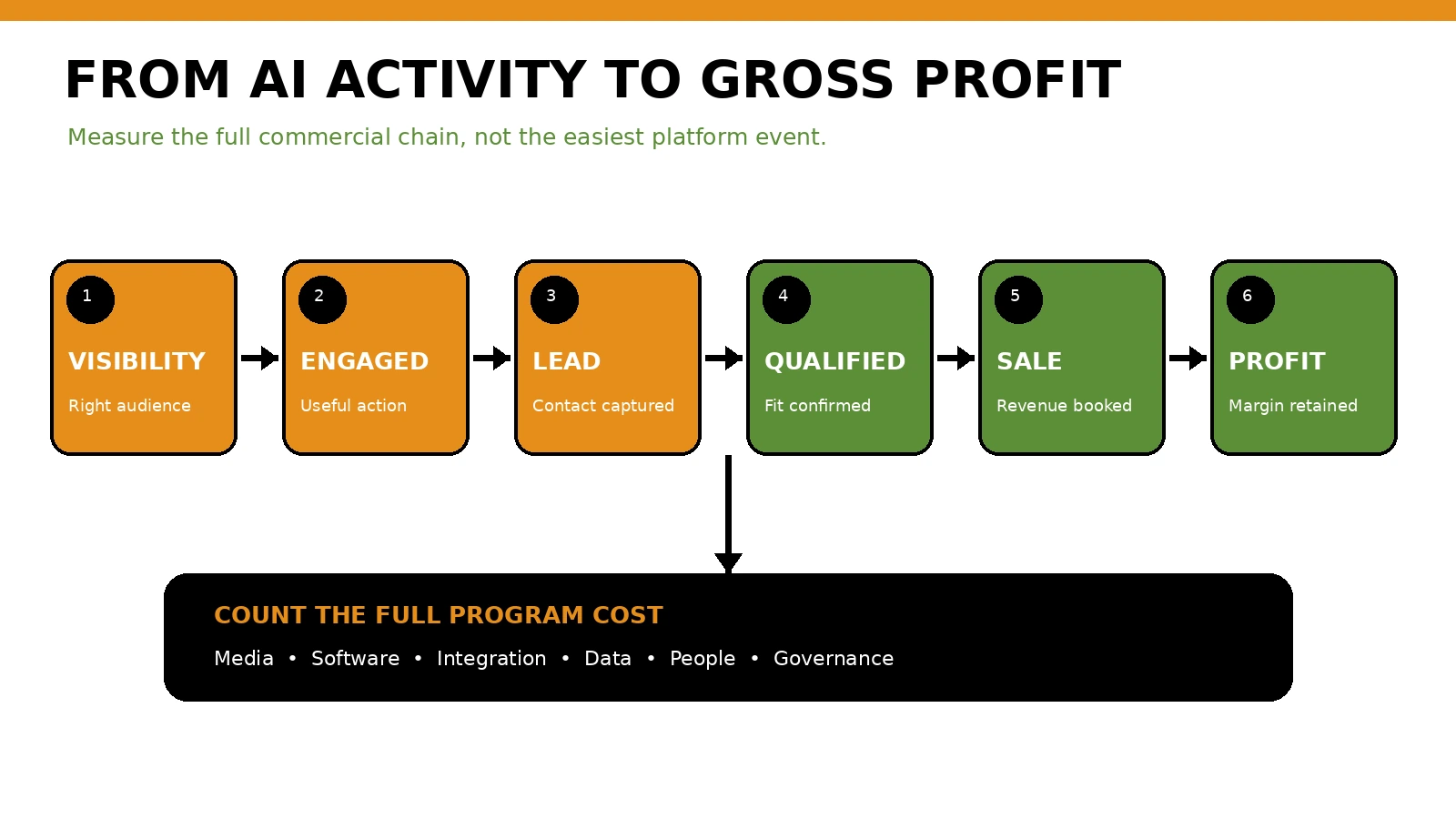
A reliable system connects six stages:
- Relevant visibility: the intended audience encounters the message.
- Meaningful engagement: the person takes an action that indicates real interest.
- Lead capture: the business receives enough information to follow up.
- Qualification: sales or service staff confirm commercial fit.
- Sale: the customer completes the agreed revenue event.
- Gross profit or retained value: the business accounts for delivery cost, refunds and retention.
Google Analytics defines a key event as an action that is particularly important to business success. That supports measuring meaningful website or app actions, but the browser event is still only one layer. A lead-generation business needs the later CRM outcome as well. Use the Google Ads conversion-tracking checklist for Kenyan SMEs when paid-search measurement is part of the journey.
Create a shared data dictionary
Write down the exact definition, owner and source for every stage. For example:
| Field | Definition | Source | Owner |
|---|---|---|---|
| Qualified lead | Decision-maker, relevant need, serviceable location and budget band confirmed | CRM | Sales lead |
| Opportunity value | Realistic proposal value, excluding VAT where finance requires | CRM or quoting system | Sales lead |
| Won revenue | Invoice accepted or payment received, according to finance policy | Accounting system | Finance |
| Gross profit | Won revenue less direct delivery and fulfilment cost | Accounting system | Finance |
| AI programme cost | All incremental technology, media, labour and governance costs | Budget register | Marketing and finance |
This prevents marketing from counting a form submission while sales counts only qualified opportunities and finance counts only paid invoices. One meeting to agree the definitions can improve the report more than another visual dashboard.
Preserve identifiers across the journey
Capture campaign parameters, landing-page source, enquiry time and a lead identifier where the tools allow it. Store identifiers with appropriate access controls. When a lead becomes qualified or a sale closes, update the record rather than creating a disconnected result.
For Google Ads lead generation, Google documents enhanced conversions for leads as a way to supplement offline conversion data with hashed first-party customer data and match later outcomes back to ad interactions. Its current documentation also notes 2026 changes to the upload route. Use the current official setup guidance, test the implementation and obtain legal or privacy advice where the processing requires it. Hashing does not remove the obligation to handle personal data lawfully.
Calculate ROI without hiding costs
The core formula is straightforward:
ROI = (incremental gross profit attributable to the initiative − total programme cost) ÷ total programme cost × 100
The hard work is defining each term honestly.
Use incremental value
Do not put all revenue touched by an AI-assisted journey into the numerator. Estimate the change above a credible baseline or control. If a business would normally close eight customers in a month and closes ten after the intervention, the starting question concerns the additional two, adjusted for seasonality, sales capacity, pricing, promotion and other material changes.
Prefer gross profit to revenue
Revenue can overstate value when fulfilment costs are high. A KES 100,000 sale is not worth KES 100,000 to the business if products, commissions, delivery and service labour consume most of it. Finance should define the margin basis.
Count the full programme cost
Include material incremental costs:
- AI and marketing software subscriptions
- implementation, integration and maintenance
- data cleaning and migration
- media and distribution spend
- staff time for setup, review and exception handling
- agency or specialist fees
- training and change management
- privacy, security and legal review where required
- refunds, credits or remediation linked to poor automation
Illustrative Kenyan example
Assume a Nairobi B2B company spends KES 150,000 during a three-month pilot across software, integration, staff time and campaign distribution. Against a matched historical baseline, the pilot produces three additional won deals. The additional revenue is KES 600,000, and finance calculates a 55% gross margin, giving KES 330,000 in incremental gross profit before the programme cost.
The illustrative ROI is:
(KES 330,000 − KES 150,000) ÷ KES 150,000 × 100 = 120%
That number is not a benchmark and does not claim a real Tabala client result. It demonstrates the method. The report should still disclose the baseline, attribution rule, sales-cycle window and confidence level. If one large deal explains the result, show the sensitivity: what happens if that deal is excluded or delayed?
Establish a credible baseline
Before switching on the AI change, capture the existing performance for a period long enough to reflect the sales cycle. Record volume, quality, conversion rate, value, cost and operational load.
Use one of four comparison designs:
Pre-and-post baseline
Compare the same process before and after the change. This is easy to operate but vulnerable to seasonality, pricing changes and concurrent campaigns. Use it only when the business records those other changes.
Holdout or control group
Keep an eligible group on the existing process and compare it with the AI-supported process. This provides stronger evidence when the groups are comparable and large enough, but it requires discipline and can be impractical for small volumes.
Staggered rollout
Introduce the change by branch, region, product group or team at different times. A business operating in Nairobi, Mombasa and Kisumu can sometimes use a staggered implementation, provided the markets are not treated as identical and other differences are documented.
Cohort comparison
Group leads or customers by acquisition month, campaign, source or first exposure and follow each cohort through the full sales cycle. This is useful when revenue arrives weeks after the first interaction.
Do not choose the design after seeing the result. Define it in the measurement plan before launch.
Measure different AI marketing use cases
AI-assisted content and search
Measure relevant impressions, qualified visits, assisted enquiries and pipeline influenced by the content. Separate branded from non-branded demand where possible. Review whether the content answers a real buying question and whether it supports the correct service page. Faster publishing is an efficiency metric; it becomes an ROI input only when saved time is actually redeployed or cost is reduced.
For conversion-focused content, the reader should land on a page with a clear next step. The guide to building landing pages that convert explains the page-level handoff from interest to enquiry.
AI chatbots and WhatsApp workflows
Track containment or response-time savings separately from lead generation. A useful chatbot scorecard includes completed conversations, human handoffs, qualified leads, booked appointments, sales, opt-outs, complaints and unresolved exceptions. Do not assign a sale to the chatbot simply because it appeared in the journey.
AI-assisted advertising
Judge advertising on qualified outcomes, value and cost. Platform automation can find more of the conversion signal it receives. If the primary conversion is a weak action, it may scale weak actions. Pair platform results with CRM qualification and closed outcomes. The Google Ads Quality Score guide is useful for diagnosing search relevance, while ROI reporting should remain centred on acquisition cost, qualified leads and revenue.
AI-assisted email and CRM
Track deliverability, replies, qualified appointments, sales and retention. Account for list quality and consent. If AI helps draft emails but staff still spend the same total time reviewing and correcting them, do not claim the theoretical time saving as realised value.
AI lead scoring
Compare scored and unscored cohorts on qualification rate, speed to contact, opportunity creation, win rate and false-negative risk. Monitor whether certain customer groups are systematically deprioritised. High accuracy on an imbalanced dataset can still produce poor commercial and fairness outcomes.
Handle attribution and incrementality
Attribution distributes credit across touchpoints. Incrementality asks what would have happened without the intervention. They answer different questions.
Use attribution for operational decisions such as which campaigns assist conversions. Use a baseline, holdout, staggered rollout or another credible comparison when estimating incremental value. Do not present a platform’s attributed revenue as fully incremental revenue.
Report three layers:
- Observed outcome: what happened in sales, gross profit or retention.
- Attributed outcome: which journeys or touchpoints received credit under the chosen model.
- Estimated incremental outcome: the change that the comparison design suggests would not have happened otherwise.
Add a confidence label:
- High: clean identifiers, stable definitions, suitable control and completed sales cycle.
- Medium: reliable CRM outcomes and baseline, but no control or some concurrent changes.
- Low: short window, incomplete costs, weak identifiers or major external changes.
This is more useful to a decision-maker than a precise percentage with hidden uncertainty.
Create a practical Kenyan SME scorecard
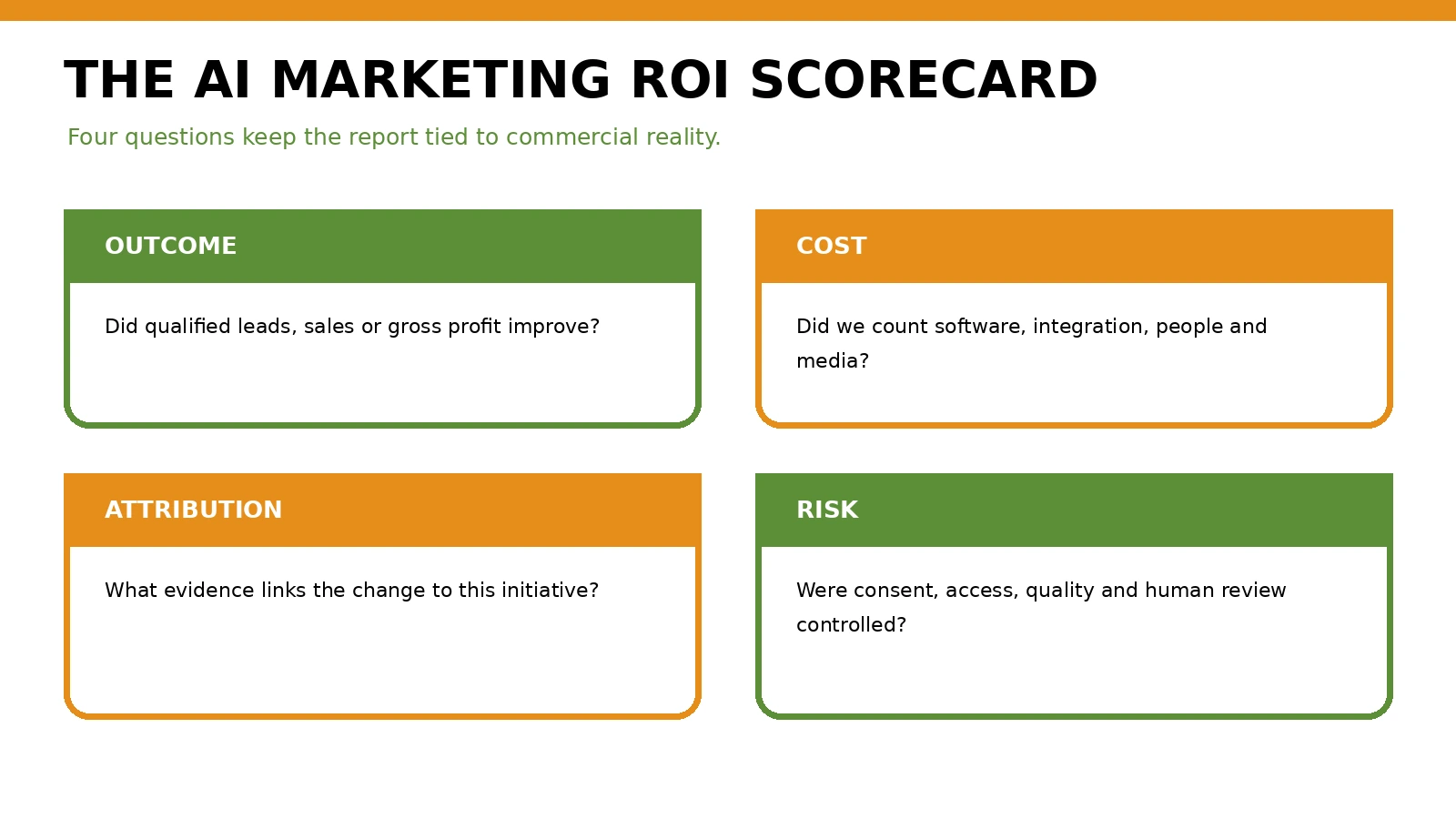
The scorecard should fit on one page and answer four questions.
Outcome
- What commercial outcome changed?
- How many leads reached the qualified, opportunity and won stages?
- What incremental gross profit or retained value is estimated?
Cost
- What was the full incremental programme cost?
- Which costs are one-off and which will recur?
- Did staff time actually fall, or only move from creation to review?
Attribution
- Which measurement model is being used?
- What baseline, control or cohort supports the estimate?
- Which other changes may have influenced the result?
Risk and quality
- Were consent, access and retention rules followed?
- How many errors, complaints, opt-outs or harmful exceptions occurred?
- Where does human approval remain mandatory?
| Metric | Baseline | Current | Change | Evidence quality | Owner |
|---|---|---|---|---|---|
| Sales-qualified leads | Enter actual | Enter actual | Calculated | High/medium/low | Sales |
| Won gross profit | Enter actual | Enter actual | Calculated | High/medium/low | Finance |
| Full programme cost | Enter actual | Enter actual | Calculated | High/medium/low | Marketing |
| Estimated ROI | N/A | Calculated | N/A | High/medium/low | Finance |
| Complaints or exceptions | Enter actual | Enter actual | Calculated | High/medium/low | Operations |
Use actual business data. Do not insert a generic benchmark merely to fill the table.
Protect data and keep human oversight
The measurement system may combine contact details, campaign identifiers, conversation records, buying behaviour and lead scores. That makes governance part of ROI, not a separate legal appendix.
Kenya’s Data Protection Act gives a data subject rights in relation to decisions based solely on automated processing that produce legal or similarly significant effects. Section 35 includes notification and reconsideration provisions in relevant cases. A marketing team should therefore identify where an AI score or automation could significantly affect a person, document the purpose and legal basis, limit access, and provide suitable human review.
Practical controls include:
- collect only the data needed for the stated purpose;
- explain material tracking and profiling in clear privacy information;
- restrict access to CRM, advertising and analytics data;
- set retention periods rather than keeping every conversation indefinitely;
- test outputs for errors and uneven treatment;
- require human review for sensitive, high-value or consequential decisions;
- keep an incident and exception log;
- review vendors, data locations and contractual responsibilities.
Treat a privacy failure, complaint, remediation cost or damaged customer relationship as a real programme cost. A workflow that increases short-term conversion while creating unmanaged risk is not a strong return.
Follow a 30-day implementation plan
Days 1–5: define the decision
- Name the AI initiative and owner.
- State the commercial outcome and guardrail metrics.
- Choose the evaluation period based on the sales cycle.
- Record the baseline and comparison method.
- Agree definitions with marketing, sales and finance.
Days 6–10: map the data
- Draw the path from campaign or content to enquiry, qualification, sale and gross profit.
- List every system and identifier.
- Mark missing, duplicated and manually entered fields.
- Decide who updates lead stage, value and loss reason.
- Review consent, access and retention requirements.
Days 11–15: repair measurement
- Configure only meaningful website or app events as key events.
- Test forms, calls, WhatsApp actions, bookings and purchases end to end.
- Add campaign parameters and preserve source data in the lead record.
- Connect qualified and won outcomes where technically and lawfully appropriate.
- Deduplicate events and document counting rules.
Days 16–20: build the cost register
- List software, media, implementation, staff, review and governance costs.
- Separate one-off and recurring costs.
- Agree the gross-margin basis with finance.
- Record the cost of exceptions and remediation.
Days 21–25: launch a bounded test
- Start with one audience, journey or branch.
- Keep the comparison design intact.
- Monitor lead quality and customer experience daily.
- Stop or escalate if the workflow creates harmful errors.
Days 26–30: review and decide
- Reconcile analytics, CRM and finance totals.
- Calculate the outcome, cost and estimated incremental value.
- Assign an evidence-confidence level.
- Decide whether to stop, repair, continue testing or scale.
- Record the next measurement milestone.
If the current system cannot connect visibility, conversion and revenue, run the 360 Digital Growth Diagnostic before adding another tool. Tabala’s digital marketing services in Nairobi are designed around the same full-funnel principle: channels, website conversion and measurement should work as one system.
Frequently asked questions
What is a good AI marketing ROI in Kenya?
There is no responsible universal percentage. A good result depends on margin, sales cycle, risk, cash flow, implementation maturity and the alternative use of the budget. Compare the initiative with the business’s own hurdle rate and credible alternatives. State the evidence quality beside the percentage.
Should a small business use revenue or gross profit?
Use gross profit when the data is available because it accounts for direct delivery or fulfilment cost. If only revenue is available, label the calculation as a revenue return and do not present it as profit ROI.
How long should an AI marketing pilot run?
Run it long enough for the relevant outcome to mature. A chatbot response-time test may show operational results within weeks. A B2B content or lead-nurture initiative may need several months. Use the normal sales cycle, seasonality and volume to set the window before launch.
Can Google Analytics measure AI marketing ROI on its own?
No. Google Analytics can measure website and app events, traffic sources and attribution paths. A lead-generation business still needs qualification, opportunity, sale and value data from its CRM or sales process, plus cost and margin data from finance.
Do AI-generated leads count as conversions?
Only if they meet the conversion definition. A conversation or form submission may be an early signal. Keep it separate from a qualified lead, booked appointment and completed sale.
How should WhatsApp leads be measured?
Record the click or conversation as an initial event, then update the lead when identity, need, fit and outcome are known. Do not give every WhatsApp click the value of a sale. Use campaign parameters or a disciplined source field where appropriate.
What if the business has no CRM?
Start with a controlled lead register that has unique IDs, dates, source, qualification stage, value, owner and loss reason. A simple system used consistently is more valuable than a sophisticated CRM with missing outcomes. Restrict access and define retention.
How do we measure time saved by AI?
Measure the task time before and after, including review, correction and exception handling. Convert only realised savings into value. If staff use the saved time for higher-value work, document that redeployment and its outcome. Do not count theoretical minutes that never change cost or capacity.
How does data protection affect ROI measurement?
Personal data must be handled lawfully and securely. Profiling and significant automated decisions require particular care. Include compliance, security, human review and incident costs in the programme cost, and obtain professional advice for high-risk processing.
Turn AI activity into a revenue decision
AI marketing ROI is not a count of prompts, posts or conversations. It is a disciplined decision about whether a specific change produced enough additional commercial value to justify its complete cost and risk.
Define the outcome before the tool. Keep the measurement chain intact from meaningful engagement to gross profit. Compare the result with a credible baseline. Report attribution limits and evidence confidence. Then scale only what improves the business outcome without degrading lead quality, customer trust or governance.
If your analytics, CRM and sales data do not yet connect, start with the 360 Digital Growth Diagnostic. It will help identify where visibility, conversion and revenue measurement are leaking before you commit more budget to AI.
Accelerate Your Revenue
While Revenue Intelligence builds long-term authority, Google Ads delivers immediate, high-intent traffic. Combine both for maximum market dominance.

Strategist Profile
Abala Tom
Digital systems strategist specializing in high-performance SEO, Google Ads, and conversion optimization. Mission: to replace marketing 'guesswork' with predictable revenue systems.