AI Marketing Automation for Kenyan SMEs: Build a Safe Workflow
A practical framework for Kenyan SMEs to automate repetitive marketing tasks without compromising data privacy, customer trust, or human review.
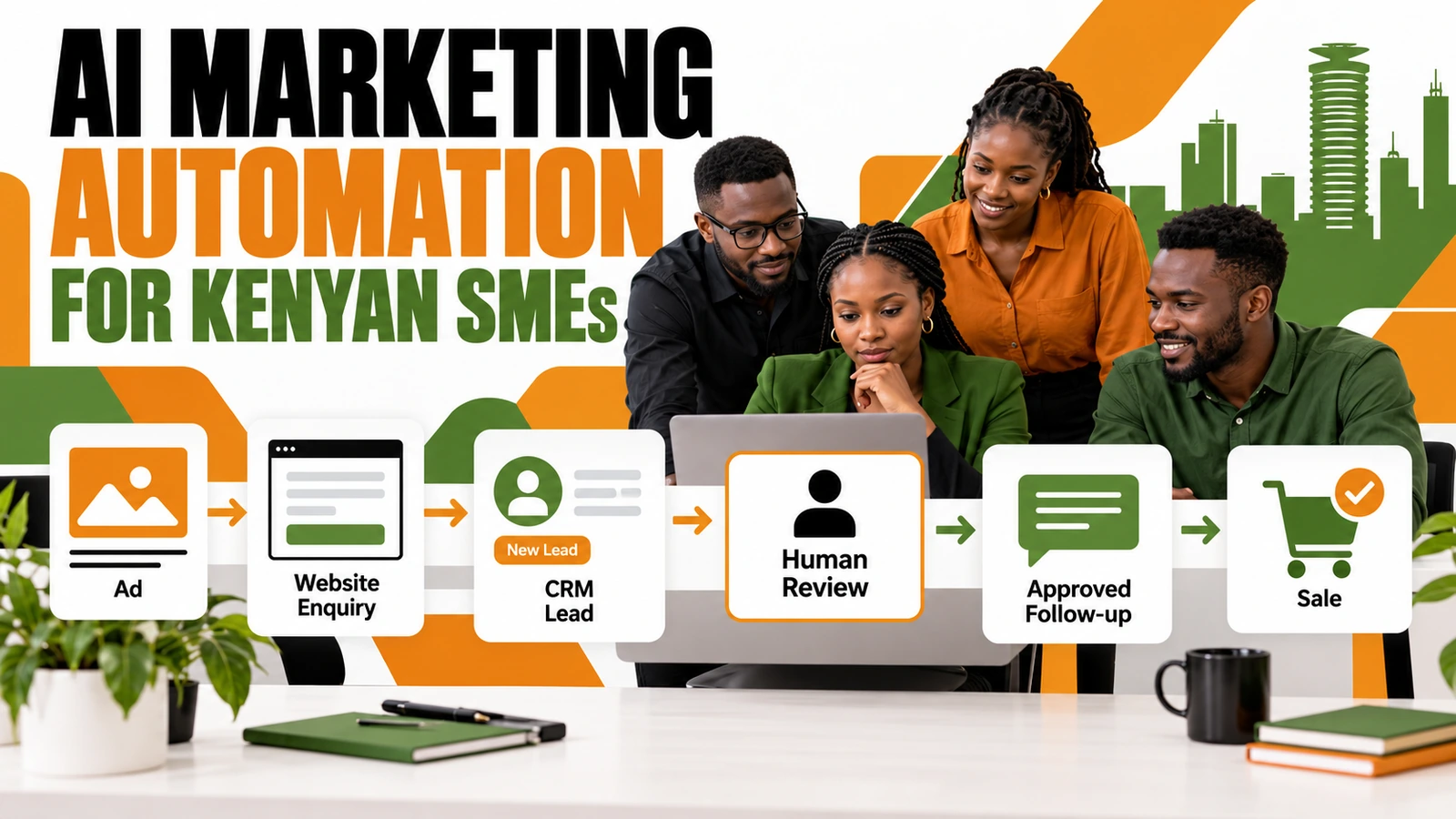
AI Marketing Automation for Kenyan SMEs: Build a Safe Workflow
A lead fills in your website form after seeing an ad. The form creates a CRM record, an AI tool scores the enquiry, an email sequence starts and the sales team receives a notification. It looks efficient until the same person gets two messages, a weak lead is marked urgent, a serious buyer receives a generic reply and the advertising platform is told that every form submission is a valuable conversion.
That failure has a commercial cost. Staff stop trusting the CRM. Prospects lose confidence. Automated bidding learns from the wrong outcome. Personal data moves through tools no one has properly reviewed. The business has removed manual steps without building a reliable operating system.
For a Kenyan SME, safe AI marketing automation should make the customer journey easier to manage and easier to measure. It should connect a small number of approved steps, give people control over high-consequence decisions, record what happened and stop cleanly when data is missing or a system fails.
This guide shows how to choose the first workflow, design its controls, connect marketing and sales, protect customer data and measure revenue without buying a complicated stack first.
Quick answer
Start with one frequent, measurable workflow such as lead capture and follow-up. Define the trigger, validate the data, apply transparent rules, require human approval where judgment matters, send the approved action, record the outcome and route failures to an exception queue. Automate only after the manual process has a clear owner, service-level target and success measure. Keep sensitive, unusual, high-value and legally significant decisions under meaningful human review.
Key takeaways
- Automate a complete customer outcome, not a collection of disconnected tasks.
- Use rules for predictable decisions and AI for bounded interpretation, classification or drafting.
- Validate contact, consent, source and ownership before any automated follow-up.
- Keep pricing exceptions, complaints, sensitive data and high-value opportunities with a person.
- Send sales outcomes back to marketing so platforms learn from qualified leads and revenue, not every form fill.
- Build an exception queue, audit trail, manual stop and named owner before launch.
- Prove one workflow for 30 days before adding more channels or tools.
What AI marketing automation means
Marketing automation uses software to move information or trigger actions across a customer journey. AI can add bounded capabilities such as classifying an enquiry, summarising a conversation, extracting fields from free text, predicting a likely next step or drafting a reply for review.
The useful distinction is between automation, which follows a defined process, and autonomy, which allows a system to choose actions with less direct control. Most SMEs need dependable automation with limited AI assistance. They do not need an autonomous agent changing budgets, approving discounts and contacting customers without supervision.
| Component | Practical role | Example | Control needed |
|---|---|---|---|
| Trigger | Starts the workflow | Valid form submission | Deduplication and source check |
| Rule | Applies a known condition | Route Mombasa enquiries to Coast team | Documented owner and fallback |
| AI step | Interprets unstructured input | Summarise the customer need | Approved prompt, confidence rule and review |
| Action | Changes the customer journey | Send acknowledgement | Approved content and consent check |
| Human decision | Adds judgment | Accept lead priority or pricing exception | Named role and response target |
| Measurement | Records business outcome | Consultation booked or sale won | Stable event names and CRM stage definitions |
Tabala’s broader guide to AI marketing in Kenya provides the strategic context for these workflows. If “lead”, “qualified lead” and “conversion” mean different things to marketing and sales, automation will scale the disagreement.
What to automate first
The strongest first workflow is usually frequent, repetitive, time-sensitive and measurable. It should also have a clear manual process that staff already understand.
Good first candidates
- acknowledging a valid website enquiry;
- assigning a lead by service, branch or county;
- notifying the correct salesperson with a useful summary;
- reminding staff when a qualified lead has no owner;
- confirming a booked consultation;
- requesting one missing document or detail;
- updating a CRM stage after an approved action;
- sending a permitted follow-up after a quotation;
- importing a closed sale into advertising measurement.
Use a simple selection score
Score each candidate from one to five on frequency, staff time, delay cost, process clarity, data quality and measurability. Subtract risk for sensitive data, complex judgment, regulatory impact and weak system reliability. The highest score is not automatically the winner, but the exercise exposes where a seemingly attractive workflow depends on poor data or unclear ownership.
For example, a Nairobi training company may receive many course enquiries. Automating the first acknowledgement and routing by programme is low risk. Automatically deciding whether a candidate is eligible for admission may require much stronger evidence, transparency and human review.
Start with the bottleneck, not the fashionable tool
If qualified leads already receive a response within five minutes but quotations take four days, another chatbot will not solve the commercial problem. Map the journey from source to sale and locate the delay, loss or repeated work. Tabala’s Revenue Recovery Sprint is designed for gaps between traffic, enquiry, follow-up and revenue.
What should remain under human control
Pricing exceptions and negotiation
A system can present approved prices or create a draft quotation from a controlled price list. A person should approve discounts, unusual scope, credit terms and commitments that affect margin or delivery.
Complaints, refunds and urgent situations
Automation can recognise and route these messages. It should not trap a frustrated customer in a sequence. Escalate quickly and preserve the context so the customer does not repeat the issue.
Sensitive or significant decisions
Credit, employment, healthcare, insurance, education access and similar decisions can materially affect people. Do not let a marketing workflow become the sole decision-maker. Use meaningful human involvement and the safeguards required by Kenyan law.
High-value or unusual opportunities
The more valuable or ambiguous the enquiry, the more useful human judgment becomes. AI can summarise the known facts and suggest questions, but the account owner should decide priority, solution and next action.
Changes to advertising budgets and conversion goals
Platforms already automate bidding. Adding an external agent that also changes budgets, targets or goals can create competing control loops. Require approval for material changes and protect the conversion actions used for bidding. Google explains that Smart Bidding relies on conversion data, so poor outcome definitions can train the system toward the wrong behaviour.
The safe workflow architecture
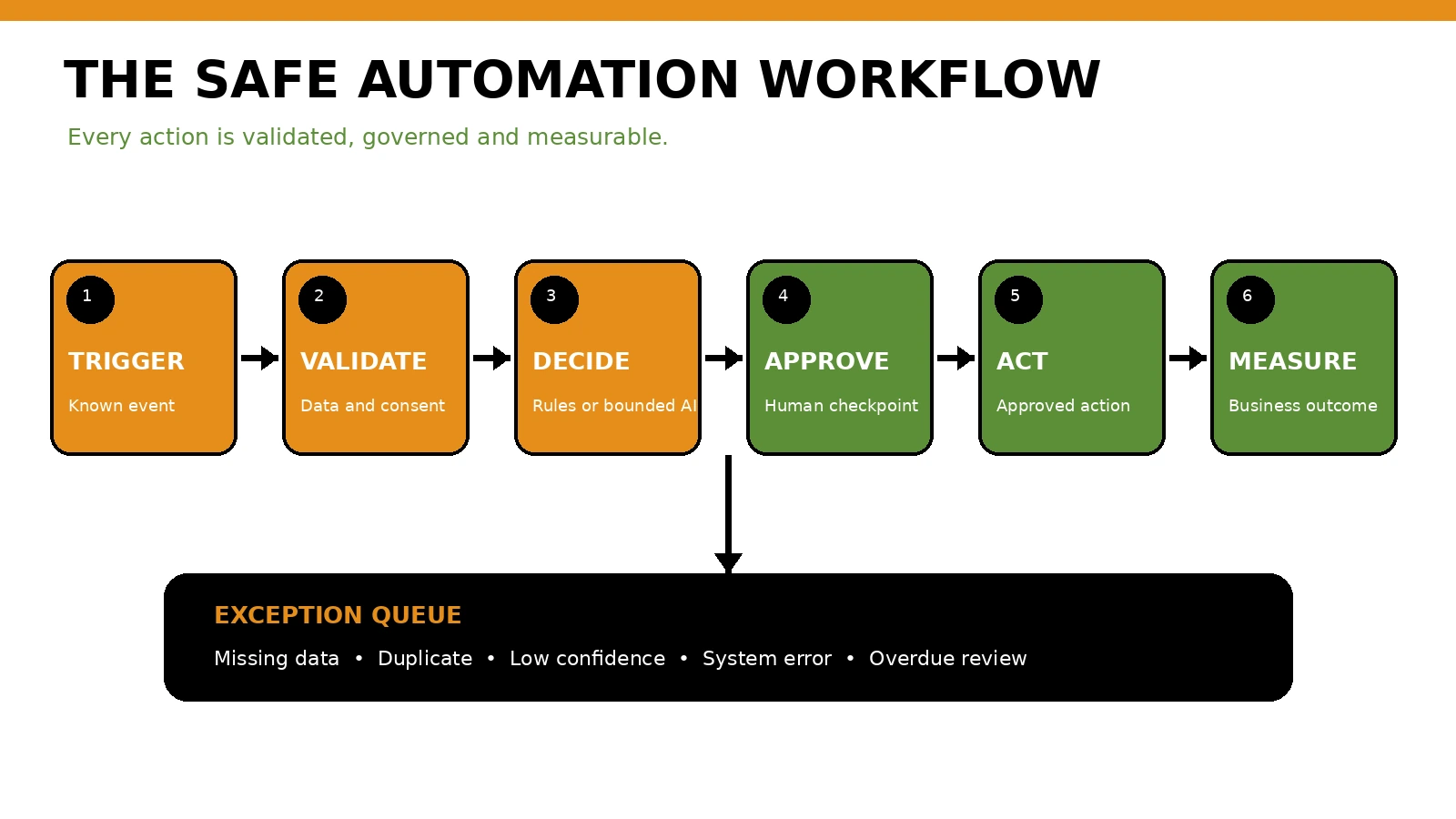
A safe workflow has eight parts. Each part should be visible in the process documentation and test plan.
1. Trigger
Define the exact event that starts the workflow: a submitted form, a booked appointment, a CRM stage change or a payment confirmation. Avoid vague triggers such as “new activity”. Record the timestamp and source.
2. Validation
Check that required fields exist, the contact is not a duplicate, the record has a lawful purpose, the source is expected and the data format is usable. Validation should fail closed: an incomplete record moves to review instead of continuing with invented values.
3. Enrichment
Add only information needed for the next step. A location may determine branch ownership. A selected service may determine the sales queue. Avoid buying or appending unrelated personal data simply because a tool makes it possible.
4. Decision
Use transparent rules wherever possible. For example: website projects go to the web team; Mombasa leads go to the Coast owner; existing customers go to account management. If AI classifies free text, define the allowed categories, minimum confidence and fallback.
5. Human approval
Place approval before high-consequence actions such as a custom price, public response, paid-media change or sensitive communication. The reviewer needs the original input, proposed action, reason and deadline.
6. Action
Send only approved messages or updates. Log the version used, destination, system response and responsible owner. Prevent the same record from firing twice.
7. Measurement
Record the next business state: accepted lead, consultation booked, quotation sent, sale won, sale value or disqualification reason. The automation is incomplete until the outcome is captured.
8. Exception queue
Every integration fails eventually. Create a visible queue for missing data, duplicate contacts, API errors, low-confidence classification, invalid consent and overdue human review. Give the queue an owner and a daily review routine.
A starter workflow for lead capture and follow-up
This workflow is suitable for many professional services, training firms, property businesses, home-service companies and B2B SMEs in Nairobi, Mombasa, Kisumu, Nakuru and Eldoret.
| Step | System action | Human control | Evidence captured |
|---|---|---|---|
| 1 | Receive website form | Form fields and privacy notice approved | Source, timestamp and consent record |
| 2 | Validate and deduplicate | Exception queue for conflicts | Validation result and match key |
| 3 | Classify service and urgency | Review low-confidence or sensitive messages | Category, confidence and reason |
| 4 | Create or update CRM lead | Sales operations owns field mapping | Record ID and owner |
| 5 | Send acknowledgement | Approved message; no invented promise | Message version and delivery status |
| 6 | Alert salesperson | SLA based on business hours and lead type | Notification and acceptance time |
| 7 | Escalate if untouched | Manager receives overdue alert | Escalation history |
| 8 | Record outcome | Salesperson confirms stage and value | Booking, quotation, sale or reason lost |
| 9 | Return qualified outcomes to marketing | Marketing approves conversion mapping | Platform upload result and match rate |
Example: a Nairobi accounting firm
A prospect selects “monthly bookkeeping”, enters a business email, chooses Nairobi and requests a call. The workflow validates the form, checks for an existing account, creates the CRM record, sends an acknowledgement and alerts the bookkeeping lead. If the lead is untouched after the agreed response period, the sales manager receives an alert.
The AI step may summarise a free-text description such as “We are behind on reconciliations and need help before audit”. It should not decide whether the client is acceptable, set the price or provide tax advice. Those actions remain with qualified staff.
Example: a Mombasa hospitality business
A corporate organiser requests rooms and meeting space. The system can extract dates, guest count and contact details, route the request to events sales and create a follow-up task. If dates are missing or the request includes a special accessibility need, it moves to human review. Availability and price should come from the approved reservation system, not a language model’s guess.
Channel and system design
Website and landing pages
Use a stable form schema, server-side validation where practical, spam controls and a clear success state. Keep hidden attribution fields separate from customer-provided information. Test the form on mobile and on slower connections.
Run a technical SEO check for Kenyan websites before depending on a site as the automation entry point. Broken forms, slow pages and tracking errors weaken the workflow before the CRM receives anything.
CRM
Choose one system of record for lead status, ownership and revenue. Define field names, allowed values and who can change them. Avoid creating separate copies of the same prospect in email, spreadsheets and sales tools without a reliable identifier.
Email and messaging
Keep automated messages useful, specific and easy to stop. State what happens next and when a person will respond. Do not send a long sequence simply because the platform makes it easy. Frequency and purpose should match the customer’s expectation and the lawful basis for processing.
Advertising platforms
Separate enquiry events from qualified outcomes. A form submission may be useful for reporting, but the event used for automated bidding should reflect a meaningful business goal. Tabala’s Google Ads conversion tracking checklist explains how to define and test those actions.
Google’s enhanced conversions for leads can connect later CRM outcomes back to ad interactions using hashed first-party information and relevant identifiers. It still requires a lawful data process, correct tagging, consistent CRM fields and diagnostic checks. Hashing is a technical protection; it does not replace consent, transparency or purpose limitation.
AI model or assistant
Limit the AI step to a defined task. Give it approved categories or source material, require structured output, log the model and prompt version and reject responses outside the schema. Do not expose the model to every CRM field by default. Send only the minimum data required for the task.
Kenyan data protection and AI governance
Kenya’s Data Protection Act applies when personal data is collected, stored, used, shared or deleted. A marketing workflow can involve several controllers and processors, including the website host, CRM, email platform, integration provider, AI provider and advertising platform.
Document the purpose and lawful basis
State why each field is collected and how it supports the customer journey. A phone number for a requested call has a clear operational purpose. Adding personal profile data for speculative scoring requires a separate justification and stronger review.
Minimise access and retention
Give each tool and team only the fields needed for its role. Set retention rules for abandoned enquiries, test records, logs and exported spreadsheets. Remove access when staff or vendors change.
Review processors and transfers
Record which vendors receive personal data, where it is processed, their security commitments, sub-processors and deletion process. Keep contracts and instructions consistent with the actual configuration.
Protect rights in automated decisions
Section 35 of the Act gives data subjects rights regarding decisions based solely on automated processing that produce legal or similarly significant effects. The Data Protection General Regulations add requirements around information, logic, consequences, safeguards, error prevention and human intervention.
The ODPC’s July 2026 Guidance Note on Artificial Intelligence covers transparency, data minimisation, privacy by design, impact assessment, third-party processors, monitoring and high-risk AI applications. Use it during design, vendor review and ongoing governance rather than treating privacy as a final launch checklist.
Set a clear human-control policy
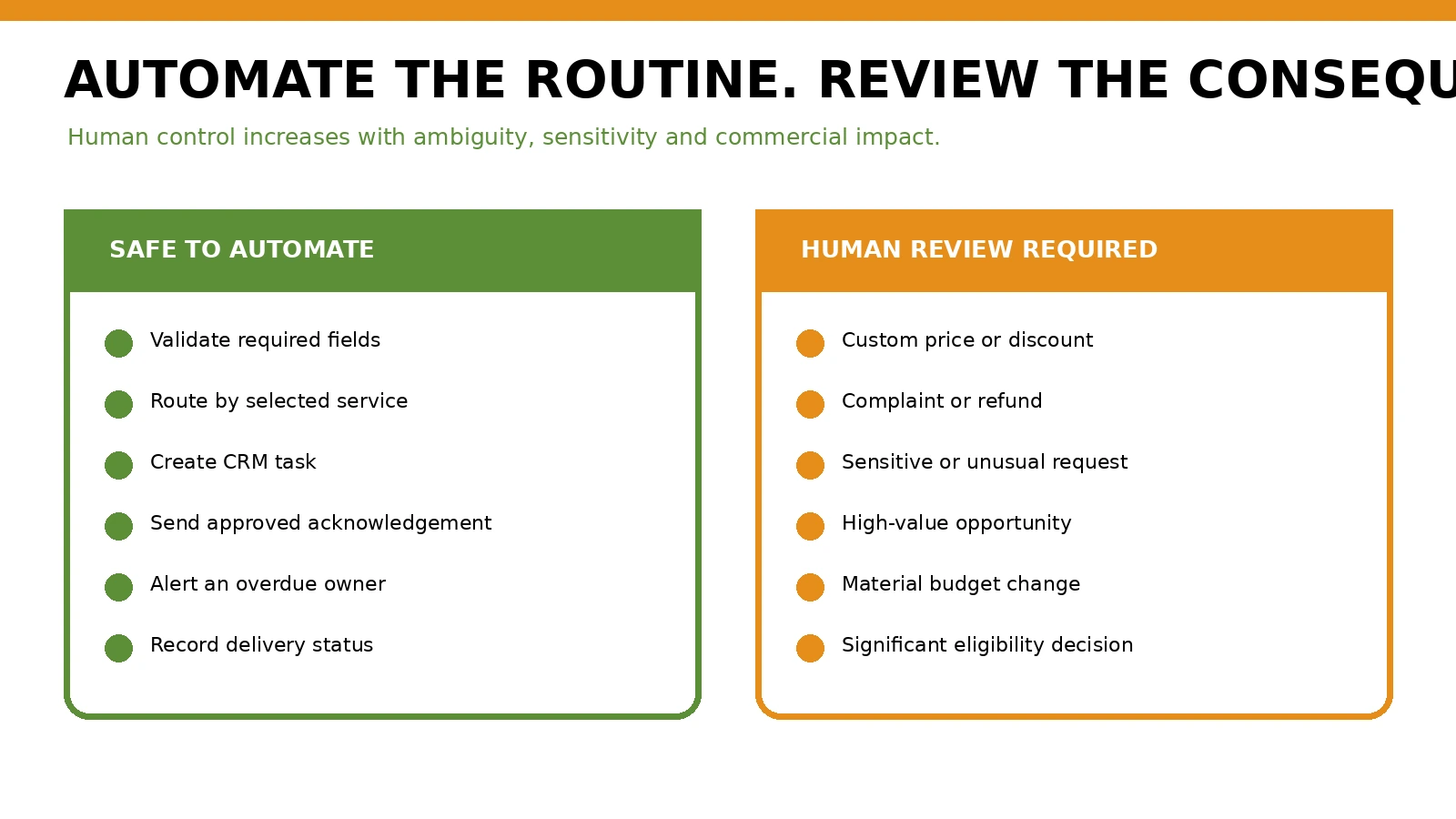
| Action | Automation role | Human role |
|---|---|---|
| Validate required form fields | Complete automatically | Review exceptions |
| Route by selected service or branch | Complete automatically | Maintain rules |
| Summarise an enquiry | Draft summary | Check before consequential use |
| Send standard acknowledgement | Send after validation | Approve template and purpose |
| Set custom price or discount | Prepare information | Decide and approve |
| Handle complaint or refund | Detect and route | Own response and resolution |
| Change paid-media budget | Recommend with evidence | Approve material change |
| Decide credit, employment or eligibility | Support analysis only | Qualified decision with legal safeguards |
Measurement and failure controls
Measure the funnel as separate stages
Track at least:
- valid enquiries received;
- duplicate or invalid records;
- leads accepted by sales;
- time to first human response;
- consultations or appointments booked;
- quotations sent;
- sales won and revenue recorded;
- reasons lost or disqualified;
- automation exceptions and resolution time.
Do not collapse all activity into one “conversion” metric. Google Analytics key events can represent actions that matter to the business, while Google Ads can use selected conversion actions for bidding. The labels and counting rules should reflect the actual business journey.
Use quality gates before platform feedback
Send a qualified lead or closed sale back to an advertising platform only after the CRM state is reliable. Prevent duplicate uploads with a transaction or event ID. Test with non-production records. Reconcile platform totals with the CRM on a regular schedule.
Monitor leading and outcome indicators
Fast acknowledgement is a leading indicator. Revenue is an outcome. A workflow can improve response time while reducing lead quality or customer trust. Review both.
Build failure controls
- Idempotency: the same trigger cannot create duplicate actions.
- Rate limits: an error cannot send hundreds of messages.
- Manual stop: an owner can pause the workflow immediately.
- Fallback: customers receive a safe alternative when a system is unavailable.
- Audit log: the business can reconstruct what happened.
- Version control: prompts, rules and templates have dates and owners.
- Test environment: changes are tested before live customer data is used.
- Alerts: failures, delays and unusual volumes reach the responsible person.
Cost and business case
Do not compare tools only by the monthly licence. The real cost includes setup, integration, data cleanup, staff training, message or API usage, monitoring, maintenance and vendor support.
Build the case with your own figures:
- Estimate the monthly number of valid enquiries.
- Measure current staff minutes spent on the chosen process.
- Record current response time and stage-to-stage conversion.
- Calculate the value of staff capacity released.
- Estimate the value of additional qualified leads reached within the service target.
- Subtract software, implementation and ongoing operating cost.
- Add a risk allowance for rework, errors and vendor change.
Avoid claiming savings before the pilot. Establish the baseline, run the workflow, and compare like-for-like cohorts. A process that saves time but weakens conversion quality is not a successful automation.
If the business needs help connecting marketing, sales and measurement, review Tabala’s digital marketing services in Nairobi. The engagement should begin with the commercial workflow and evidence, then select the stack.
30-day implementation checklist
Week 1: define the process
Week 2: build the controlled workflow
Week 3: pilot with close supervision
Week 4: evaluate and decide
Frequently asked questions
What is AI marketing automation?
It is a defined marketing or sales workflow that uses software to move data and trigger actions, with AI assisting bounded tasks such as classification, extraction, summarisation or drafting.
What should a Kenyan SME automate first?
Choose a frequent, repetitive and measurable process with clear rules. Lead capture, routing, acknowledgement and follow-up are often good candidates when the manual process already works.
Does marketing automation require a CRM?
Simple workflows can run without one, but a CRM becomes valuable when several people handle leads, ownership must be visible and sales outcomes need to return to marketing measurement.
Can AI automatically qualify leads?
AI can classify or summarise information, but the qualification rules should be transparent. Sensitive, ambiguous, unusual or high-value leads should receive human review.
How can automation comply with Kenya’s Data Protection Act?
Document the purpose and lawful basis, collect the minimum data, inform people appropriately, secure access, review processors, respect data-subject rights and provide meaningful human involvement where automated decisions have significant effects.
How do I stop duplicate follow-up messages?
Use a stable contact or event identifier, check the CRM before creating a new record, make actions idempotent, log message status and prevent retries from creating a second customer-facing action.
Should every lead be sent to Google Ads as a conversion?
No. Track form submissions for visibility, but use well-defined primary conversion actions for bidding. Qualified leads and closed sales can provide stronger feedback when the CRM and upload process are reliable.
How many tools does a small business need?
Use the fewest systems that can complete and measure the workflow. A website form, CRM, messaging platform, analytics setup and one integration layer may be enough. Add tools only when a proven requirement cannot be met safely.
When should the workflow hand over to a person?
Handover should occur when the customer asks, confidence is low, data is missing, the topic is sensitive, the request is unusual, a complaint arises or the action affects price, eligibility, reputation or legal rights.
Build the first workflow around revenue
The best AI marketing automation is rarely the one with the most steps. It is the one your team can explain, monitor and improve. Start with a real commercial delay, define the customer outcome, protect the data, keep people in control and connect the final sales result back to marketing.
Tabala Digital Solutions can help map the workflow, validate measurement, identify the smallest useful stack and build the controls required for a safe pilot. Start with the 360 Digital Growth Diagnostic to see where leads, follow-up and revenue are currently disconnecting.
Accelerate Your Revenue
While Revenue Intelligence builds long-term authority, Google Ads delivers immediate, high-intent traffic. Combine both for maximum market dominance.

Strategist Profile
Abala Tom
Digital systems strategist specializing in high-performance SEO, Google Ads, and conversion optimization. Mission: to replace marketing 'guesswork' with predictable revenue systems.