How AI Is Changing Google Ads in Kenya
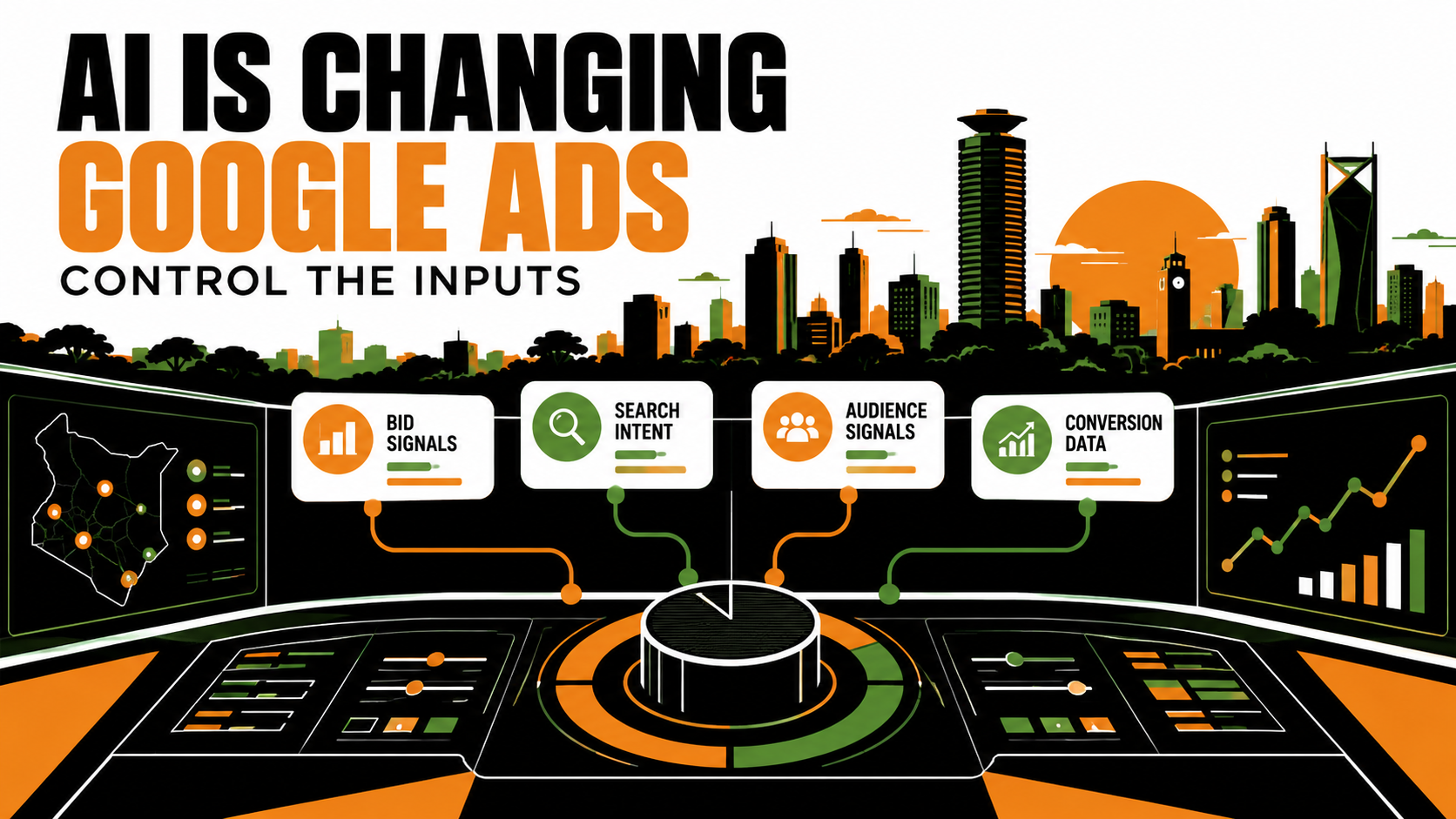
Kenyan businesses can now let Google’s AI choose bids, expand search matching, assemble creative, find audiences and serve ads across several channels. That speed is useful. It can also scale the wrong outcome faster. If a campaign treats every WhatsApp tap, accidental call or poor-fit form submission as success, automation will learn to find more of the same while the advertising budget keeps moving.
The commercial question is therefore not whether to use AI in Google Ads. Much of the platform already uses machine learning. The question is whether your business has given that system the right goal, dependable conversion data, clear creative, suitable landing pages and sensible limits.
For a Nairobi professional-services firm, a Mombasa hotel, a Kisumu retailer or an East African ecommerce brand, the winning approach is controlled automation. Let Google handle calculations that benefit from scale. Keep people responsible for economics, customer quality, claims, consent, brand standards and the final decision about what deserves more budget.
## Quick answer
AI is changing Google Ads by broadening how queries are matched, automating bids, creating or adapting assets, combining inventory through Performance Max and making ads eligible around AI-powered search experiences. It does not remove the advertiser’s responsibility. Kenyan advertisers still need to control business goals, primary conversions, first-party data, search-term quality, creative approval, landing pages, budgets, exclusions and experiments. The most important safeguard is to optimise for qualified leads or completed sales rather than easy but low-value actions.
## Key takeaways
- AI can make campaign execution faster, but it cannot decide what a profitable Kenyan customer is worth to your business.
- AI Max is an optimisation layer for Search campaigns. Performance Max is a separate goal-based campaign type that can access Google’s full inventory.
- Smart Bidding works from the conversion signals and values you provide. Weak measurement gives the system a weak target.
- Ads may appear above, below or within AI Overviews for eligible English searches in Kenya when Google detects commercial intent.
- Generative creative still needs human review for accuracy, brand fit, local context and regulated or sensitive claims.
- The safest adoption path is a measured experiment with clear success criteria, adequate data and a protected budget.
What has actually changed in Google Ads
Google Ads has used machine learning for years. The recent change is the reach of that automation. AI now influences more of the path between a person’s need and an advertiser’s result: interpreting intent, estimating the likelihood of conversion, setting a bid, selecting an asset, choosing inventory and reporting which combinations worked.
Three shifts matter most.
First, matching is less dependent on an advertiser predicting every exact phrase. Google’s AI Max for Search campaigns can expand query coverage through search-term matching and use page content or existing assets to help tailor ads. This can uncover demand that a rigid keyword list misses, but it increases the importance of accurate pages, strong brand language and regular search-term review.
Second, bidding is increasingly based on the probability and value of an outcome rather than a manual maximum bid for each keyword. Smart Bidding uses auction-time signals to pursue conversion or conversion-value goals. That makes the conversion setup a strategy decision, not just a technical checkbox.
Third, campaigns can operate across more surfaces. Performance Max is a goal-based campaign type that can serve across Search, YouTube, Display, Discover, Gmail and Maps. It complements keyword-based Search campaigns rather than making every other campaign unnecessary.
The practical result is a change in the advertiser’s job. Less time should go into repetitive bid edits. More time must go into deciding what success means, supplying trustworthy data, building useful creative, improving landing pages and checking whether automation produces real revenue.
Seven ways AI is changing Google Ads
1. Search matching is moving from literal words towards intent
A customer might search “emergency office internet Nairobi,” “backup Wi-Fi for a business” or “fix unreliable company internet.” These phrases differ, but the underlying need may be the same. AI-assisted matching can connect a relevant ad with that broader intent.
This improves reach only when the destination page clearly explains the offer. A generic homepage gives the system little useful context and gives the visitor no confident next step. Review the actual queries, add exclusions where appropriate and keep the promise in the ad consistent with the page.
Our guide to negative keywords for Kenyan campaigns explains how to block irrelevant intent without shrinking a campaign blindly.
2. Bids are becoming predictions, not fixed instructions
At each auction, Smart Bidding can consider signals that would be impractical to combine manually. The advertiser chooses the objective, such as conversions or conversion value, and the system predicts the bid most likely to achieve it.
That power creates a common failure. A business counts a form submission as a conversion even when most forms are spam or poor-fit enquiries. The system then optimises for form completion rather than commercial value. The interface can show more conversions while the sales team sees no improvement.
Before increasing automation, complete the Google Ads conversion-tracking checklist. Separate primary actions from secondary observations, deduplicate events and connect qualified or closed outcomes where practical.
3. Creative production is becoming assisted and adaptive
Google Ads can combine headlines and descriptions in responsive ads and can generate or adapt text, image and video assets in eligible campaign workflows. Google provides controls and reporting, but generated output still requires review.
Check every asset for:
- an accurate offer and price;
- Kenyan spelling, place names and context;
- realistic availability and delivery areas;
- approved brand language;
- readable text and safe cropping;
- compliant financial, health or performance claims; and
- a landing page that supports the same promise.
AI can produce variants. It cannot accept legal responsibility, protect customer trust or know that a phrase sounds wrong to your market.
4. Performance Max coordinates decisions across channels
Performance Max can use one campaign to pursue a conversion goal across Google inventory. For an ecommerce retailer with a sound product feed, reliable purchase tracking and enough creative, that coordination can be valuable. For a lead-generation business with vague conversions, it may spread poor signals across more placements.
Treat asset groups as focused offers, not a storage box for unrelated services. Give each group coherent copy, images, video and a relevant page. Monitor search-term insights, placement information, asset performance, product feed health and lead quality.
Performance Max is not a substitute for understanding the market. It is an execution system that needs a useful objective.
5. Ads can participate in AI-powered search experiences
Google states that ads can appear above, below or within AI Overviews when its systems detect relevant commercial intent. Its current availability information includes English queries on mobile and desktop in Kenya. Eligibility does not guarantee placement, and an ad still needs to meet relevance and quality requirements.
This creates a more conversational search journey. Someone may ask a longer question, compare options and then move towards a provider. Advertisers should build pages that answer the decision questions behind the query, not pages that repeat a keyword.
The opportunity is strongest when the page explains scope, process, proof, limitations, pricing logic and next steps. That content helps both a person and the systems interpreting the offer.
6. Landing pages and assets have become campaign inputs
Automation can use website content to understand an offer or tailor an ad. An outdated page can therefore damage more than conversion rate. It can feed unclear information into the campaign.
Create a dedicated page for the ad’s promise. Keep the first screen clear, make the action obvious, show trust signals and remove distractions. Our Google Ads landing-page guide for Kenya covers the practical changes that improve message match and lead quality.
Landing-page experience also contributes to Google Ads Quality Score, alongside expected click-through rate and ad relevance. Quality Score is a diagnostic, not a direct business outcome, so use it to locate weaknesses rather than chase a perfect number.
7. Campaign management is becoming a feedback discipline
The valuable human work now happens before and after the auction. Before it, define economics, goals, audiences, offers and safeguards. After it, inspect search terms, qualified-lead rate, sales feedback, profitability and creative quality.
Do not judge an automated campaign by platform conversions alone. Ask:
- Did the enquiries fit our service and location?
- Did the sales team contact them quickly?
- Which leads reached proposal or purchase?
- Which products generated contribution margin, not just revenue?
- Did brand searches or existing customers inflate the result?
- Did the campaign create demand or only capture it?
This feedback is what turns machine optimisation into business optimisation.
AI Max and Performance Max are not the same
The similar names cause avoidable confusion.
| Feature | AI Max for Search | Performance Max |
|---|---|---|
| What it is | An optimisation layer within Search campaigns | A goal-based campaign type |
| Main reach | Search inventory | Search, YouTube, Display, Discover, Gmail and Maps |
| Main purpose | Expand relevant query coverage and tailor ads in Search | Find conversions across Google inventory |
| Important inputs | Keywords, pages, ads, conversion goals and controls | Conversion goals, audience signals, asset groups, feeds and creative |
| Main risk | Irrelevant query expansion or weak page-based messaging | Opaque allocation or scaled low-quality conversions |
| Human control | Query review, exclusions, brand and URL controls, creative and goals | Goals, feeds, creative, exclusions, budgets, brand rules and lead-quality feedback |
Google says AI Max is not a new campaign type. It can be enabled in eligible Search campaigns and includes controls for search-term matching, asset optimisation and related settings. Performance Max remains its own campaign type.
Choose according to the business problem. A mature Search campaign may test AI Max to find incremental queries. A retailer with strong purchase data and creative may test Performance Max for cross-channel reach. Neither should be activated merely because the interface recommends it.
What Kenyan advertisers must still control
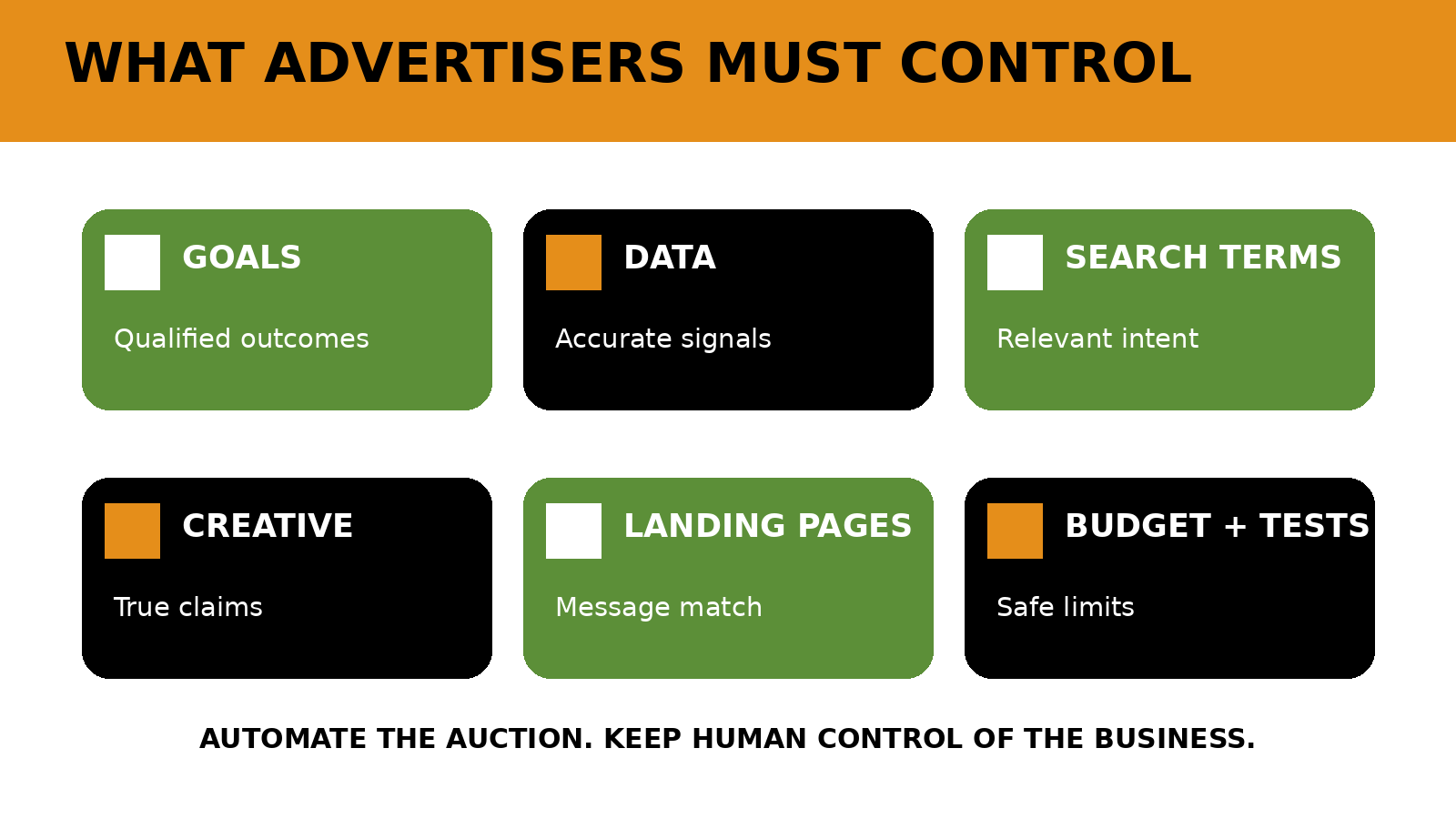
Business outcome
Define the result before choosing a campaign setting. A law firm may value a verified consultation, not every call. A hotel may value a confirmed booking, not a page view. An online shop may optimise for gross profit rather than equal treatment of every sale.
Conversion hierarchy
Choose one or a small number of primary outcomes for bidding. Keep useful diagnostic actions, such as time on page, as secondary observations where appropriate. Avoid sending several duplicate events for the same customer action.
Data quality and consent
Google offers enhanced conversions, which can use hashed first-party data to improve measurement. Implementation does not remove the advertiser’s privacy obligations. Kenyan organisations should assess purpose, transparency, access, retention and vendor handling under the Data Protection Act and applicable regulations. Obtain professional legal advice for your circumstances.
Search terms and exclusions
Review what people actually searched. Protect budget from jobs, training, free resources, unsupported locations and unrelated products when those intents do not fit the offer. Use exclusions carefully because an overgrown negative list can block legitimate demand.
Brand and creative
Maintain an approved claims list, prohibited phrases, visual standards and local language guidance. Check automatically created assets and final URLs. Do not let a convenient asset make a promise the business cannot fulfil.
Landing pages
Control which pages receive paid traffic. Confirm that forms work on mobile, phone numbers are accurate, WhatsApp routes correctly, pages load reliably and consent language is appropriate.
Budget and economics
Set a test budget the business can afford while the campaign gathers evidence. Define a target cost per qualified lead or target return using real margins and close rates. A KES 2,000 lead may be excellent for one service and unprofitable for another.
Experiments and change control
Change one major variable at a time where possible. Record dates, settings and expected effects. Allow a fair test window, but do not use a “learning” label as a reason to ignore clear tracking failures or unsafe spend.
Build a measurement loop AI can learn from
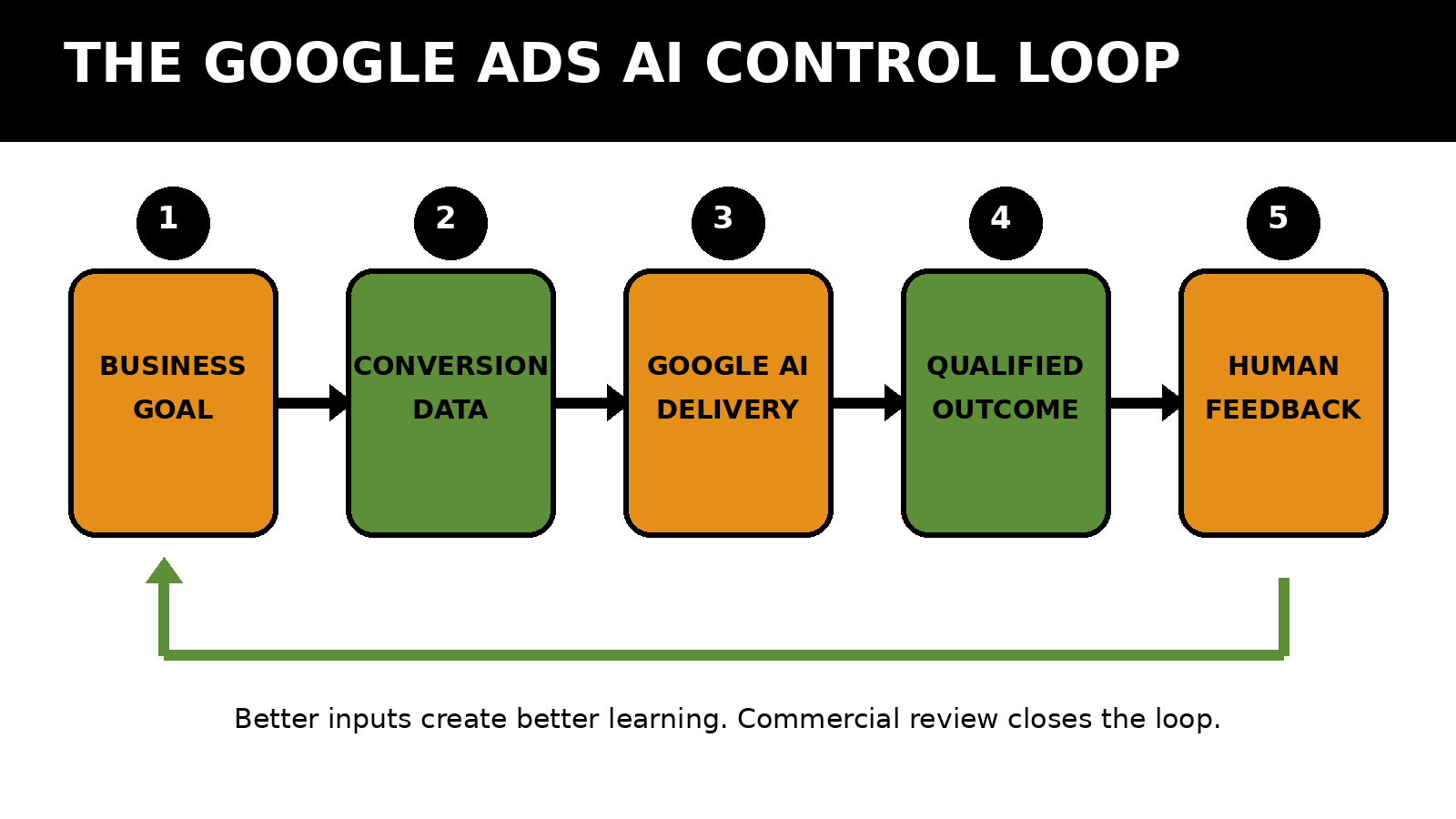
A dependable loop has five parts:
- 1. Business goal: define a qualified enquiry, completed booking or profitable sale.
- 2. Accurate capture: record the action once and preserve useful source information.
- 3. Quality feedback: return qualified, won or valued outcomes when feasible.
- 4. Campaign learning: let bidding use the selected primary goals and values.
- 5. Commercial review: compare platform results with CRM, order and finance data.
For lead generation, import later-stage outcomes when volume and systems permit. A click-to-call event shows intent, but a verified appointment shows more value. A submitted form shows activity, but a closed sale teaches the campaign which leads mattered.
For ecommerce, keep Merchant Center data accurate, pass purchase values correctly, exclude cancelled or duplicated transactions where your setup allows and review margin by product category.
If you are unsure whether the account is feeding automation reliable information, start with Tabala’s Google Ads audit. It is safer to correct the measurement foundation before asking an automated campaign to scale.
Practical Kenyan business examples
Nairobi B2B services
An IT provider wants meetings with companies, but the form attracts students and job seekers. The fix is not simply a lower target cost per lead. The advertiser tightens the offer, adds qualifying questions, excludes employment intent, separates location targeting and feeds qualified-meeting outcomes back into reporting. Automation can then pursue a more useful signal.
Mombasa hospitality
A hotel uses Performance Max across Search, Maps and visual inventory. It separates domestic weekend packages from business travel, supplies authentic property assets and tracks confirmed bookings rather than “check availability” clicks alone. Seasonal pricing and room availability remain business-controlled inputs.
Kisumu retail
A retailer has online orders and WhatsApp enquiries. It keeps purchases as the main value signal, tracks WhatsApp separately and verifies whether those chats convert. This prevents high chat volume from overshadowing profitable orders.
Nakuru professional practice
A clinic or professional office must be especially careful with sensitive information and claims. It uses factual creative, limits form collection, reviews consent language and avoids sending unnecessary sensitive data into advertising platforms.
Eldoret agribusiness supplier
Demand varies by product, season and delivery radius. The supplier groups campaigns by commercial category, keeps stock and location promises current and tests automation within clear geographic and budget limits rather than combining every product into one undifferentiated campaign.
These examples are frameworks, not performance forecasts. Each account needs its own economics, demand pattern, data volume and compliance review.
A 30-day plan for adopting Google Ads AI responsibly
Days 1 to 7: repair the foundation
- Confirm primary and secondary conversions.
- Test forms, calls, purchases and WhatsApp events.
- Compare Google Ads data with CRM or order records.
- Review location settings, final URLs and brand exclusions.
- Document the qualified-customer definition and allowable cost.
Days 8 to 14: improve inputs
- Rewrite weak ads and remove unsupported claims.
- Build or improve the dedicated landing page.
- Supply useful images and video where the campaign needs them.
- Clean product feeds and conversion values.
- Create a search-term and negative-keyword review routine.
Days 15 to 21: run one controlled test
- Select one campaign with enough dependable data.
- Test AI Max, Smart Bidding or Performance Max according to the use case.
- Protect a defined budget.
- Record the baseline, hypothesis and decision threshold.
- Avoid simultaneous changes that make the result impossible to interpret.
Days 22 to 30: judge business quality
- Review query relevance and asset combinations.
- Compare qualified leads, sales and values, not only platform conversions.
- Check location, device and timing patterns.
- Collect sales-team feedback.
- Scale, revise or stop based on commercial evidence.
Businesses new to paid search may benefit from the Google Ads starter guide for Kenyan small businesses. Established advertisers should also review the common Google Ads mistakes that waste budget before adding more automation.
AI advertising control checklist
- The campaign has one clearly defined business outcome.
- Primary conversions represent valuable actions and are deduplicated.
- Lead quality or transaction value can be checked outside Google Ads.
- Customer-data collection has a documented purpose and privacy review.
- Search terms and exclusions have an owner and review frequency.
- Brand rules, claims and generated assets receive human approval.
- Final URLs and landing pages match the ad promise.
- The budget, target economics and stop conditions are documented.
- The test has a baseline, hypothesis and decision date.
- Results are judged by qualified revenue outcomes, not activity alone.
Paid search is only one part of demand capture. Use our comparison of Google Ads and SEO in Kenya to decide where immediate acquisition and long-term organic visibility should work together.
Frequently asked questions
Is Google Ads using artificial intelligence?
Yes. Google Ads uses machine learning in areas including bidding, query matching, creative combinations, audience discovery, campaign recommendations and cross-channel delivery. The level of automation varies by campaign type and settings.
What is AI Max for Search campaigns?
AI Max is an optimisation layer for Search campaigns. Google describes features for expanding relevant matching, tailoring creative and applying controls. It is not a separate campaign type.
Is AI Max the same as Performance Max?
No. AI Max works within Search campaigns. Performance Max is a separate goal-based campaign type that can access inventory across Google channels.
Does AI Max replace keywords?
It can broaden query coverage beyond a campaign’s existing keywords, but advertisers still need coherent account structure, useful pages, query review, exclusions and conversion goals. Keywords remain part of Search campaign strategy.
Should a Kenyan small business use Performance Max?
It may be suitable when the business has dependable conversion tracking, useful creative, a clear offer and enough budget to evaluate results. A business with broken tracking or unqualified leads should fix those issues first.
Can Google AI write and create my ads?
Eligible workflows can generate or adapt text, image and video assets. Advertisers remain responsible for accuracy, rights, policy compliance, brand fit and the claims that appear.
Can ads appear in AI Overviews in Kenya?
Google’s current availability information includes English searches on mobile and desktop in Kenya. Ads may appear above, below or within AI Overviews on a subset of queries with relevant commercial intent. Placement is not guaranteed.
How much conversion data does automated bidding need?
There is no single useful threshold for every account, goal and strategy. More representative, recent and accurately valued data generally gives the system a better basis for learning. Follow the eligibility guidance shown for the selected strategy and judge stability over an appropriate period.
Will AI replace a Google Ads specialist or agency?
AI can automate campaign calculations and production tasks. It does not replace business judgement, measurement design, offer strategy, creative accountability, privacy decisions or the work of connecting leads to revenue. The role shifts from manual control of every auction to control of the system’s inputs and outcomes.
Turn automation into accountable growth
AI is not a reason to surrender a Google Ads account. It is a reason to become more precise about what the account is allowed to learn.
Define the commercial result. Track it accurately. Review customer quality. Give the system clear pages and creative. Protect the brand, the budget and customer data. Test one meaningful change at a time. When those controls are in place, automation can help a Kenyan business respond to more relevant demand without confusing activity with growth.
If your account is spending but you cannot explain which searches, assets and conversions create qualified revenue, request a professional Google Ads account audit. For ongoing campaign strategy and management, explore Tabala’s Google Ads services in Nairobi and Kenya.
Editorial note: Platform availability and interfaces change. This article was fact-checked against official Google and Kenya Law sources on 23 October 2026. Legal references are general information, not legal advice.
Accelerate Your Revenue
While Revenue Intelligence builds long-term authority, Google Ads delivers immediate, high-intent traffic. Combine both for maximum market dominance.

Strategist Profile
Abala Tom
Digital systems strategist specializing in high-performance SEO, Google Ads, and conversion optimization. Mission: to replace marketing 'guesswork' with predictable revenue systems.