AI Content Strategy for Kenyan Businesses: How to Use AI Without Losing Trust
A practical framework for Kenyan teams using AI to research, draft and repurpose content while keeping facts, voice, privacy and final approval under human control.
AI Content Strategy for Kenyan Businesses: How to Use AI Without Losing Trust
Publishing more content has never been easier. That is exactly why the commercial risk is rising. A Nairobi consultancy can now produce a month of articles in an afternoon, a Mombasa hotel can generate hundreds of destination descriptions, and an Eldoret retailer can turn one product brief into posts for every channel. But if those outputs sound generic, make unsupported claims, expose customer data or contradict the brand, speed becomes a liability.
The cost is not merely an awkward sentence. Weak AI-assisted content can make a capable business look careless, give sales teams the wrong promise to defend, and leave customers unsure whether anything they read is reliable. It can also create a library of near-duplicate pages that adds little value. Google explicitly says generative AI can help with research and structure, but using it to create many pages without added value may violate its scaled content abuse policy.
The better question is not “Should we use AI?” It is: Which parts should AI accelerate, which decisions must people own, and what evidence must exist before anything is published? This guide gives Kenyan businesses a practical content operating system that protects trust while still capturing the speed advantages of AI.
Quick answer
An effective AI content strategy uses AI as an assistant inside a human-controlled editorial process. People own the audience insight, original evidence, factual claims, brand point of view, privacy decisions and final approval. AI can help organise research, suggest structures, create constrained first drafts, generate variations and repurpose approved material. Every output should pass source, accuracy, voice, usefulness, privacy and conversion checks before publication.
Key takeaways
- Start with a business problem and first-party evidence, not a blank prompt.
- Give AI a defined role; do not let it become the strategy, expert or final approver.
- Add Kenyan context only when it is accurate and useful, never as decorative localisation.
- Verify every material claim against a primary or authoritative source.
- Never paste sensitive customer, employee or confidential commercial information into an unapproved tool.
- Build expert review, brand voice, source logging and final accountability into the workflow.
- Measure qualified actions and assisted conversions, not content volume alone.
What an AI content strategy actually is
An AI content strategy is a governed plan for using artificial intelligence across research, creation, editing, distribution and measurement while preserving human accountability. It connects content to a defined audience, commercial goal, evidence base, channel and next action.
That is different from “using ChatGPT to write blogs”. A tool can produce words. It cannot decide which business problem deserves attention, whether a customer quotation is representative, whether a legal statement is current, or whether a claim reflects what your company can actually deliver. Those are strategic and accountable decisions.
A useful strategy answers seven questions before a draft begins:
- Who is this for, and what decision are they trying to make?
- What business outcome should the content support?
- What original evidence, expertise or experience can we contribute?
- Which tasks may AI assist with?
- Which claims require verification or specialist review?
- Who owns approval?
- How will we know the content helped?
This article supports Tabala’s broader guide to AI marketing in Kenya, but it has a narrower job: turning AI-assisted content production into a reliable editorial system.
Why trust breaks when businesses scale AI content
The content sounds confident but is not grounded
Generative systems predict plausible outputs. They can summarise supplied evidence well, but they can also produce incorrect names, dates, rules, quotations and product features. The risk rises when prompts ask for expertise without providing sources.
For a Kenyan business, a fabricated statistic about mobile usage, an outdated tax explanation or an invented regulator requirement can travel from a blog into a proposal, sales call and social post. One error becomes a multi-channel credibility problem.
The brand loses its point of view
Generic content is usually not offensive; it is forgettable. It repeats familiar advice, uses interchangeable phrasing and avoids the hard judgment that makes expertise valuable. A founder’s practical lesson becomes “leverage innovation to drive growth”. A Nairobi legal practice, a Kisumu healthcare provider and a Mombasa tour operator suddenly sound the same.
Volume replaces usefulness
Teams often measure AI by output: articles produced, captions generated or pages launched. Customers measure whether a page answered their question and reduced uncertainty. Google’s people-first content guidance similarly asks whether content provides substantial value and demonstrates first-hand expertise.
Private information enters the wrong system
Drafting can involve client briefs, sales transcripts, support tickets, employee details and campaign data. Those materials may contain personal or confidential information. The safe choice depends on the product, contract, data controls and company policy. For example, OpenAI states that inputs and outputs from its business products and API are not used to train models by default, but a business still needs to evaluate retention, access, connected apps and processor obligations for its specific setup.
Nobody owns the final decision
“AI wrote it” is not an accountability model. The publishing organisation owns the output. A named editor must be able to explain what was checked, which sources were used and why the claim is safe to publish.
The six-layer trust framework
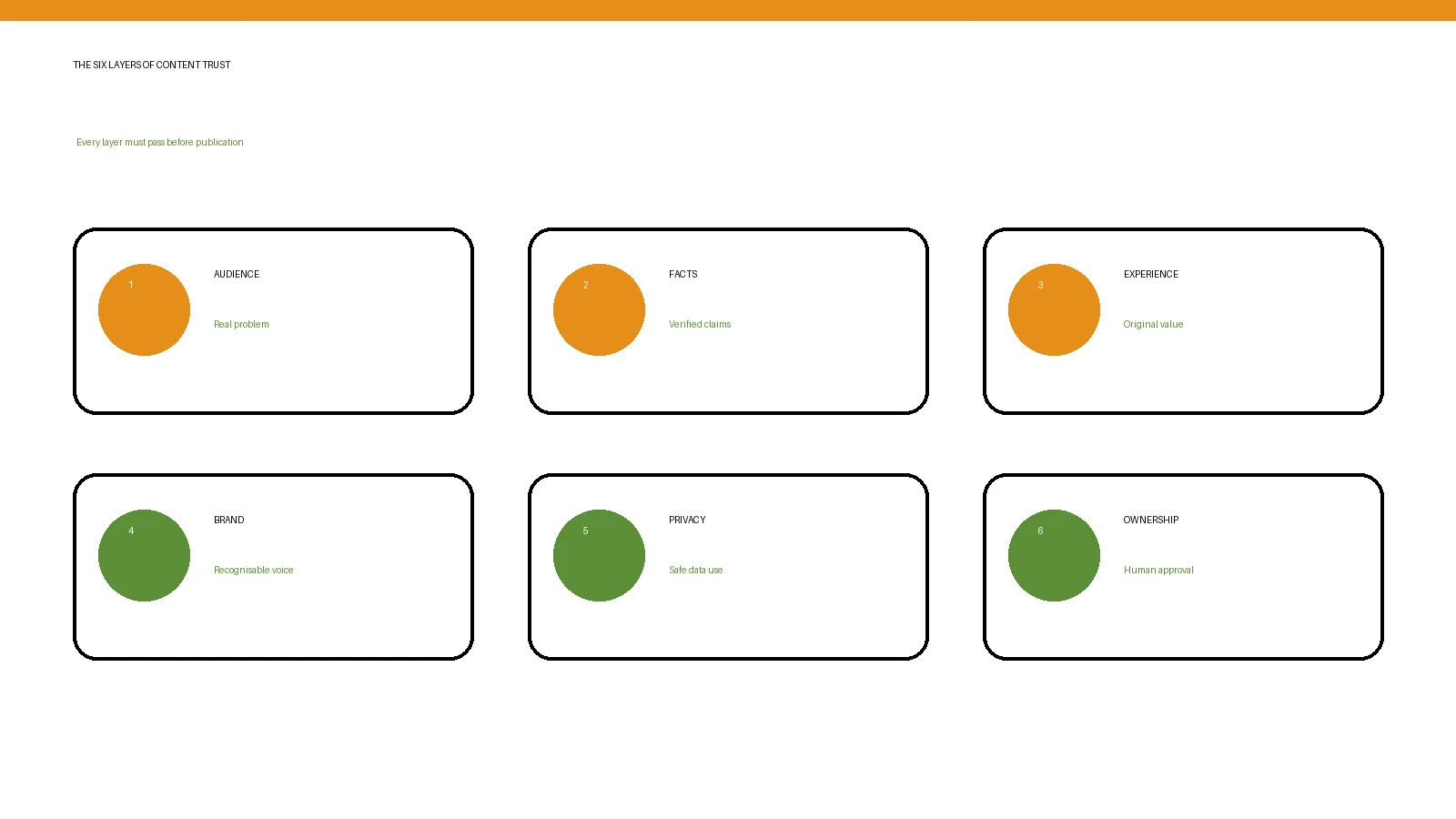
Use six layers to evaluate every important article, landing page, email sequence or campaign asset.
| Trust layer | Question before publication | Evidence |
|---|---|---|
| Audience | Does this solve a real reader problem? | Search queries, interviews, sales questions, support logs |
| Factual | Are material claims accurate and current? | Primary sources, source log, expert review |
| Experiential | What do we know from practice? | Examples, process detail, screenshots, observations |
| Brand | Does this sound and behave like us? | Voice guide, approved examples, offer boundaries |
| Privacy | Was data handled lawfully and safely? | Approved tools, minimisation, consent or lawful basis |
| Accountability | Can a person stand behind the final output? | Named owner, review record, publication approval |
The framework prevents a common mistake: treating fact-checking as the only trust issue. An article can be factually correct and still be unhelpful, off-brand, privacy-invasive or commercially misleading.
A practical human-AI content workflow
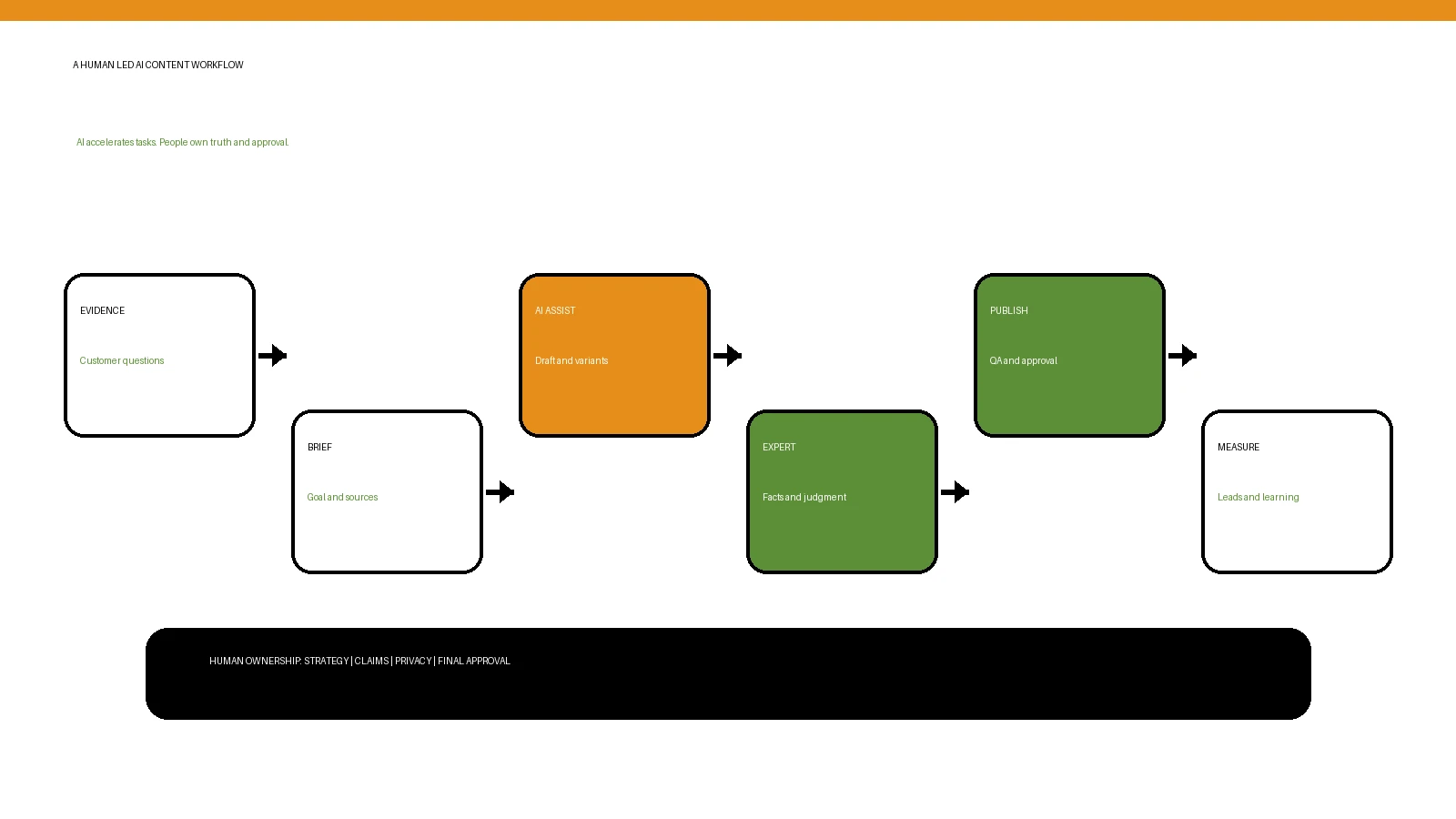
1. Define the commercial job
Write one sentence: “After reading this, the right reader should be able to ___.” For this article, the desired outcome is that a Kenyan marketing leader can design a controlled AI content process and identify where human review is mandatory.
Choose one primary next action. A problem-aware guide may invite the reader to a diagnostic. A comparison article may lead to a service consultation. A support article may lead to a related implementation guide.
2. Build an evidence pack
Before prompting, collect:
- customer questions from sales calls and WhatsApp conversations;
- product or service facts approved by the delivery team;
- original examples that can be shared safely;
- current primary sources for technical, legal or platform claims;
- existing Tabala pages that the new article should support;
- topics and claims that must not be made.
Remove personal data and confidential information. Use summaries or synthetic examples when the identity of a client is not essential.
3. Create a constrained brief
A useful brief specifies audience, intent, promise, angle, evidence, prohibited claims, required links, voice, CTA and reviewer. It also says what the AI must not infer. “Use only the attached facts for prices” is stronger than “write an authoritative pricing guide”.
4. Use AI for bounded tasks
AI is strongest when the task and evidence are clear. Ask it to cluster interview notes, propose alternative structures, identify unanswered questions, create a first draft from an approved brief, compress a paragraph, or adapt an approved article into channel-specific versions.
Ask the system to mark uncertainty and missing evidence. Do not ask it to “fill the gaps”. A visible gap is a research task, not a writing invitation.
5. Add human expertise
The subject-matter expert should add the part a general model cannot know: what customers misunderstand, where projects usually fail, which trade-offs matter, and how the advice changes in local conditions.
For example, a blanket instruction to “automate customer follow-up” ignores whether a Kenyan SME relies on WhatsApp, how consent was captured, who handles replies outside office hours, and when a conversation must move to a person. Specific operational detail creates trust.
6. Run editorial and evidence QA
Verify every material claim. Open the source. Check the date. Confirm that the source actually supports the wording. Review titles, names, product availability and regulatory statements. Replace vague citations with direct links.
Then run voice, duplication, privacy, accessibility, link and conversion checks. A practical digital marketing terms guide can support readers when terminology would otherwise interrupt the main explanation.
7. Approve, publish and measure
Record the editor, approver and publication date. After publication, check the page on mobile and desktop, validate structured data, test the CTA, and confirm that links resolve.
Measure what happens next: qualified visits, scroll or engagement depth, CTA clicks, diagnostic completions, assisted enquiries, branded search and sales-team usage. Content that helps a buyer make a decision can be valuable even before it ranks for a broad keyword.
What AI should and should not do
| AI can assist with | A person must own |
|---|---|
| Organising approved research | Audience and business strategy |
| Suggesting outlines and question clusters | Original point of view |
| Drafting from a source-controlled brief | Truth of factual and commercial claims |
| Generating headline and CTA variants | Brand promise and offer boundaries |
| Repurposing approved material | Privacy and consent decisions |
| Flagging repetition or unclear wording | Legal, medical, financial or regulatory approval |
| Creating a QA checklist | Final publication approval |
The dividing line is consequence. The higher the impact of an error, the stronger the human review must be. A caption variation is not equivalent to a health claim, a financial comparison or a statement about Kenyan law.
Kenyan privacy and governance
Kenya’s Data Protection Act, 2019 sets principles and obligations for processing personal data. The Office of the Data Protection Commissioner’s July 2026 AI Guidance Note applies those responsibilities to AI systems that process data of people in Kenya, including transparency, data minimisation, security and appropriate safeguards.
This is not a reason to avoid AI. It is a reason to operate deliberately.
A practical data rule
Do not place information into an AI tool unless you know:
- what the information contains;
- why the processing is necessary;
- which approved product and account will process it;
- what contractual and privacy terms apply;
- who can access the output;
- how long the data may be retained; and
- whether a safer summary or redacted version would work.
Avoid pasting names, phone numbers, email addresses, customer complaints, medical information, payroll data, unpublished financials, passwords, API keys or confidential strategy into an unapproved system.
Disclosure should be useful, not theatrical
There is no universal requirement to label every AI-assisted sentence. Transparency should match materiality and risk. Disclose AI involvement when customers could reasonably need that fact to interpret the content, when a platform requires it, when synthetic media could mislead, or when internal or client policy requires it. Never present fabricated experience, testimonials or imagery as real.
For high-risk processing or sector-specific work, obtain qualified legal or compliance advice. This article is operational guidance, not legal advice.
How to preserve brand voice and Kenyan relevance
Build voice from evidence
A useful voice guide contains examples, not adjectives alone. “Professional but friendly” is too broad. Include approved opening paragraphs, preferred sentence length, phrases the brand uses, claims it avoids, and examples of how it explains trade-offs.
Use a localisation test
Mention Nairobi, Mombasa, Kisumu, Nakuru, Eldoret or East Africa only when location changes the advice. Natural local relevance may include KES budgeting, WhatsApp-led enquiry journeys, multi-location operations, local regulation, connectivity constraints or buying behaviour. Adding city names to a generic paragraph does not create local expertise.
Require an experience block
Every substantial article should contain at least one element that could not be created by summarising the first page of search results:
- an original workflow;
- a decision table;
- a practical failure mode;
- an anonymised example;
- a checklist based on delivery experience; or
- a clear professional judgment with its reasoning.
If the team cannot add anything original, reconsider whether the article should exist.
SEO and AI-search visibility without content spam
Google’s guidance on generative AI content focuses on purpose and value, not a blanket ban on AI assistance. Its spam policies define scaled content abuse around large amounts of unoriginal content made mainly to manipulate rankings.
The durable approach is straightforward:
- answer a real question completely;
- demonstrate experience and expertise;
- use clear headings and concise answers;
- cite authoritative sources;
- define entities and relationships accurately;
- include descriptive internal links;
- keep facts, dates and author information current; and
- use structured data that matches visible content.
BlogPosting and BreadcrumbList schema are
appropriate for this guide. The FAQ content can also be represented as
FAQPage, but Google currently restricts FAQ rich-result
visibility mainly to authoritative government and health sites. Schema
can still clarify the page’s meaning; it should not be sold as a
guaranteed rich-result tactic.
This informational article should link naturally to Tabala’s AI Visibility Audit and explain the distinct commercial role of AI Search Optimization services. It should not target the service page’s transactional query or duplicate its offer.
Good content also needs a technically accessible home. Use Tabala’s technical SEO checklist for Kenyan websites when checking crawlability, page experience and machine-readable structure.
Measure trust and business impact, not output
| Weak metric | Better question |
|---|---|
| Articles produced | Did the right audience reach a useful answer? |
| Words generated | Did the page reduce buyer uncertainty? |
| Social impressions | Did qualified people engage or act? |
| Keyword count | Did the page earn relevant visibility and assisted conversions? |
| AI time saved | Was total review and correction time reduced? |
Track editorial rework, factual corrections, content reuse by sales, CTA engagement, diagnostic starts and qualified enquiries. If AI doubles draft volume but triples review time, it has not improved the system.
Use Tabala’s 360 Digital Growth Diagnostic to identify whether the constraint is content, search visibility, conversion, advertising or measurement. If the problem is a broader acquisition system, producing more posts will not fix it.
AI content strategy implementation checklist
Governance
Brief and production
Publication QA
Improvement
For organisations that want help connecting content to acquisition, Tabala’s digital marketing services cover strategy, search, campaigns and conversion as one system.
Frequently asked questions
Does Google penalise AI-generated content?
Google does not describe AI use by itself as the problem. It focuses on helpfulness, reliability and whether content is created primarily to manipulate rankings. Generating many low-value pages with AI can violate the scaled content abuse policy.
Can AI content rank in Kenya?
AI-assisted content can be eligible to rank if it satisfies the same quality, technical and spam-policy requirements as other content. Ranking is never guaranteed. Original value, topical relevance, links, competition, site quality and user experience still matter.
How do we stop AI from flattening our brand voice?
Use an evidence-based voice guide, supply approved examples, restrict the drafting task and require a human editor to restore point of view, specificity and offer accuracy. Do not expect a one-line tone prompt to carry the brand.
Should a business disclose that it used AI?
Disclosure should reflect risk, platform rules, policy and whether AI involvement changes how a reasonable reader would interpret the material. Synthetic media, automated decisions and potentially misleading representations deserve stronger transparency than routine grammar assistance.
What should never be pasted into a public AI tool?
Do not paste passwords, API keys, confidential contracts, unpublished financials, personal customer or employee data, sensitive personal data, or material covered by confidentiality obligations into an unapproved tool. Use approved business products and data-minimised inputs.
Who should approve AI-assisted content?
The approver should have enough subject knowledge and authority to own the claim. Marketing can approve routine brand content; regulated, technical or high-consequence material may need legal, compliance, clinical, financial or product review.
How much content should an SME automate?
Automate bounded, repeatable tasks whose failure is easy to detect and correct. Keep human control over research quality, strategy, sensitive claims, privacy, customer promises and final approval. The right level depends on risk, not team size.
What is the first step for a Kenyan SME?
Choose one content type, document its brief, sources, review checklist and owner, then run a small pilot. Measure total production time, correction rate, audience response and qualified actions before expanding.
Build a system your customers can trust
AI can make content operations faster, but trust still comes from recognisable human judgment: accurate evidence, honest limitations, real experience and accountability. The winning system is not the one that produces the most pages. It is the one that reliably turns business expertise into useful decisions for customers.
If your team is producing content without a clear connection to visibility, leads and revenue, start with Tabala’s free 360 Digital Growth Diagnostic. We will help you identify the real constraint and build a practical content and growth system around it.
Dominate Search Results
Rankings are only high-value if they generate inquiries. Our SEO Systems turn search intent into predictable revenue. Explore SEO Systems.

Strategist Profile
Abala Tom
Digital systems strategist specializing in high-performance SEO, Google Ads, and conversion optimization. Mission: to replace marketing 'guesswork' with predictable revenue systems.