AI Chatbots for Lead Generation in Kenya: When WhatsApp Automation Helps
A practical Kenyan guide to using WhatsApp chatbots for faster responses, lead qualification, safe human handoff and measurable sales follow-up.
AI Chatbots for Lead Generation in Kenya: When WhatsApp Automation Helps
A customer messages your business at 8:47 p.m. asking whether a product is available, what it costs and how quickly it can be delivered. By the time someone replies the next morning, the customer has already bought elsewhere. This is the commercial problem behind the excitement around AI chatbots in Kenya.
The opposite problem is just as expensive. A poorly configured bot answers quickly but gives the wrong price, repeats the same question, traps a high-value prospect in a loop or keeps talking when a person should take over. The business has automated the response while weakening the sale.
For most Kenyan SMEs, the best chatbot is not a digital employee that tries to close every deal. It is a controlled front desk that acknowledges the enquiry, answers approved questions, collects only the information required, identifies intent and moves the right conversation to a person with useful context.
This guide explains when WhatsApp automation helps, when it creates risk, how to design a human handoff, what to measure and how to test a pilot before committing to a larger system.
Quick answer
An AI chatbot can improve lead generation when a business receives repeated enquiries, loses leads outside working hours or needs to qualify people before a sales conversation. It should use approved business information, disclose that it is automated where appropriate, collect the minimum necessary data and provide a fast route to a person. Do not use a chatbot as the sole decision-maker for sensitive, regulated, high-value or unusual enquiries.
Key takeaways
- Automate the predictable first steps: acknowledgement, FAQs, routing, basic qualification and booking.
- Give customers a clear human handoff from the start.
- Treat a WhatsApp click, conversation, qualified lead and sale as separate stages.
- Use approved information for prices, availability, policies and eligibility.
- Collect the least personal data needed for the next step.
- Test failure paths, mixed English and Kiswahili, spelling variations and urgent requests.
- Measure qualified conversations and revenue outcomes, not message volume alone.
What an AI lead-generation chatbot actually does
A lead-generation chatbot is a messaging system that receives an enquiry, interprets the customer’s request and follows approved rules to answer, qualify, route or book the next step. The word “AI” can describe several levels of capability.
| System | What it does | Best use |
|---|---|---|
| Menu bot | Presents buttons or numbered choices | Simple routing and common requests |
| Rules-based bot | Follows fixed questions and conditions | Consistent qualification flows |
| AI assistant | Interprets natural language and retrieves approved answers | Varied FAQs and conversational intake |
| Agent-assisted inbox | Suggests replies while a person remains in control | Complex sales and support conversations |
| Integrated workflow | Connects messaging with CRM, calendar or order systems | High-volume operations with clear processes |
The right choice depends on the problem. A five-person Nairobi firm that receives 15 similar enquiries a day may need a well-designed menu and human inbox. A multi-location school, clinic or retailer may need routing, availability checks, booking and CRM records. More intelligence is useful only when the underlying information and process are reliable.
This guide sits inside Tabala’s broader approach to AI marketing in Kenya. The chatbot is one part of the lead journey, not the complete marketing system.
When WhatsApp automation helps
Repeated questions delay the sales team
If most conversations begin with the same questions about price, location, stock, appointment times, delivery areas or required documents, automation can provide an immediate approved answer and reserve staff time for decisions that need judgment.
Leads arrive outside working hours
An after-hours chatbot can acknowledge the enquiry, explain when a person will respond, capture the customer’s need and offer a booking slot. This is more useful than pretending that a full sales team is available around the clock.
The business cannot see which enquiries are serious
A short qualification flow can distinguish a person asking for general information from someone ready for a quotation, appointment or site visit. The bot should not label people as “bad leads”. It should collect signals that help a person prioritise the next action.
Enquiries are routed to the wrong person
A business with several branches, services or salespeople can ask one or two routing questions, then assign the conversation based on location, service or urgency. A Mombasa hospitality enquiry should not wait in the same queue as a Nairobi corporate event request if different teams own them.
Follow-up is inconsistent
With appropriate consent and platform-compliant messaging, automation can remind a prospect about a booked consultation, request missing information or alert a salesperson when a qualified lead has not received a human response.
Tabala’s Revenue Recovery Sprint focuses on these gaps between traffic, WhatsApp, follow-up and the final sale. A chatbot is valuable when it closes a specific gap in that chain.
When a chatbot is the wrong tool
The business information is unreliable
A bot trained on outdated prices, contradictory policies and incomplete product information will make those problems faster. Fix the knowledge base first.
Enquiry volume is low
If a business receives only a few conversations each week and responds well, automation may add cost and friction without creating meaningful capacity. A saved-reply library and clear responsibility may solve the problem.
Every conversation is complex
High-value consulting, legal work, medical concerns, financial eligibility and unusual technical projects often require context, empathy and professional judgment. A bot can collect basic intake details and schedule a conversation, but it should not replace the qualified person.
The team will not monitor failures
Conversation systems need review. Customers will ask questions the original design did not anticipate. Prices change. Staff roles change. Integrations fail. A chatbot without an owner gradually becomes less accurate.
The business wants automation to hide poor service
Fast acknowledgement cannot compensate for late quotations, unclear offers or weak follow-up. Run the 360 Digital Growth Diagnostic when the real constraint may sit elsewhere in the acquisition system.
The lead journey and human handoff
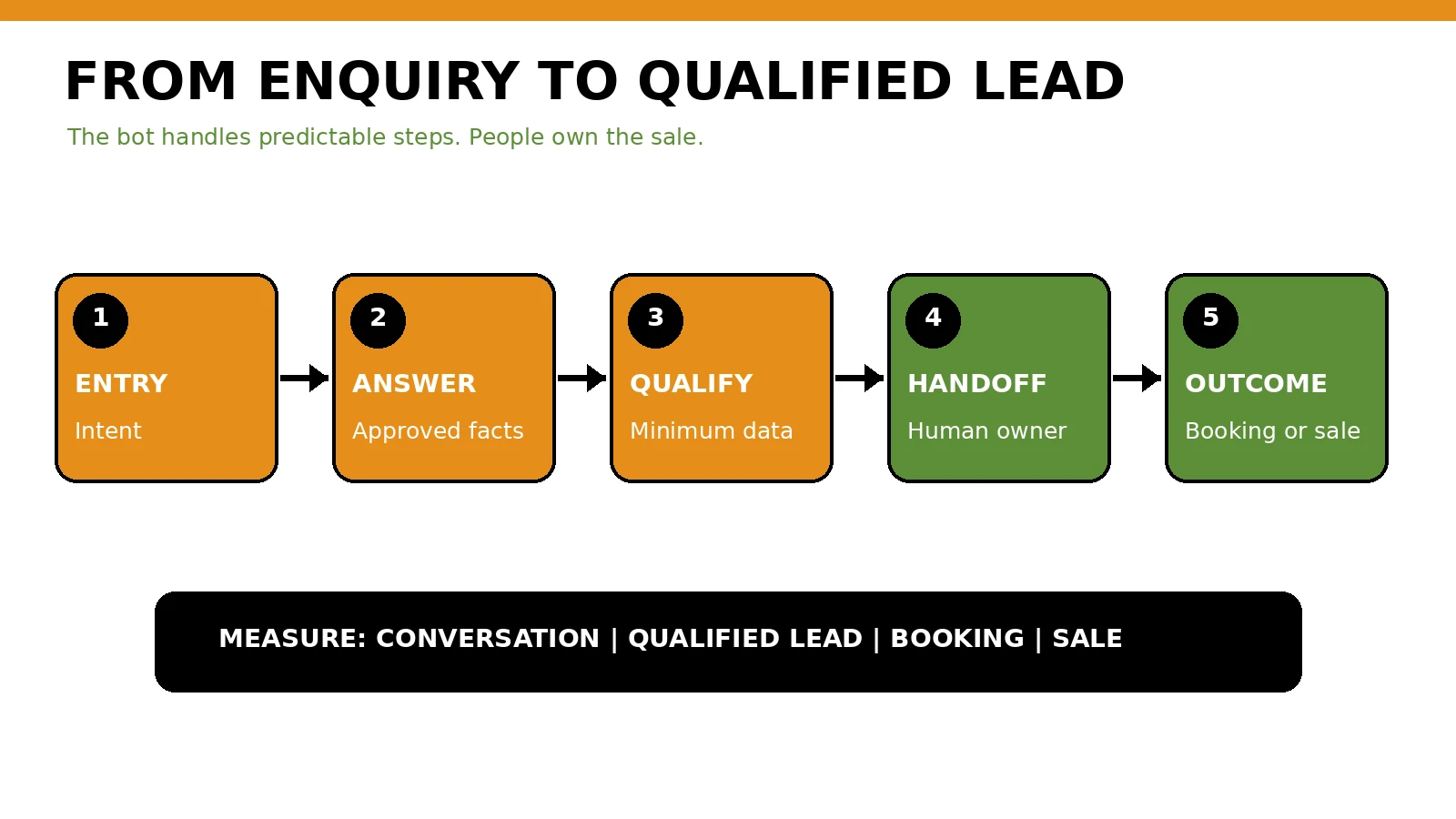
The safest design treats automation as a short bridge to the right human action.
| Stage | Chatbot role | Human role | Useful measure |
|---|---|---|---|
| Entry | Acknowledge and identify intent | Monitor urgent or unusual requests | Conversations started |
| Answer | Retrieve approved FAQs | Correct gaps and exceptions | Answer success rate |
| Qualify | Ask minimal relevant questions | Judge fit and priority | Qualified conversations |
| Route | Assign team, branch or service | Accept ownership | Time to human acceptance |
| Book | Offer valid appointment options | Prepare for consultation | Bookings completed |
| Follow-up | Send permitted reminders | Call, quote and close | Qualified lead to sale |
Make human help visible
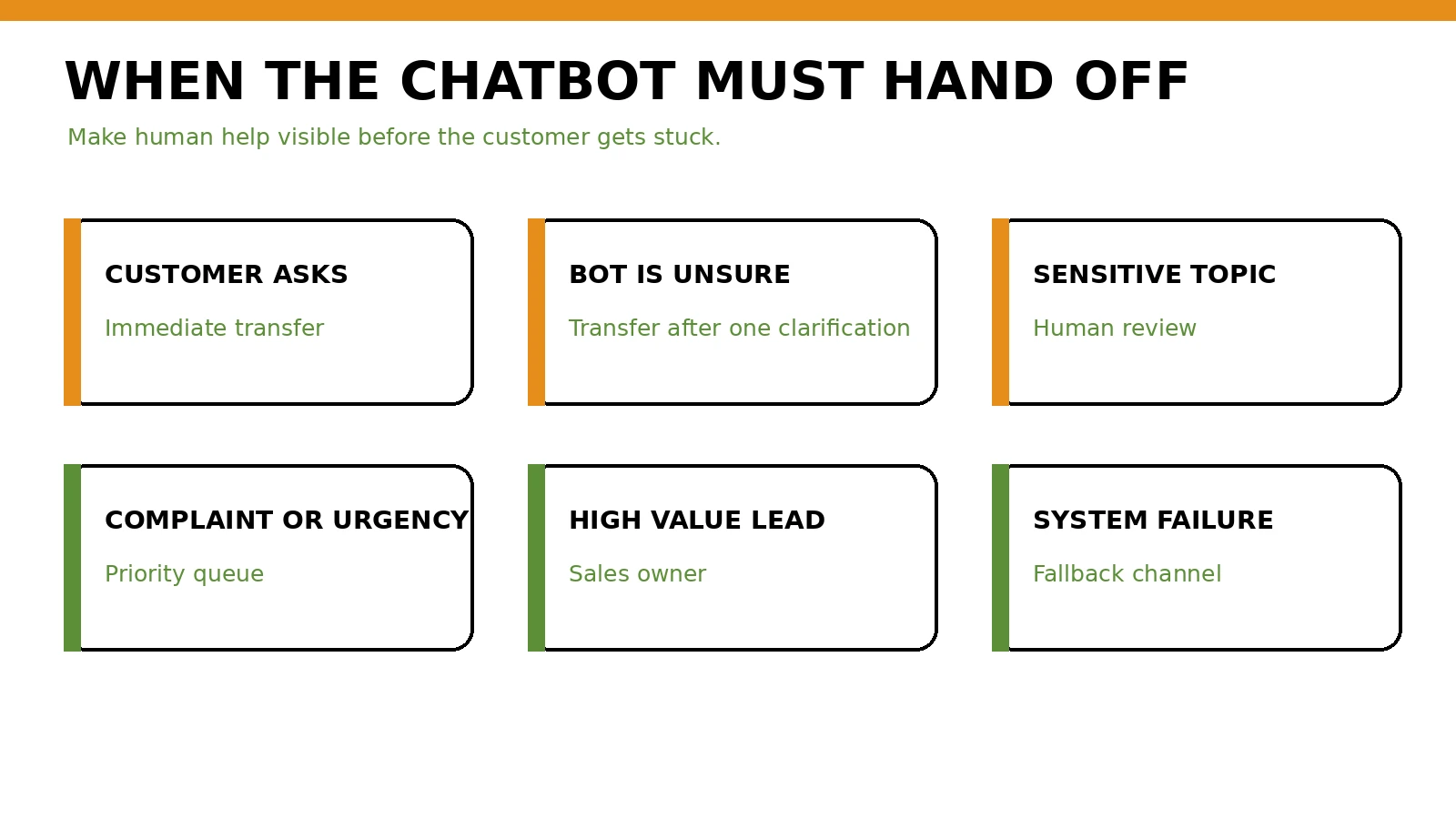
Customers should not need to fail three times before reaching a person. Offer “Talk to a person” at the beginning, after uncertainty, when the customer asks for it and before any sensitive or high-consequence decision.
The handoff should include the conversation summary, contact details the customer chose to provide, intent, service, location, urgency and unanswered question. Do not force the customer to repeat everything.
Define automatic escalation rules
Escalate when:
- the customer asks for a person;
- the bot is uncertain or fails twice;
- the request involves a complaint, refund, emergency or safety issue;
- the message includes sensitive health, financial or legal information;
- the lead meets a high-value threshold;
- the requested price or policy is missing from the approved source;
- the customer uses language the system cannot handle reliably.
WhatsApp rules and Kenyan data protection
Businesses should distinguish the WhatsApp Business app from the WhatsApp Business Platform used for larger integrations and automated workflows. Features, pricing and setup depend on the product and provider.
The WhatsApp Business Messaging Policy states that businesses may use automation during the customer-service window, but they must provide clear and direct escalation paths. Outside that window, business-initiated messages generally require approved message templates. Teams should verify the current policy, template category and pricing that apply to their account before launch.
Consent and expectation
The fact that a business has a phone number does not automatically mean it should send promotional messages. Record how the person started the conversation or opted in, what they agreed to receive and how they can stop messages.
Data minimisation
Kenya’s Data Protection Act requires lawful, fair and transparent processing of personal data. Collect information because it is necessary for the stated purpose, not because the chatbot can ask for it.
For a quotation, service, location and timeline may be enough. A national ID number, medical detail or financial record should not be requested unless it is genuinely required, lawfully processed and protected.
Automated decisions
Section 35 of the Act addresses decisions based solely on automated processing that have legal or similarly significant effects. The associated Data Protection General Regulations require transparency, safeguards and access to human intervention in relevant cases.
A lead-routing bot usually supports a sales process rather than making a legally significant decision. Even so, businesses should avoid using opaque scores to deny service, credit, employment, insurance or healthcare access without the required safeguards and qualified review.
The ODPC’s AI Guidance Note also emphasises transparency, data minimisation, security and accountability where AI systems process personal data in Kenya.
How to design a useful chatbot conversation
1. Start with the customer’s goal
Open with a useful choice:
“Hi, I’m Tabala’s automated assistant. I can help you choose a service, request an audit or book a strategy call. You can ask for a person at any time.”
This sets the expectation and gives the customer a route forward. Avoid long introductions and lists of everything the business does.
2. Ask one question at a time
Long forms inside chat feel like interrogation. Ask only what changes the next step. A website prospect may need to choose between a new site, redesign and ecommerce before you ask about pages or timeline.
3. Use approved answers
Create a knowledge base with:
- services and exclusions;
- current prices or approved pricing language;
- locations and operating hours;
- availability rules;
- delivery and refund policies;
- booking instructions;
- escalation contacts;
- the date each answer was reviewed.
When the bot lacks an approved answer, it should say so and hand over. It should never invent a price, stock position, legal answer or appointment.
4. Write for Kenyan conversations
Test English, Kiswahili and natural code-switching that your customers actually use. Do not promise Sheng support until real examples have been tested. Include common spelling variations, voice-note behaviour and short messages such as “how much”, “location?” or “iko available?”
5. Confirm the next step
End automated intake with a clear outcome:
“Thanks. I’ve sent your request to our website team. Tom will reply here during business hours. Your request is for a five-page business website with an October launch target.”
The customer should know what was captured, who owns the next step and when to expect it.
Qualification questions by business type
| Business | Useful questions | Send to a person when |
|---|---|---|
| Professional services | Service needed, problem, location, timeline | Scope is unusual or confidential |
| Clinic | Appointment type, preferred branch and time | Symptoms, emergencies or clinical advice arise |
| School | Programme, learner level, intake and location | Fees need exception or admissions judgment |
| Real estate | Buy/rent, location, budget band and timeline | Viewing, negotiation or financing begins |
| Ecommerce | Product, variant, delivery area and order status | Stock conflict, refund or damaged item |
| Hotel/tourism | Dates, guests, location and experience | Custom itinerary, accessibility or exception |
| Home services | Service, area, urgency and property type | Safety risk or technical diagnosis is required |
Qualification should help the team prepare. It should not extract every possible detail before a human conversation.
Integrations and measurement
Useful integrations
- CRM or lead sheet for ownership and status;
- calendar for valid appointment slots;
- product or booking system for current availability;
- analytics for conversation sources;
- advertising platforms for qualified offline conversions where permitted;
- shared inbox for human takeover.
Integrations create value only when records are deduplicated, permissions are correct and failures are visible. Test what happens when the CRM is unavailable, the calendar has no slots or an API returns an error.
Build a measurement hierarchy
Tabala’s Google Ads conversion-tracking checklist makes an essential distinction: a WhatsApp click is not automatically a conversation, qualified lead or sale.
Track the stages separately:
- WhatsApp or chat entry clicked
- Conversation started
- Qualification completed
- Human accepted the lead
- Appointment or quotation created
- Sale completed
- Revenue recorded
Useful operational measures include time to first useful response, handoff rate, unanswered-question rate, qualified-lead rate, time to human acceptance, booking completion, opt-outs, blocks and complaints.
Do not optimise for the longest conversation. A good chatbot may solve a simple request in three messages or move a serious buyer to a person immediately.
A 30-day chatbot pilot plan
Week 1: evidence and scope
Week 2: build and internal testing
Week 3: controlled launch
Week 4: decide and improve
For help connecting chatbot conversations with acquisition, measurement and sales follow-up, explore Tabala’s digital marketing services.
Frequently asked questions
Are WhatsApp chatbots legal in Kenya?
Yes, businesses can use chatbots, but their processing of personal data must comply with Kenya’s Data Protection Act and applicable regulations. The messaging setup must also comply with current WhatsApp Business terms and policies.
Does a business need customer consent?
The lawful basis depends on the processing and context. Promotional or business-initiated messaging requires particular care. Record opt-in where required, explain the purpose and provide a simple way to stop messages.
Can a chatbot qualify leads?
It can collect relevant facts such as service, location, timeline and budget band, then route the enquiry. A person should own judgment for complex, sensitive or high-value opportunities.
Can a chatbot replace a salesperson?
For most SMEs, the best role is to reduce repetitive work and prepare a better human conversation. Negotiation, trust, exceptions and commercial judgment still need a person.
What should happen when the chatbot cannot answer?
It should admit uncertainty, preserve the conversation and route the customer to a person or another clear support channel. It should not invent an answer or repeat the same failed question.
How much does a WhatsApp chatbot cost in Kenya?
Cost depends on the platform, conversation volume, AI usage, integrations, knowledge-base work, monitoring and support. Compare total setup and operating costs against the value of qualified leads and staff time saved. Request a written scope rather than choosing by the lowest monthly fee.
How should chatbot leads be tracked?
Track conversation started, qualification, handoff, appointment or quotation, sale and revenue as separate stages. Connect later outcomes to the source where lawful and technically reliable.
Which businesses benefit most?
Businesses with frequent repeated enquiries, slow response times, several branches or services, booking workflows and clear qualification rules usually have the strongest case for a pilot.
Build a faster route to a real sales conversation
A chatbot works when it shortens the distance between customer intent and useful human action. The business must provide accurate information, clear escalation, disciplined follow-up and measurement from enquiry to sale.
Start with one painful part of the journey. Test it with real conversations. Keep a person accountable for the system. Then expand only when the evidence shows that customers are receiving faster, clearer service and the team is converting more qualified opportunities.
If leads are entering through your website, ads or WhatsApp but failing to become sales conversations, run Tabala’s free 360 Digital Growth Diagnostic. We will identify the real leak and recommend the smallest practical fix.
Accelerate Your Revenue
While Revenue Intelligence builds long-term authority, Google Ads delivers immediate, high-intent traffic. Combine both for maximum market dominance.

Strategist Profile
Abala Tom
Digital systems strategist specializing in high-performance SEO, Google Ads, and conversion optimization. Mission: to replace marketing 'guesswork' with predictable revenue systems.