SEO for Small Businesses in Kenya: A Practical Growth Guide

Quick answer
SEO is worth doing for a Kenyan small business when potential customers already search for its products, services or location and the business can turn that demand into profitable enquiries or sales. Start with a minimum viable SEO system: make the site accessible to Google, create one useful page for each priority offer, keep business information accurate, earn relevant trust signals, answer real buyer questions and measure enquiries from search. Do not begin by buying a large volume of articles or backlinks. Fix the commercial path first, prove that it works, then expand.
Key takeaways
- Choose one profitable offer and one realistic market before choosing a long keyword list.
- Make sure Google can discover, crawl and index the pages that matter.
- Build complete service pages before producing a large blog library.
- Use local SEO when customers choose providers by location, proximity or service area.
- Measure calls, forms, bookings, qualified leads and revenue, not rankings alone.
- Handle simple, recurring work internally and hire specialists for diagnosis, architecture, technical fixes or stalled growth.
- Treat AI visibility as an extension of clear, trustworthy web content, not as a separate shortcut.
Is SEO worth it for a small business in Kenya?
A small business can lose months of cash by doing SEO in the wrong order. The owner commissions ten blog posts, buys a bundle of links and waits for traffic. Meanwhile, Google cannot confidently understand the core service page, the phone number differs across profiles and no one can tell which enquiries came from search. Activity rises, but commercial confidence does not.
That is the real small-business SEO problem. It is rarely a shortage of tactics. It is a shortage of focus.
SEO can be valuable when three conditions are true:
- People search for the problem, product, service or location you serve.
- Your business has a credible offer and a page capable of helping those people decide.
- You can measure what happens after a searcher arrives.
A Nairobi accounting firm may benefit from searches around tax support, payroll and outsourced bookkeeping. A Mombasa logistics company may need visibility for specific routes and services. An Eldoret repair business may depend more heavily on local discovery, directions and calls. The right SEO system will not look identical for all three.
Google describes SEO as helping search engines understand content and helping users find a site and decide whether to visit it. Google also makes clear that there is no secret that automatically ranks a site first. That is a useful constraint for a small company: invest in clarity, usefulness and sound implementation, not promises of a hidden trick. See Google's SEO Starter Guide and Search Essentials for the underlying principles.
SEO is less attractive when nobody searches for the offer yet, the service cannot be delivered profitably, the website cannot convert interest or the business needs demand immediately. In the last case, paid search may provide faster testing while organic visibility develops. Our guide to Google Ads versus SEO in Kenya explains how the channels can share the job instead of competing for the entire budget.
What does a minimum viable SEO system include?
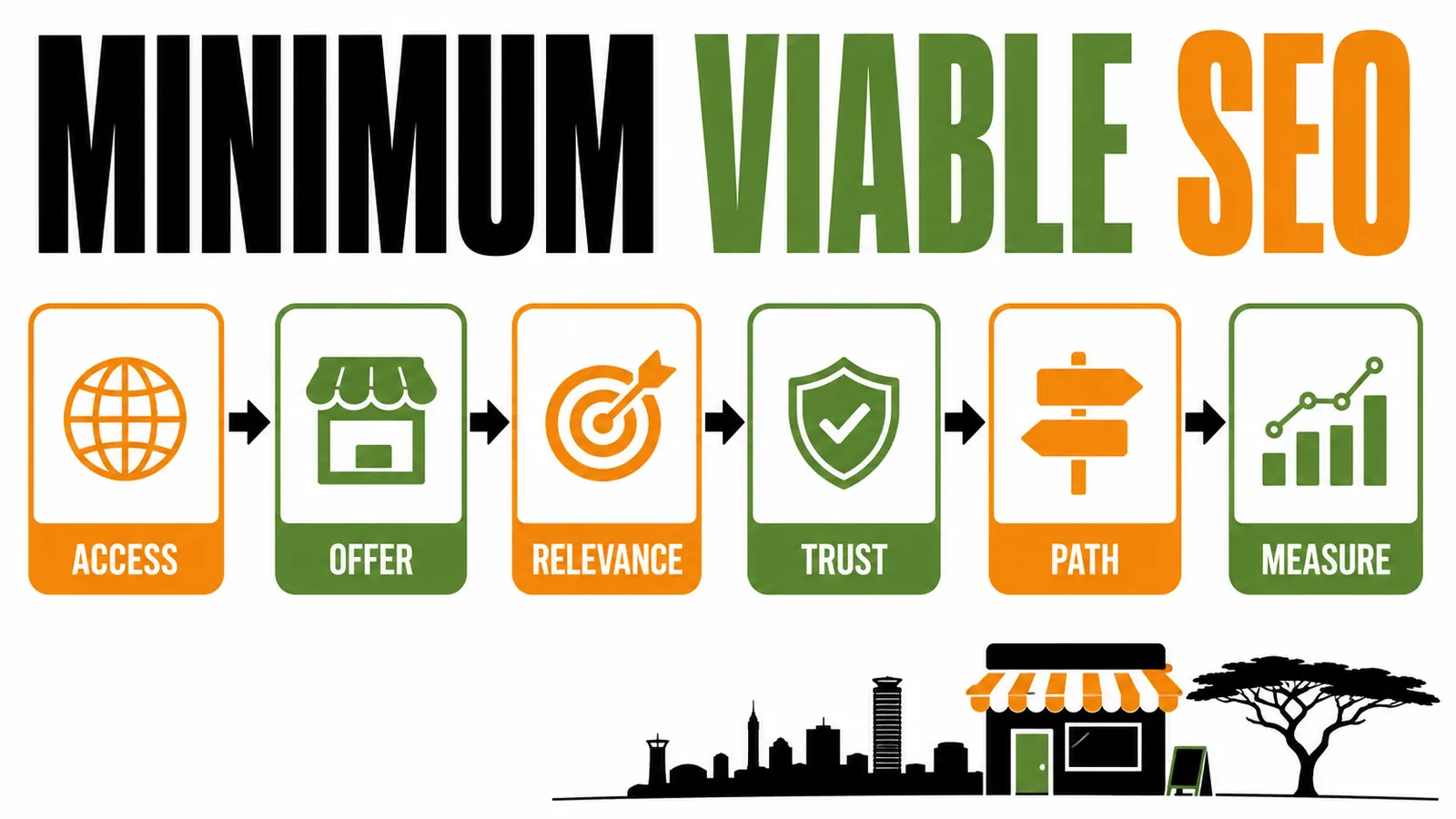
A minimum viable SEO system is the smallest set of assets and routines capable of producing useful evidence. It has six connected parts:
| Part | What the small business needs | What goes wrong when it is missing |
|---|---|---|
| Access | A secure, mobile-usable site that Google can crawl and index | Important pages stay invisible or unstable |
| Offer | One strong page for each priority service or product category | Searchers land on vague pages that do not answer buying questions |
| Relevance | Language, locations and supporting content that match genuine demand | The site attracts the wrong audience or no clear audience |
| Trust | Accurate business information, evidence, reviews and relevant mentions | Buyers and search systems have little reason to believe the claims |
| Path | Clear calls to action and easy contact, booking or purchase steps | Traffic arrives but does not become an enquiry |
| Measurement | Search Console plus conversion and lead-quality tracking | Decisions are based on impressions or rankings without commercial context |
These parts work as a system. A beautiful service page cannot perform if it is blocked from indexing. A first-place local listing is not valuable if callers need a service you do not provide. A growing traffic graph can hide a weak commercial result.
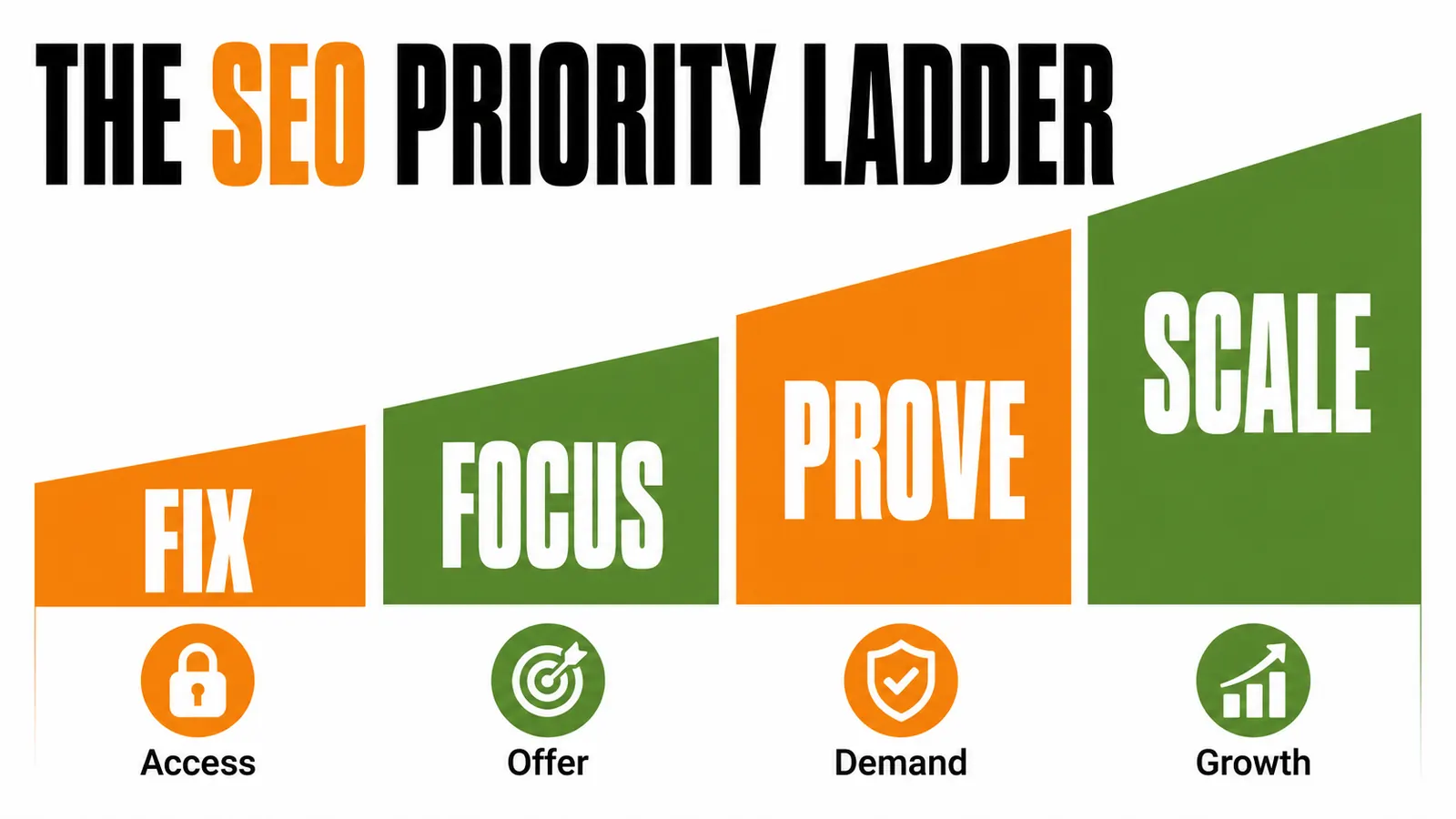
The priority order is simple: fix access, focus the offer, prove demand, then scale. That sequence is especially important for a small team because every new page creates a maintenance obligation.
Step 1: choose a profitable search market
Do not start with the keyword that appears to have the largest audience. Start with the customer problem your business can solve well and profitably.
For each possible offer, write down:
- the customer and decision-maker;
- the problem they are trying to solve;
- the service or product that solves it;
- the locations you genuinely serve;
- the evidence a buyer needs before contacting you;
- the next action you want the buyer to take;
- the approximate value of a qualified lead or sale to the business.
Then translate the offer into search language. A business owner may call a service “growth enablement,” while buyers search for “SEO services in Nairobi.” A supplier may use an internal product family name while customers search by material, size, application or delivery area.
Segment keywords by intent
Use four practical groups:
| Intent | Example pattern | Suitable page | Business role |
|---|---|---|---|
| Transactional | hire, book, buy, request a quote | Service or product page | Capture demand |
| Commercial investigation | cost, best, company, comparison | Service page, comparison or pricing guide | Help buyers evaluate |
| Informational | how, why, checklist, guide | Supporting article or tool | Build trust and assist a later decision |
| Navigational | brand, address, contact, login | Homepage, contact or profile | Help people reach the right destination |
A small business should usually build from the bottom of the funnel upward. A complete page about a profitable service is more commercially useful than a broad article that attracts students, jobseekers or people outside the service area.
Keyword tools can help estimate competition and discover language, but their numbers are estimates. Current Google Search Console data, when available, is usually more useful for prioritising an existing site because it shows the queries and pages already earning impressions. If you do not have a current export, begin with customer conversations, sales questions and live search results, then treat the plan as provisional.
Step 2: make the website accessible and indexable
Technical SEO does not need to become an owner's new career. The aim is to remove barriers between useful pages, search engines and customers.
Check the following before expanding content:
- Every priority page loads over HTTPS and works on a phone.
- Important pages return a successful status and are not blocked by
robots.txtor anoindexinstruction. - Each page has one stable, preferred URL.
- Navigation and contextual links lead to the pages that matter.
- The site has an XML sitemap that lists canonical, indexable pages.
- Search Console can report indexing and search performance.
- Titles, headings and visible copy describe the page accurately.
- Forms, phone links and booking actions work on common mobile screen sizes.
Google's Search Console introduction explains that the service helps owners understand how Google crawls, indexes and serves a site. It does not need to be checked every day. A monthly review and a review after important site changes are a sensible starting rhythm for a small team.
Indexing is not the same as ranking
Indexing means Google has stored a page and may show it. Ranking means Google considers it a useful result for a particular search in a particular context. Submitting a sitemap or requesting indexing does not guarantee visibility.
Likewise, a perfect tool score does not guarantee a profitable result. Fix issues that block discovery, create duplicate or conflicting URLs, frustrate mobile users or break the conversion path. Do not spend the first month polishing warnings that have no meaningful effect on customers or search access.
If you are unsure which issues are material, start with a free SEO visibility audit and use the findings to separate urgent constraints from maintenance tasks.
Step 3: build pages that help buyers decide
Your service pages are the commercial centre of the SEO system. A page should not exist merely because a keyword tool produced a phrase. It should help a real prospect decide whether your offer fits.
A strong small-business service page normally explains:
- who the service is for;
- the problem and commercial consequence;
- what is included and excluded;
- how the process works;
- why the business is credible;
- the areas served, where location matters;
- common objections, risks or prerequisites;
- the next step and what happens after an enquiry.
Use plain language. “We deliver integrated digital transformation solutions” gives a buyer little to evaluate. A specific description of the problem, deliverables and outcome is more useful to people and easier for search systems to interpret.
One page per distinct intent, not every keyword variation
Do not create separate pages for “small business SEO Kenya,” “SEO for SMEs Kenya” and “affordable SEO for Kenyan businesses” if the same person expects the same answer and offer. One complete page can address the language naturally. Separate pages make sense when the offer, audience or decision criteria are genuinely different.
This principle prevents cannibalisation, where several weak pages compete to represent the same intent. It also keeps the site manageable.
Show evidence without inventing certainty
Useful evidence can include named qualifications, an explained process, real reviews, before-and-after implementation details, original photographs, transparent terms and case studies with permission. Do not manufacture client numbers or present an isolated ranking as proof of business growth.
If the current site has many thin or overlapping pages, an experienced SEO services team in Nairobi can help consolidate them around a coherent service architecture.
Step 4: compete for relevant local searches
Local SEO matters when a customer's decision depends on where the business is located or where it can provide a service. It may be central for a clinic, restaurant, workshop or lawyer and less important for a software product serving customers across East Africa.
Google says local results are mainly based on relevance, distance and prominence. The company also says there is no way to request or pay for a better local ranking. Its current guidance is available in Tips to improve your local ranking on Google.
For an eligible business, the basic work includes:
- claim and verify the Google Business Profile;
- use the real-world business name and the most accurate primary category;
- keep the address, service area, hours, phone and website current;
- describe services clearly;
- add genuine photographs that help a customer understand the business;
- ask customers for honest reviews without incentives or review gating;
- respond to reviews professionally;
- link the profile to the most relevant live page.
Our Google Business Profile guide explains the profile fundamentals. The broader local SEO guide for Kenyan businesses covers how profiles, websites and local reputation work together.
Do not manufacture location relevance
Mention Nairobi, Mombasa, Kisumu, Nakuru or Eldoret only when the business genuinely serves the place and can provide useful local information. Replacing a city name across dozens of otherwise identical pages creates little value. A location page should contain distinct service information, availability, evidence, directions or logistics that matter to that market.
For a service-area business, follow Google's eligibility and representation rules instead of using a virtual office simply to appear closer to customers. Accuracy protects both visibility and trust.
Step 5: publish content that supports sales
A blog earns its budget when it helps the right customer move forward. That can happen before an enquiry, during evaluation or after a salesperson shares the article to answer an objection.
Start with questions heard in sales calls and support conversations:
- What does the service cost?
- How long does it take?
- What should we fix first?
- What is the difference between two approaches?
- What information does the provider need?
- Which risks or mistakes should we avoid?
For example, this article should not duplicate the detailed SEO cost guide for Kenya. It helps a founder decide what to build first. The pricing guide helps the same founder evaluate investment models. Contextual links connect the two stages.
Build a small cluster around the core offer
A useful starter cluster might contain:
- A commercial SEO service page.
- A practical small-business SEO guide.
- A guide to cost and engagement models.
- A guide to realistic timelines.
- An audit or technical checklist.
- A local SEO guide where geography affects demand.
Each supporting article should link naturally to the service page and to closely related articles. The service page should also link out when a guide helps a buyer understand a decision. This bidirectional structure is more useful than treating every blog post as an isolated traffic asset.
Write for search and answer engines by being clear
Google's guidance for AI features and your website says the same foundational SEO practices remain relevant for AI Overviews and AI Mode. There is no special AI file or markup required to appear in those features.
For a small business, practical AI-search readiness means:
- give a direct answer before adding nuance;
- identify the business, service and place consistently;
- use descriptive headings and accessible text;
- support current claims with authoritative sources;
- show first-hand knowledge and evidence where available;
- make important content available in text, not only inside images;
- keep structured data consistent with visible content.
If AI discovery has become a serious acquisition priority, review AI Search Optimization services as an extension of the core search foundation. Do not replace clear service pages with content written only to chase citations.
Step 6: build trust and authority
Search visibility is partly a reflection of what exists beyond your own claims. A Kenyan small business builds authority through real relationships and useful work, not through an arbitrary backlink quota.
Possible sources of relevant authority include:
- professional associations and verified directories;
- suppliers, distributors and implementation partners;
- local chambers, events and community initiatives;
- original research or practical resources worth citing;
- expert commentary in relevant publications;
- customers who independently mention or review the business.
Quality matters more than a long list of unrelated placements. A link from a genuine industry partner can carry more context and referral value than dozens of pages created only to sell links.
Reviews also influence human decisions. Ask at a natural point after delivery, make the process easy and never offer a reward in exchange for a positive rating. Respond to criticism with facts and a route to resolution. The goal is not a perfect-looking profile. It is a credible record of customer experience.
Keep trust signals consistent
The website, Google Business Profile and important directory listings should agree on the business name, contact details and core offer. Team biographies, service terms, policies and contact information should be easy to find. If the business handles health, finance, legal or other high-stakes decisions, qualifications and source quality deserve even more attention.
What should you do yourself or outsource?
Google notes that a small local business may be able to do much of the work itself. That is often true when the owner understands the customer, the site is simple and someone can follow a monthly routine. Google's guidance on whether you need an SEO is a useful starting point.
| Keep internally | Consider specialist help |
|---|---|
| Collect customer questions | Diagnose sudden traffic or indexing losses |
| Check hours, contact details and service availability | Plan a migration, redesign or URL consolidation |
| Request and respond to genuine reviews | Repair crawling, rendering, canonical or structured-data problems |
| Write first-hand service explanations | Build a keyword-to-page architecture for several offers or locations |
| Qualify leads and record revenue outcomes | Analyse competitors, links and content gaps at scale |
| Supply original photos and proof | Improve performance when work has stalled despite consistent execution |
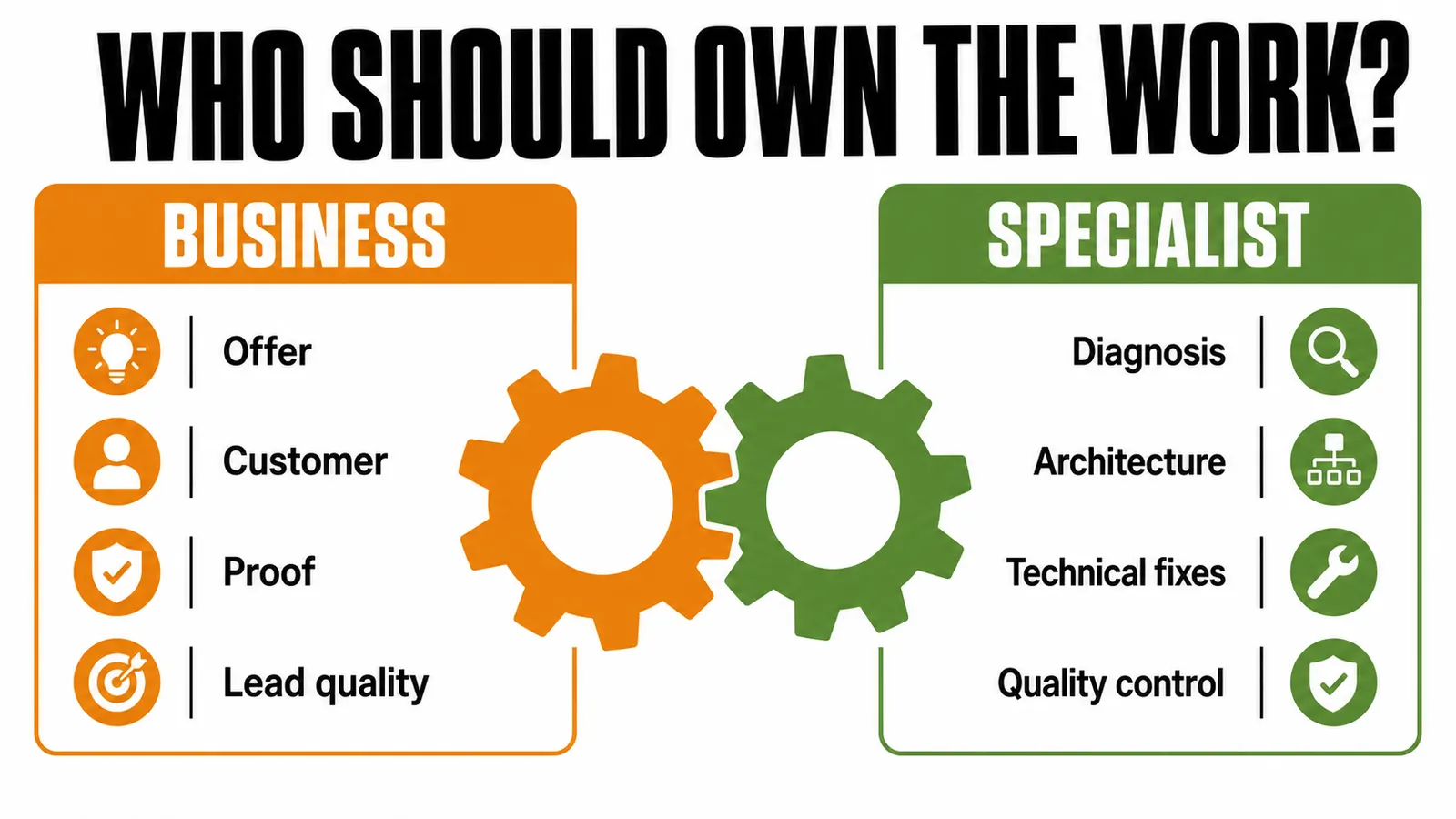
The decision is not simply DIY versus agency. A productive arrangement often divides responsibilities. The business owns the offer, customer insight, proof and lead feedback. The specialist owns diagnosis, prioritisation, technical direction and quality control. Clear ownership prevents the familiar situation where an agency waits for business information while the owner assumes everything has been outsourced.
Before hiring, ask how priorities are selected, what access is required, which changes will be made, how leads will be measured and what happens if a recommendation cannot be implemented. Avoid guarantees of a particular position. Search results change by query, place, device, competition and time.
A practical 90-day SEO plan
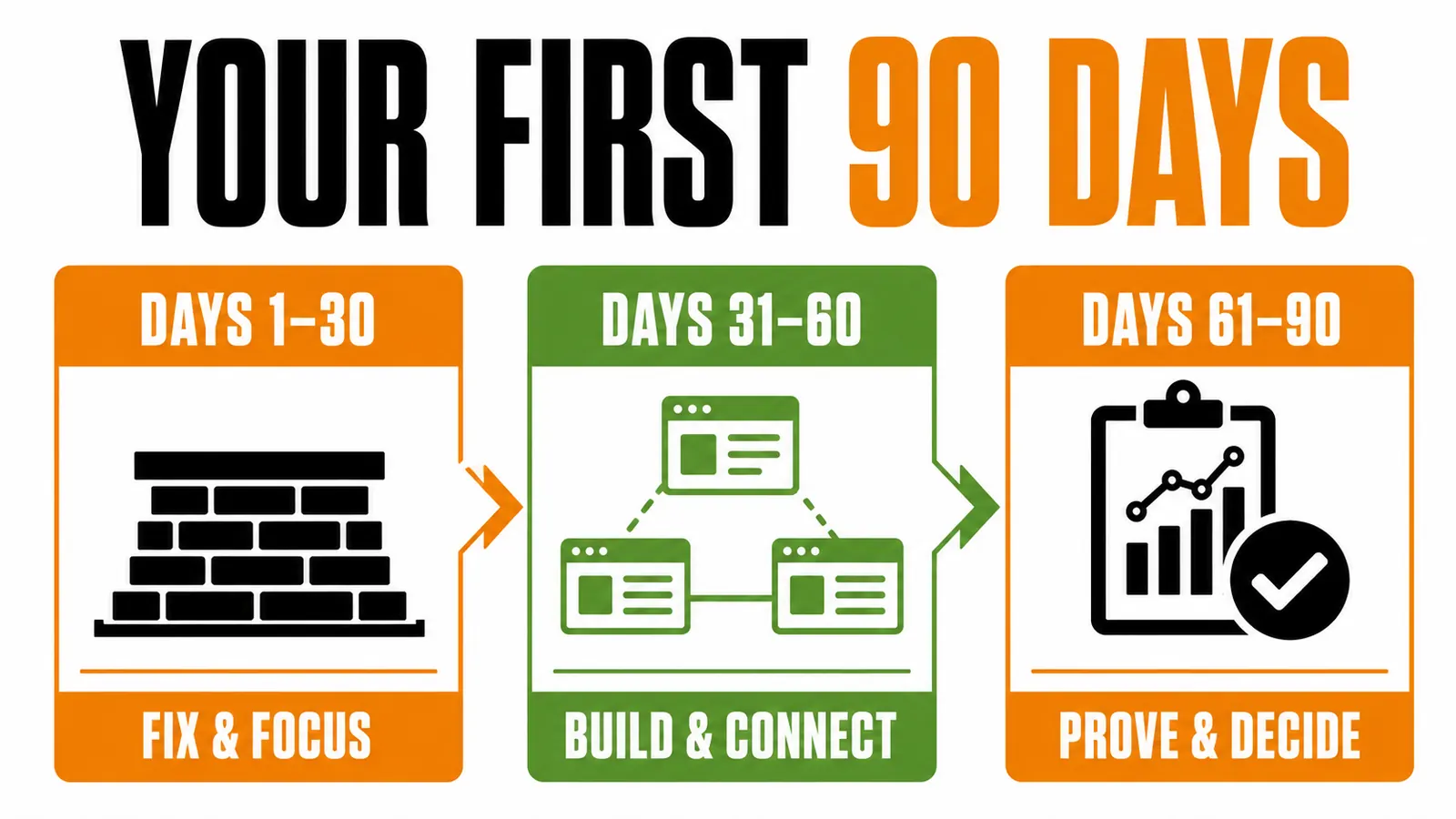
Ninety days is a useful planning window, not a guaranteed ranking deadline. The aim is to complete the foundation, publish the most commercially important assets and create enough measurement to make a better next decision.
Days 1 to 30: fix and focus
- Confirm business goals, priority offers, margins, service areas and lead value.
- Set up or verify Search Console and analytics access.
- Test indexing, canonical URLs, mobile usability and conversion actions.
- Map each priority search intent to one existing or planned page.
- Correct high-impact technical and profile errors.
- Record baseline impressions, clicks, enquiries and known lead quality without inventing missing history.
Days 31 to 60: build and connect
- Improve or create the first priority service pages.
- Align Google Business Profile information where local visibility matters.
- Add contextual internal links between related services and guides.
- Publish one or two genuinely useful supporting resources.
- Add appropriate Article, BreadcrumbList or FAQPage markup where the visible page qualifies.
- Test forms, phone links and thank-you events.
Days 61 to 90: prove and decide
- Review which queries and pages are earning impressions.
- Separate qualified enquiries from irrelevant contacts.
- Improve weak titles or page sections only when evidence supports the change.
- Ask satisfied customers for honest reviews.
- Earn relevant mentions through real partners or useful resources.
- Choose whether to expand, repair or pause based on commercial evidence.
Do not rewrite every page after a quiet week. Google says some changes can take hours while others can take several months to be reflected. Review a coherent batch of work long enough to learn from it.
How should a small business budget for SEO?
There is no universal affordable package. A low fee can be expensive if it funds irrelevant pages, unmanaged link risk or reports nobody uses. A larger engagement can also be wasteful if the business lacks a viable offer or cannot implement recommendations.
Budget across four resource types:
- Expertise: research, diagnosis, architecture and quality control.
- Implementation: development, copy, design, profile work and fixes.
- Evidence: customer interviews, original photography, case studies and useful data.
- Measurement: analytics configuration, lead qualification and review time.
The mix changes by business. A five-page professional-services site may need concentrated strategy and page improvement. An ecommerce shop may require more technical, category and product work. A multi-location company needs stronger governance for profiles and local pages.
Use the SEO pricing guide for Kenya to compare retainers, projects and audits. Whatever the model, insist on a prioritised scope, named owners, expected evidence and a review point.
How do you measure whether SEO is working?
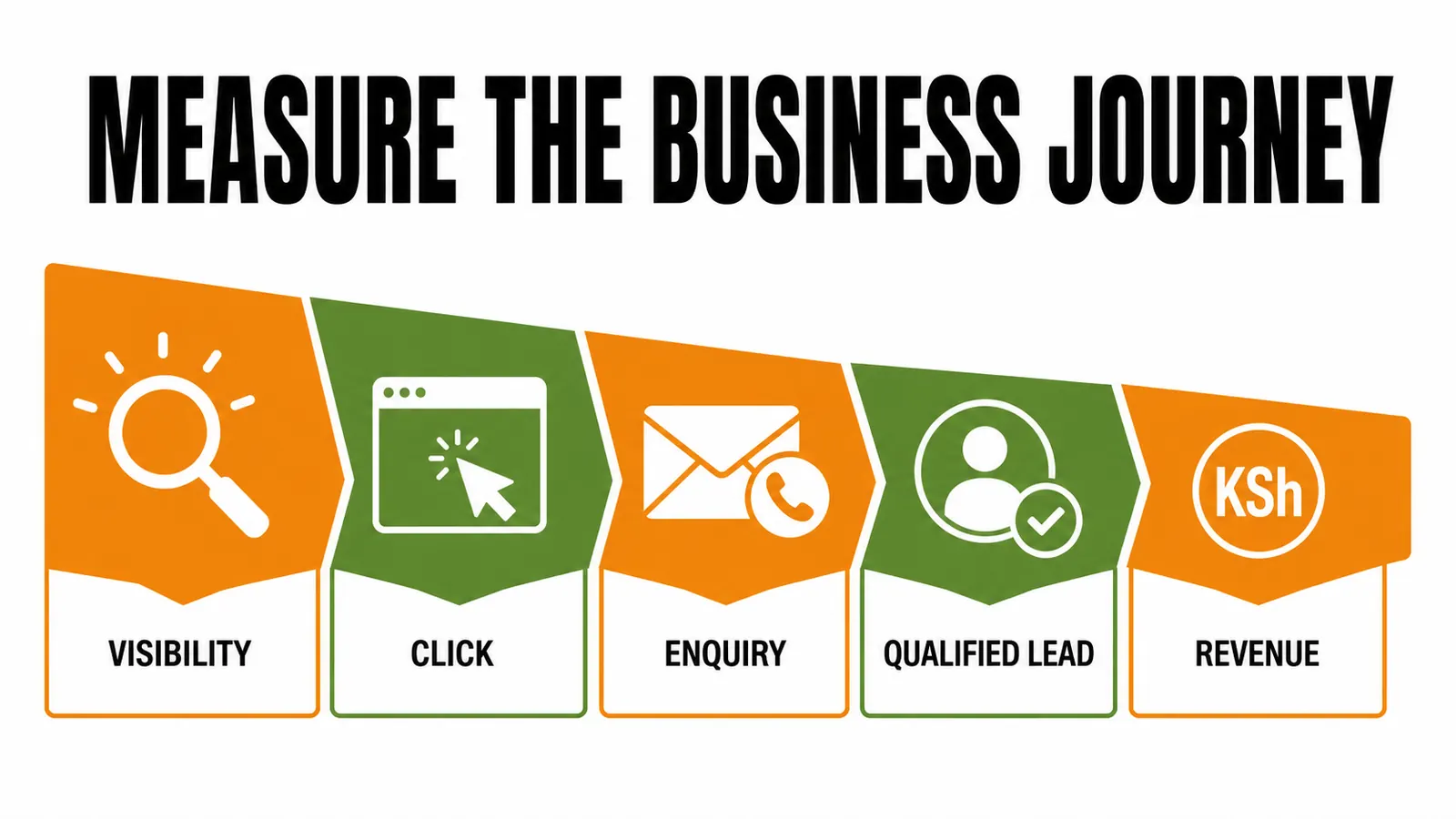
Rankings are diagnostic signals, not the final outcome. Measure the journey from visibility to revenue.
| Stage | Useful measures | Question to answer |
|---|---|---|
| Visibility | indexed priority pages, relevant impressions, local discovery | Are we eligible and appearing for the right demand? |
| Engagement | clicks, landing pages, useful actions | Do searchers choose us and find the page relevant? |
| Conversion | calls, forms, bookings, purchases | Does organic traffic take a meaningful next step? |
| Quality | qualified leads, accepted opportunities, repeat demand | Are the right people contacting us? |
| Commercial | pipeline, sales, revenue and gross profit where available | Is the programme contributing economic value? |
Tag source information in the CRM or lead sheet. Ask new prospects how they found the business, but do not rely on memory alone. Configure meaningful conversions in analytics and test them. Where calls matter, use a measurement method that does not make the public business number inconsistent across important listings.
Review page and query data in Search Console. Look for high-relevance impressions with weak click-through, pages approaching useful visibility, unexpected queries and declining priority pages. Then connect those observations to actual lead quality.
Decide whether to scale, repair or stop
Scale when the system attracts relevant demand, priority pages are improving and leads show commercial promise. Repair when impressions grow but clicks or conversions remain weak. Reconsider the offer or channel when the site attracts the wrong audience, the market is too small or the economics cannot support acquisition.
A Digital Growth Diagnostic can help connect search symptoms to offer, website, tracking and sales-process constraints.
Small-business SEO checklist
Strategy
- One profitable offer and realistic market are prioritised.
- Each important search intent has one owner page.
- The target customer, pain point, evidence and next action are clear.
- SEO, paid search, referrals and social media have defined roles.
Website and pages
- Priority pages are crawlable, indexable, canonical and mobile-usable.
- Navigation and contextual links expose important pages.
- Service pages explain fit, process, proof, objections and CTA.
- Forms, calls, bookings and purchases have been tested.
- Thin or overlapping pages are consolidated instead of multiplied.
Local visibility
- Google Business Profile information is accurate and compliant.
- Business name, category, hours, phone, address or service area are current.
- Reviews are requested honestly and answered professionally.
- Location pages contain genuinely distinct, useful information.
Content and authority
- Content answers questions heard in sales or support conversations.
- Every article has a role in the buyer journey and internal-link structure.
- Current claims link to authoritative sources.
- Partnerships and mentions are relevant and genuine.
- Important information is available as accessible text.
Measurement
- Search Console ownership and access are confirmed.
- Meaningful conversion actions are configured and tested.
- Lead source and quality are recorded.
- Results are reviewed on a consistent schedule.
- The next action is based on evidence, not a guaranteed-ranking promise.
Frequently asked questions
Is SEO worth it for a small business in Kenya?
It can be when customers already search for the offer and the business can convert that demand profitably. Validate the search market, strengthen priority service pages and measure qualified enquiries before expanding the programme.
How much does small-business SEO cost in Kenya?
Cost depends on the site's condition, competition, number of services and locations, required content, technical implementation and reporting depth. Compare the work included and the commercial problem being solved, not the monthly fee alone. Use a focused audit or project when the scope is narrow and a retainer when research, implementation and iteration need to continue.
How long does SEO take for a small business?
There is no fixed deadline. Technical fixes can be processed quickly, while competitive service visibility and authority can take months. Site history, competition, implementation speed, content quality and demand all affect the timeline. Set milestones for completed work, relevant impressions, qualified enquiries and revenue rather than accepting a guaranteed ranking date.
Can I do SEO myself?
Yes, especially for a simple local business site. Owners can maintain accurate information, collect customer questions, improve service explanations, request honest reviews and monitor Search Console. Specialist help becomes valuable for technical problems, migrations, multi-location architecture, competitive research or stalled performance.
Does a small business need local SEO or national SEO?
Use local SEO when location or service area affects the customer's choice. Use broader organic targeting when the business can deliver nationally or across East Africa without a local decision. Some businesses need both, but each page should have a clear role.
Should a small business choose SEO or Google Ads first?
Choose according to urgency, economics and evidence needs. Google Ads can test demand and messages quickly, while SEO builds reusable organic assets over time. Many businesses use paid search for immediate, measurable demand and SEO for durable coverage. Both channels need a credible landing page and conversion tracking.
Do social media posts improve Google rankings?
Social activity can distribute content, create awareness and lead to mentions, links or branded searches. A post or follower count is not a substitute for accessible pages, relevant content, local accuracy and genuine authority. Use social media for audience reach and relationships, then measure the business outcome.
How can a Kenyan small business appear in AI-generated search answers?
There is no guaranteed submission shortcut. Publish accessible, accurate and well-structured content; identify the business and services consistently; answer questions directly; support claims with evidence; and keep structured data aligned with visible content. These practices support both traditional search and AI features.
Build the smallest system that can prove value
Small-business SEO should reduce uncertainty, not create a new pile of unexplained work. Start with the offer customers already want. Give that offer a page worthy of the decision. Make the site accessible, connect the relevant pages, show real evidence and measure what becomes a qualified lead.
Then expand from proof. Add a new service page when the intent is distinct. Publish a guide when it answers a real buyer question. Pursue authority through relationships your business would value even without a ranking benefit. Review the whole path from search to revenue.
If you want to know what is limiting that path today, run Tabala Digital's free SEO Visibility Audit. For a broader view of the offer, website, tracking and acquisition system, use the Digital Growth Diagnostic.
Accelerate Your Revenue
While Revenue Intelligence builds long-term authority, Google Ads delivers immediate, high-intent traffic. Combine both for maximum market dominance.

Strategist Profile
Abala Tom
Digital systems strategist specializing in high-performance SEO, Google Ads, and conversion optimization. Mission: to replace marketing 'guesswork' with predictable revenue systems.